




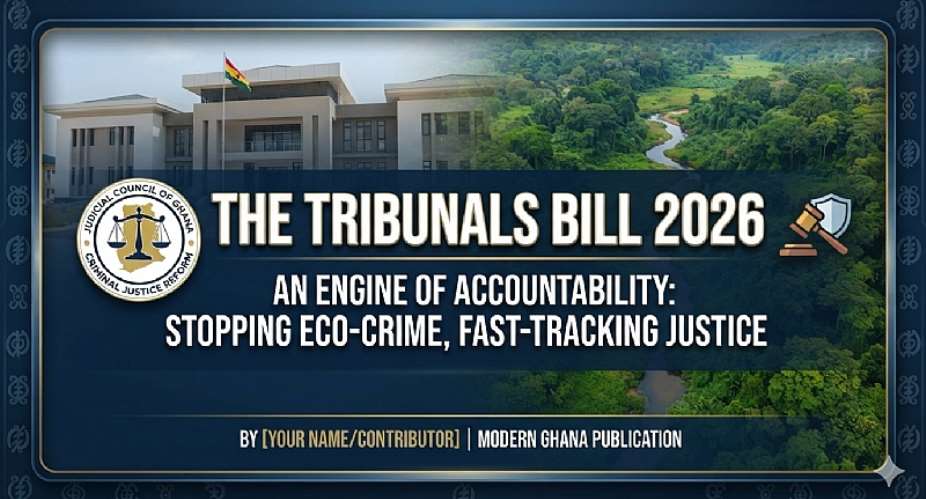
In the weeks following the historic and highly contentious passage of the Tribunals Bill, 2026, Ghana’s airwaves have been saturated with familiar, hyper-partisan anxieties. Following a dramatic walkout by the New Patriotic Party (NPP) Minority caucus, political commentary has been dominated by warnings that the nation is on the verge of resurrecting the extra-judicial excesses of the 1980s public tribunals. Critics have swiftly labelled the legislation a weapon for political intimidation. However, an objective examination of the legislative text and the realities on the ground tells a completely different story. This bill is not a tool to suppress political dissent. Rather, it is a constitutionally anchored, aggressive restructuring of our criminal justice system engineered to fast-track enforcement and save local communities from the existential threat of illegal mining (galamsey) and structural economic fraud.
To appreciate why this bill is a necessity, we must first look past the false narrative that expanding access to justice is a partisan competition. The previous NPP administration (2017–2024) set an undeniable precedent for investing heavily in the judicial branch. Over their eight years in power, the government executed an unprecedented physical expansion, constructing over 100 modern courthouses and building more than 150 residential bungalows for judges across Ghana’s sixteen regions. They physically paved the way for local justice delivery.
Yet, as the Minister for Justice and Attorney-General, Dr. Dominic Ayine, rightly pointed out during the parliamentary floor debate, physical infrastructure alone cannot cure a choking system. Defending the bill, Dr. Ayine noted that the traditional courts face an overwhelming logjam, with "approximately 3,360 new backlog cases added annually, resulting in delays and prolonged adjudication." While the NPP built the physical houses of justice, the Tribunals Bill, 2026 introduces the specialized, rapid legal machinery required to resolve specialized crises with unmatched speed.
The fiery resistance from the opposition bench highlights the depth of Ghana's political trauma. During the debate, Minority Leader Alexander Afenyo-Markin aggressively fought the bill’s implementation, warning that establishing District and Regional tribunals would trigger chaos. He explicitly condemned the framework as "mere populism and 'chooboi justice' where people will be sent to jail without proper safeguards," warning that it would establish a parallel system designed to bypass our functioning courts. Similarly, Member of Parliament for Akuapem North, Sammi Awuku, went on record to call the reintroduction of the regional tribunals a "tragedy that threatens the sanctity of Ghana's judiciary and democracy."
These fears, while understandable given our history, ignore the structural realities of the new law and, more importantly, the catastrophic ecocide happening in our rural towns. While politicians exchange blows over clauses in Accra, local communities in the Western, Ashanti, Eastern, and Central regions are drinking heavy-metal-poisoned water. Rivers like the Pra, Ankobra, and Brim have been reduced to toxic mudpools. Children in mining enclaves are being born with severe congenital deformities due to mercury poisoning, cocoa farms are being forcibly sold off, and community water treatment facilities are shutting down due to extreme turbidity.
Crucially, this environmental warfare is no longer just a domestic issue; it has been heavily weaponised by foreign nationals who flagrantly violate our sovereignty. For years, syndicates of foreign actors—often entering the country on tourist or business visas—have deployed heavy earth-moving equipment, sophisticated weaponry, and industrial-scale mercury into the hearts of our forest reserves. These foreign nationals exploit the structural bottlenecks of our traditional legal system. When arrested, high-priced legal teams drag their cases through the traditional High Courts for years, enabling foreign kingpins to secure bail, disappear across borders, or worse, continue managing their illegal operations from the comfort of luxury hotel rooms in Accra. By establishing specialized tribunals, Ghana can swiftly bypass these procedural delays, ensuring that any foreign national caught destroying our ecosystem is tried, convicted, and imprisoned immediately, without the luxury of administrative evasion.
The traditional legal structure takes years to process a single galamsey case, allowing illegal kingpins to destroy entire villages while out on bail. The Tribunals Bill, 2026 directly targets this impunity, ensuring that those who destroy local communities face swift and decisive consequences.
Ghanaians must look beyond the political crossfire and understand how the bill operates to protect both human rights and local ecosystems:
- Strict and Constitutional Grounds: The new tribunals are explicitly anchored under Articles 126 and 142 of the 1992 Constitution. They operate firmly inside—not outside—the lower judiciary under the direct oversight of the Judicial Council.
- A Narrow, Laser-Focused Jurisdiction: These bodies do not have arbitrary powers to police speech or everyday civil matters. Their scope is legally confined to environmental degradation (galamsey), tax fraud, customs evasion, and financial loss to the state.
- Fast-Tracking Environmental Justice: By removing environmental crimes from congested High Court dockets, Regional and District tribunals can try and convict illegal miners in a matter of weeks, creating an immediate, tangible deterrent.
- Diverse, Specialized Panel Expertise: Tribunals will feature three-member panels combining a legal chairperson with retired security personnel or public officers, merging rigorous legal standards with practical enforcement insights.
- Guaranteed Protections and Appeals: The bill explicitly prohibits tribunals from handling human rights violations and guarantees an absolute right of appeal directly back into the traditional higher courts.
For the Tribunals Bill to shed its historical stigma and gain the trust of the Ghanaian public, the following urgent steps must be taken:
- Launch Nationwide Civic Education: The Ministry of Information and the National Commission for Civic Education (NCCE) must aggressively educate the public to distinguish these constitutional panels from the military courts of the past.
- Depoliticise Panel Appointments: The Judicial Council must handle the selection of tribunal chairpersons with absolute transparency, ensuring appointments are based strictly on merit rather than political patronage.
- Fully Integrate and Expand E-Justice Infrastructure: The new tribunals must not rely on outdated, paper-based workflows that are prone to file tampering, missing dockets, and deliberate administrative delays. Instead, the government must fully integrate the integrated e-justice system and paperless court infrastructure developed during the previous administration. By digitising the entire process—from the digital logging of arrests in remote mining enclaves to electronic evidence filing and automated case tracking—the state can bulletproof these tribunals against corruption. Electronic court diaries will automatically assign hearing dates, preventing human interference, and allow real-time public monitoring of galamsey and financial crime metrics.
- Enforce Statutory Judgment Deadlines: The Judicial Council should institute strict operational rules requiring all galamsey and financial crime trials to reach a definitive verdict within 60 to 90 days of filing.
The passage of the Tribunals Bill, 2026 should not be misconstrued as a tool for political persecution. The rigid checks and balances of the 1992 Constitution ensure that the lawless overreaches of the 1980s cannot repeat themselves. While the massive infrastructure drive of the past eight years successfully gave Ghana the physical courtrooms it desperately needed, the severity of today’s crises requires that we match those physical buildings with agile, fast-paced legal mechanisms. Our rivers are dying, our rural communities are being poisoned, and our state coffers are being emptied by financial fraud. The 2026 tribunals represent a vital evolution in our criminal justice system—taking the handcuffs off the state so it can swiftly punish those who plunder our environment and steal our collective future. It is time for all citizens to support this framework, holding the judiciary accountable to ensure it delivers swift, fair, and uncompromised justice for all.
✍️ Submitted by:
Retired Senior Citizen
For and on behalf of all Senior Citizens of the Republic of Ghana 🇬🇭
Teshie-Nungua
[email protected]


 Leaving Majority Leader role for ministerial position was my choice – Mahama Aya...
 A Rocha Ghana stands by claim of 50-plus forest reserves affected by galamsey
 September 10: Cedi sells at GHS12.15 on forex market, GHS11.45 on BoG interbank
 Open aviation fuel supply to more players to reduce airfares – Akim Swedru MP to...
 Pay my salary arrears, terminal benefits by September 11 or face court – Former ...
 Trump says he'll give Americans $5,000 each if Republicans win midterm elections
 'Govt moves to confiscate, auction containers left at Ghana’s ports for over six...
 'We are not serious Christians; bunch of selfish, greedy people' – Duncan-Willia...
 30,000 classrooms without teachers is a crisis waiting to happen – Adutwum
 How honest station loading boy handed over missing £3,000, GH¢1,000 to Police


