




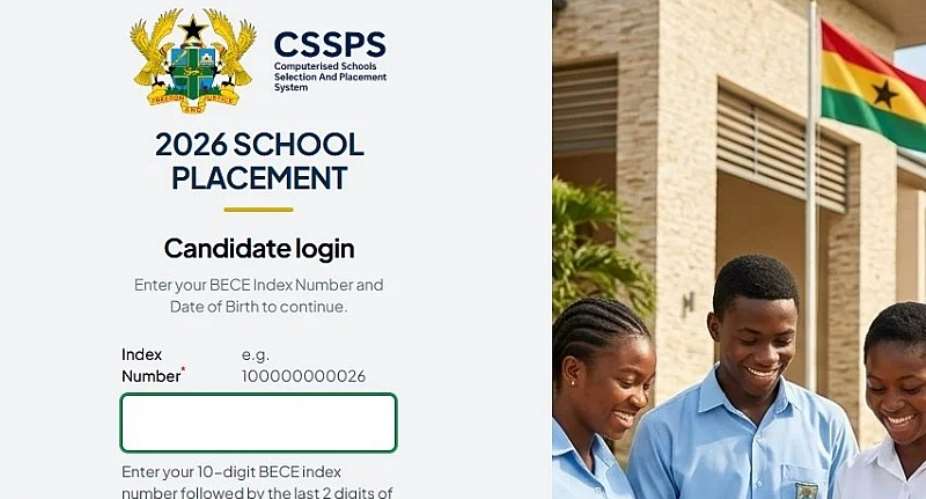
Ghana’s 2026 school placement figures expose a problem that cannot be solved by opening the self-placement portal alone. The Ministry of Education says 604,567 candidates qualified for placement, of whom 527,932, or 87.3%, have been placed. Yet thousands remain outside automatic placement. More strikingly, 313,283 candidates chose Category A schools as their first preference, against only 76,417 available places. Meanwhile, Category B and C schools had 250,366 and 468,652 declared vacancies respectively. This is not simply a shortage of school places. It is a mismatch between where places exist and where families believe quality exists. That distinction matters.
For years, Ghana has treated CSSPS largely as a technical exercise: candidates submit choices, the computer processes the data, and schools are allocated. But the numbers are telling us something deeper. Parents are voting with their children's futures. They are competing heavily for a relatively small group of schools because they perceive differences in academic performance, facilities, discipline, teaching quality, networks and future opportunities. Government should listen to that signal rather than simply asking families to broaden their choices. The answer is not to force children into schools they do not trust. The answer is to make more schools worth choosing.
Government should establish a targeted School Quality Equalisation Programme, directing additional resources to schools with persistent low demand. Investment should be tied to measurable deficiencies in laboratories, ICT, libraries, accommodation, teacher availability, sanitation, STEM facilities and student welfare. Schools should be supported based on need, not merely distributed equally. There is another concern that deserves even greater attention: the candidates who do not meet the placement requirements.
The Ministry has reported 57,259 candidates in this category, including 35,382 who obtained Grade 9 in either English or Mathematics and 18,505 who obtained Grade 9 in both. The Ministry has indicated that candidates in these groups can access self-placement, while 3,372 candidates who did not sit the examination are to be given another opportunity to resit. This should trigger a serious conversation about learning outcomes at the basic level. We cannot wait until a child reaches the CSSPS stage before discovering that the child has significant learning gaps.
CREP Africa proposes a national JHS Learning Recovery Programme beginning from JHS1. Every student should undergo periodic diagnostic assessment in English and Mathematics. Those identified as being substantially behind should receive structured remedial support before BECE.
There should also be a formal second-chance pathway for candidates who do not meet the normal progression threshold. Such students could receive intensive remedial education through selected public schools, TVET institutions and approved learning centres before undertaking a standardised assessment for transition. This is not about lowering standards. It is about refusing to confuse failure at one examination with failure for life.
Self-placement also needs improvement. The CSSPS platform already allows unplaced candidates to select schools and programmes with available vacancies, and the system has been upgraded to support online admission and enrolment. But families need more than a list of vacancies. They need reliable information on programmes, facilities, accommodation, location, school performance and available capacity before making decisions.
Most importantly, Ghana needs an annual CSSPS Equity and Transition Report. Government should publish, by region and district, how many candidates qualified, how many were automatically placed, how many used self-placement, how many failed to qualify and the principal reasons for non-placement. That would move the conversation from political claims to evidence.
The 2026 figures should therefore not be reduced to an argument over whether CSSPS is working. The system is placing hundreds of thousands of young people. The bigger question is whether it is exposing inequalities that government has yet to address.
CREP Africa believes the solution lies in three areas: improve learning before BECE, expand credible second chances after BECE, and equalise the quality of schools so that opportunity is not concentrated in a handful of institutions. A placement system can allocate a seat. It cannot create quality. And until Ghana fixes that deeper problem, the placement net will continue to catch some children while leaving thousands standing outside the gate.
By Mileba Godwin Kwame
President - CREP Africa

 NDC not worried about NPP’s Kojo Bamba, he is small boy – Azorka
 Obuasi SHTS: 'Children are not buffet' – NPP’s Fatimatu confronts Zuba
 'I didn’t know I was supposed to chop and not work' – Blakofe on her time at GTD...
 Resource exploitation fuelling Africa’s conflicts – Mahama
 Our ports' growth always depended on collaboration across maritime, logistics va...
 Stranded Ghanaian fishermen narrate how they ate fresh fish, drunk sea water to ...
 How notorious armed robber died on the way whiles leading police to arrest accom...
 'We must continuously improve cargo handling, coordination among port operators'...
 Nii Lante Vanderpuye confident of winning NDC national chairmanship despite Gold...
 Agalga dismisses critics, assures Builsa North of progress on Sandema–Wiaga Road


