




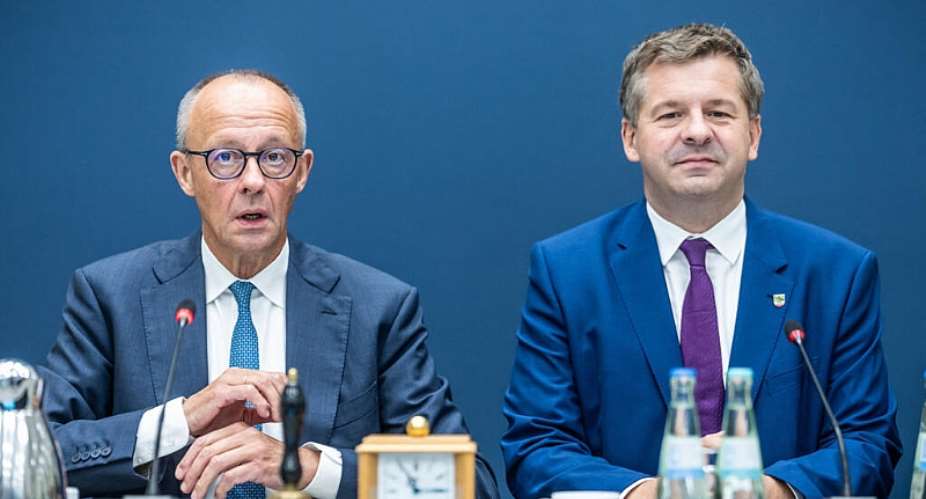
German Chancellor Friedrich Merz said on Monday he was "deeply shocked" by his party's crushing defeat to the far-right Alternative for Germany (AfD) in Saxony-Anhalt, acknowledging that his own unpopularity had contributed to the result while vowing to press ahead with reforms.
"This is the heaviest electoral defeat the CDU has suffered in years, in decades," Merz told reporters in Berlin, a day after the AfD won 43.8 percent of the vote in the eastern state.
The chancellor's centre-right Christian Democratic Union (CDU) took just 17 percent, losing roughly half the support it secured at the previous state election.
"Naturally, this will have to have consequences," Merz said, conceding that both his personal ratings and frustration over the pace of government reforms had weighed on the CDU campaign.
"I know that I personally was a constant topic in this election campaign," he said, adding that the government needed to do a better job of reaching voters and addressing their concerns.
Despite the setback, Merz insisted he would continue with planned reforms covering the economy, pensions and healthcare.
"My determination to continue on the path of reform is unbroken," he said, while acknowledging that the government needed to explain its policies more effectively.
Far-right AfD scores historic win in Saxony-Anhalt, rattling Berlin and Paris
Ukraine policy unchanged
Merz also sought to reassure Germany's allies that the AfD's success would not alter Berlin's support for Ukraine.
The AfD has repeatedly opposed German military assistance to Kyiv and favours closer relations with Moscow.
"And I want to make this very clear: 2,500 kilometres east of here, people are especially delighted with this election result," Merz said, in an apparent reference to Russia.
He added that Germany faced a "very concrete threat" to its internal security, although he did not give further details.
The result has placed renewed pressure on Merz, who came to office promising to strengthen the economy, tighten migration policy and halt the AfD's growing support.
Opinion polls ahead of the vote had already suggested the CDU was heading for a difficult night, but the eventual scale of the defeat went beyond expectations.
Saxony-Anhalt's outgoing CDU premier Sven Schulze accepted on Monday that the political initiative now belonged to the AfD.
"We are the opposition – the mandate to govern now lies with the AfD," he said.
German intelligence classifies AfD party as extremist threat to democracy
Firewall faces biggest test
That admission has turned attention to whether Germany's long-standing political "firewall" against cooperation with the AfD can survive its strongest challenge yet.
Mainstream parties have consistently refused to govern with the AfD, whose Saxony-Anhalt branch is classified as right-wing extremist by Germany's domestic intelligence agency.
The policy has previously produced unusual coalitions designed to keep the party out of power, but the arithmetic in Saxony-Anhalt is particularly difficult.
AfD candidate Ulrich Siegmund is seeking to become the first far-right leader of a German state government since the Nazi era and has said he will approach parties and individual lawmakers in an effort to secure a majority.
The AfD is only three seats short of governing alone.
One possible route could involve cooperation with the left-populist BSW, which won 5.3 percent of the vote. Despite major differences, the two parties share opposition to immigration and broadly Russia-friendly foreign policy positions.
BSW lead candidate Thomas Schulze indicated on Monday that his party could be willing to help an AfD governor take office.
Keeping the AfD out would require an exceptionally broad alliance of the CDU, Social Democrats, Greens, the Left Party and BSW – a five-party arrangement likely to prove difficult to negotiate and sustain.
(with newswires)

 Four Upper West Police officers honoured for disrupting armed robbery syndicate
 All TV stations on DTT platform to pay US$7,000 monthly under new cost-sharing s...
 'I repeated Form 4, now I’m a Chancellor' – Bishop Titi-Ofei encourages students...
 Water shortage hits three Kadjebi communities since August 31
 ‘WhatsApp grammar, poor reading habit caused decline in 2026 WASSCE English Lang...
 Israel warns of 'full-scale war' if Palestinian Authority launches Oct. 7-style ...
 Police arrest mother of suspected Nsawam highway robbery leader for hiding gun; ...
 How police busted armed robbery gang targeting gold dealers in Ashanti, Western ...
 Family demands answers over reported disappearance of corpse at Battor Catholic ...
 How errand boy murdered Dr Jesse Amuah and his wife and now arrested for hiding ...

