




A canoe glided slowly across the waters of Lake Togo, carrying the mystical Aklima tam-tam drum to a sacred wood to herald a momentous event: the 363rd unveiling of the sacred stone.
For the Guin people, the annual Epe-Ekpe or Ekpessosso festival in September marks the start of the new ancestral year.
The traditional "taking of the sacred stone" ceremony is an integral rite dating back to 1663 and started by settlers from the former Gold Coast -- modern-day Ghana.
Believers eagerly await the emergence of the stone, whose colour, which varies from year to year, is interpreted as a sign of what the coming 12 months will bring.
"The stone can be several colours: white, a symbol of peace and prosperity; sky blue, a sign of abundant food crops; or red, heralding a year of famine, war and misfortune," said Wlomo Nomo Combietey VIII Nii Labite, guardian of the sacred wood.
But "it can also be multicoloured, a sign of disease or a major epidemic", added the ceremonial guardian.
This year's stone augurs well for the 12 months ahead, being white.
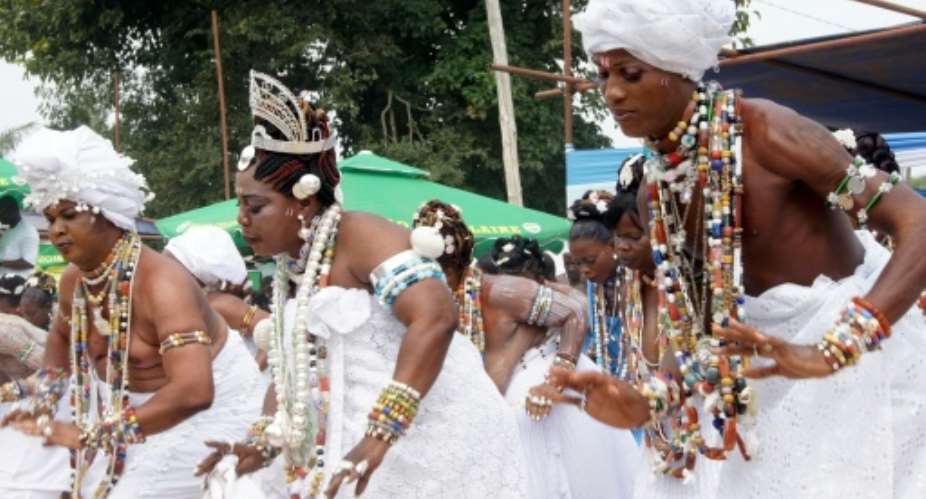
As every year for the past three-and-a-half centuries, several hundred people, the majority Voodoo priests and priestesses, gathered in Glidji-Kpodji Square, near the southern city of Aneho, to witness the emergence of the stone, known as "Ekpessosso."
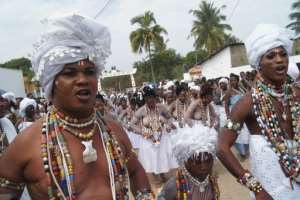 Around 51 percent of Togo's people practise Voodoo -- more than Christianity and Islam combined. By Emile KOUTON (AFP/File)
In Togo, a country of seven million people, 51 percent of the population practises Voodoo, which has multiple forms.
That is more than those who follow Christianity and Islam combined in the small west African nation.
Dressed in white loincloths and adorned with several strings of pearls, followers sing and dance for hours on end, some entering a trance-like state.
Thursday saw a frenzied crowd gather to witness a select group of believers emerge from the wood carrying the oval-shaped stone.
A Voodoo priest then cradled the stone as the crowd chanted "Helu-lo, helu-lo," meaning woe to evil spirits in the Mina language.
"The white stone heralds a year of purity, peace and prosperity," the priest proclaimed from a small podium.
"The gods have answered our prayers," exulted a relieved Pierrette Ahouefa, a priestess clad in multicoloured beads.
"The rituals began in early June in all the convents and the sacred forest. Each step is followed to the letter," said fellow priestess Jeanne Sika.
The nature-based Voodoo belief system emerged in the late 16th century in the town of Tado on the Mono river, which separates Togo from eastern neighbour Benin.
Followers worship a single god, the Mahu or Segbo-Lissa, through more than 200 deities.


 South Africa evacuation expenditure: Ablakwa harassing Foreign Ministry staff ov...
 Bawumia engages health professionals on sector challenges
 'Backbone of the web': What is PHP and how has it raised AI hacking fears?
 Russian missiles hit Kyiv as Moscow signals readiness for peace talks
 Meta fined $25 billion in New Mexico over Cambridge Analytica scandal
 Health Ministry assures Ghanaians of readiness to manage Ebola cases
 FDA shuts down Arcan Bitters factory again over illegal production in Ashanti Re...
 PAC chair praises NPA CEO Edudzi Tameklo’s performance at committee hearing
 Ghanaian jailed nine months in US for using relative’s social security number to...
 Ukraine war: I'm going to Russia to convince President Putin to ceasefire — Maha...


