




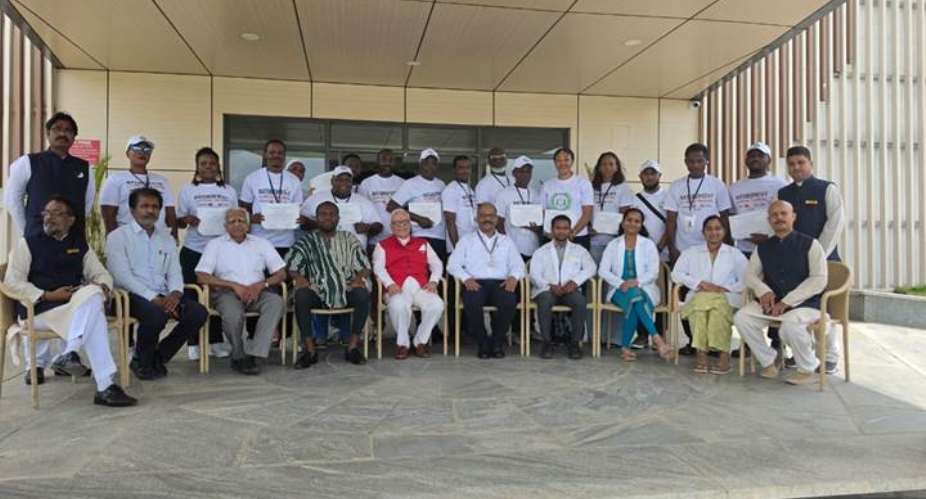
Kalaburagi, India — Sixteen African naturopathic practitioners from Ghana have successfully completed an intensive semester clinical training programme in Naturopathy, Ayurveda and Yoga in India, marking a significant milestone in Ghana–India cooperation in traditional, complementary and integrative healthcare.
The programme was jointly organised by Nyarkotey College of Holistic Medicine, Ghana, and Arujiva Ayurveda and Naturopathy Hospital, India, as part of the implementation of a Memorandum of Understanding between the two institutions.
Structured as a whole-semester clinical immersion programme, the training combined theoretical instruction with extensive hands-on clinical exposure in Naturopathy, Ayurveda, Yoga, nutrition, lifestyle medicine and integrative healthcare.
Participants were exposed to clinical assessment, naturopathic therapeutic modalities, Ayurvedic principles and procedures, yoga practices, nutrition and lifestyle interventions, as well as practical approaches to patient care.
The programme forms part of Nyarkotey College’s broader effort to strengthen the clinical competencies of African naturopathic practitioners by combining local professional education with international clinical exposure and knowledge exchange.
AYUSH Expert Commends Implementation of MoU
Speaking at the closing ceremony, Prof. Bejon Kumar Mishra, Chairman of the Core Group of Experts for Insurance, Ministry of AYUSH, India, expressed his satisfaction with the successful implementation of the partnership between Arujiva and Nyarkotey College.
Prof. Mishra observed that many institutions sign Memoranda of Understanding, but not all such agreements translate into practical programmes and measurable outcomes. He therefore commended Arujiva and Nyarkotey College for moving beyond the signing of an MoU to successfully implementing a programme that directly benefited African naturopathic practitioners.
He called for greater India–Ghana collaboration in traditional and complementary medicine, particularly in education, research, clinical training and institutional development. He further encouraged cooperation that could support the development of African Naturopathy while facilitating the responsible expansion and exchange of India’s AYUSH knowledge and services across the African continent.
The programme also recognised participants who distinguished themselves during the clinical training. Naturopath Kwame Okrah and Naturopath Cindy Boakye were specially honoured for excelling in Naturopathy, Ayurveda and Yoga. Their recognition reflected the programme’s emphasis on clinical competence, practical skills, discipline, professionalism and commitment to learning.
Arujiva’s Experience Provides Motivation for Nyarkotey College
Beyond the clinical training, the India experience also provided important lessons in institutional development and the long journey towards recognition of traditional and complementary healthcare systems.
In a meeting with Prof. Raphael Nyarkotey Obu, President of Nyarkotey College of Holistic Medicine, the Head of Operations of Arujiva Ayurveda and Naturopathy Hospital shared his personal experience of the struggles associated with developing and obtaining recognition for Ayurveda education in India.
He explained that even the Ayurveda college he attended encountered significant challenges in securing national recognition during its formative years, with the process taking more than a decade. The experience demonstrated that developing a healthcare profession and building credible institutions require patience, persistence, quality improvement, professional education and sustained engagement with government and regulatory authorities.
He further reflected on the evolution of AYUSH in India and the challenges the sector faced before gaining greater institutional autonomy and governmental attention. The Ministry of AYUSH was established as a separate ministry in 2014, giving Ayurveda, Yoga and Naturopathy, Unani, Siddha, Sowa-Rigpa and Homoeopathy greater governmental visibility and policy focus.
The discussion became an important source of motivation for Prof. Nyarkotey and Nyarkotey College as the institution continues its work to improve education, clinical training, research and public knowledge of Naturopathy and AYUSH systems in Ghana and across Africa.
The experience reinforced the view that challenges encountered in developing Naturopathy and other complementary healthcare professions in Africa should not necessarily be regarded as evidence that such systems cannot develop. Rather, the history of AYUSH in India demonstrates that building recognition, professional standards and strong institutions can be a gradual process requiring sustained effort.
For Nyarkotey College, India’s experience therefore offers important lessons for the emerging development of African Naturopathy, particularly in education, regulation, research, professional standards, government engagement and international collaboration.
Building a Ghana–India Bridge for African Naturopathy
The completion of the programme represents more than the graduation of 16 practitioners. It demonstrates the practical possibilities of South–South cooperation between Africa and India in traditional, complementary and integrative medicine.
The partnership between Nyarkotey College and Arujiva provides a platform through which African practitioners can gain exposure to India’s established systems of Naturopathy, Ayurveda and Yoga, while also creating opportunities for India to better understand the emerging African Naturopathy movement.
Nyarkotey College believes that international clinical immersion can help bridge the gap between classroom education and clinical practice while exposing practitioners to different healthcare traditions, therapeutic approaches and models of healthcare delivery.
The successful implementation of the first cohort is expected to provide a foundation for further student and faculty exchanges, clinical training programmes, research collaborations and institutional partnerships between Ghana, India and other African countries.
For Nyarkotey College, the experience has strengthened its determination to continue improving the quality and international exposure of naturopathic education in Ghana and to contribute to the development of a credible, evidence-informed and culturally relevant system of African Naturopathy.
The successful completion of the programme therefore represents not merely the end of a semester of clinical training in India, but another important step in the evolving relationship between African Naturopathy and India’s AYUSH systems.

 Police arrest mother of suspected Nsawam highway robbery leader for hiding gun; ...
 How police busted armed robbery gang targeting gold dealers in Ashanti, Western ...
 Family demands answers over reported disappearance of corpse at Battor Catholic ...
 How errand boy murdered Dr Jesse Amuah and his wife and now arrested for hiding ...
 Police dismantle robbery gangs across Ghana; AK-47s and ammunition recovered
 Effiduase Asokore MP threatens to sue Reverend Owusu Bempah over defamation
 NPP Nasara wing in Ashanti condemns Reverend Owusu Bempah over divisive comments...
 Gov’t spent over GH¢49m to evacuate Ghanaians from South Africa's xenophobic ten...
 “The direction this country is going is dangerous, Ghana is sick" – Rev. Fr. Adu...
 Gov’t supports farmers for large-scale dry-season tomato cultivation to boost su...

