




The World Meteorological Organisation (WMO), the UN body that coordinates weather and climate forecasting, said there was a near 100-percent chance El Nino would persist through February 2027. It is expected to strengthen further before peaking towards the end of this year.
“If this trajectory continues, it may be stronger than anything since our monitoring began. So literally off the charts we have used for the past four decades,” WMO Secretary-General Celeste Saulo told a press conference in Geneva on Thursday.
UN Secretary-General Antonio Guterres said in a statement released by the WMO: “El Nino is being supersized before our eyes. The science leaves no room for doubt: The planet is in uncharted waters, and those waters are heating up.”
World set to breach 1.5C climate limit as UN urges rapid reversal
Three storms at once
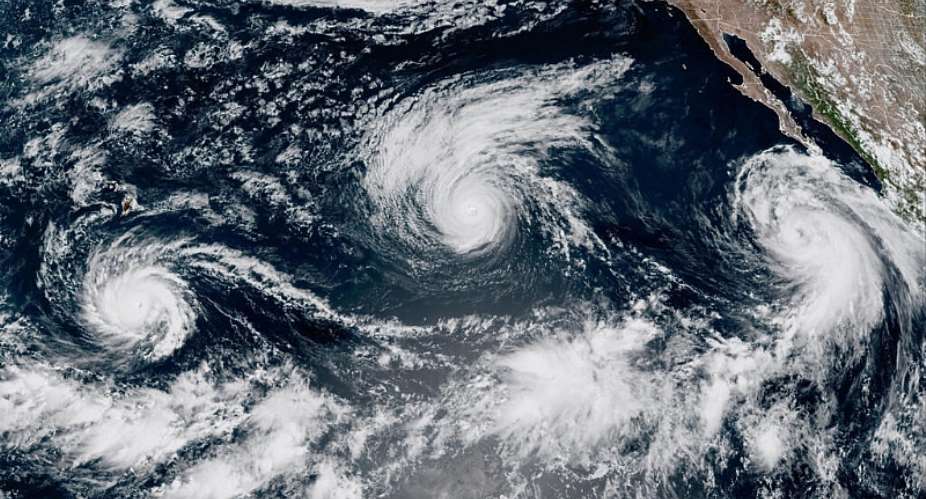
Tropical Storm Marie strengthened into a hurricane late Wednesday off Baja California, joining Hurricanes Karina and Lowell, both rated Category 4.
Three hurricanes at the same time are “definitely rare to see”, University of Michigan climate scientist Julia Cole told the French news agency AFP.
“El Nino warming sets the stage for these storms, which are fuelled in large part by warm waters – when the tropical Pacific is warmer than normal we see an increase in strong storms,” Cole said.
Lowell was about 710 kilometres south of Hilo, Hawaii, and was expected to remain a major hurricane for several days as it moved west, the US National Hurricane Centre said. Swells were likely to cause “life-threatening surf and rip current conditions” in parts of Hawaii.
Marie was about 600 kilometres southwest of the southern tip of Baja California and was expected to strengthen through Friday. Karina had weakened slightly but was likely to remain a hurricane for the next couple of days.
Climate change is 'very visible from space', France's Sophie Adenot tells RFI
Warmer waters
Warm ocean water provides fuel for storms. El Nino also reduces changes in wind speed and direction with height over the Pacific, creating favourable conditions for hurricanes to intensify.
The phenomenon occurs naturally every two to seven years. It develops when east-to-west trade winds weaken, allowing warm water that normally builds up in the western Pacific to move east and rise to the surface.
Climate change increases El Nino's impacts. A warmer atmosphere holds more moisture, making El Nino-linked rainfall more extreme, while hotter conditions can dry soils and deepen drought.
“El Nino has the potential to deliver a massive blow to communities and economies across the world,” Saulo said.
“We are already seeing disruption and devastation from droughts and floods and we expect these impacts to increase as El Nino intensifies.”
(with newswires)


 'I will die with integrity than be corrupted by galamsey' – Lands Minister
 'The people who benefit never die' – Kwesi Pratt on Gomoa, New Winneba land disp...
 Otumfuo returns to Kumasi to rapturous welcome after 10-day US visit
 Cement price hike looms as manufacturers introduce GH¢12 clinker demurrage surch...
 BOGISS defilement case: Security guard allegedly lured 14-year-old student with ...
 Police recover AK-47, 28 rounds of ammunition; suspect killed in Binduri operati...
 Your conduct is undeserving of a leader of the bench - John Boadu slams Chief Ju...
 Port inspection delays is increasing cost of doing business – ICC Ghana
 Works Minister pushes for shorter timeline for Kaneshie–First Light Road Project
 Driving must be studied from primary to university – Ada West DCE proposes

