




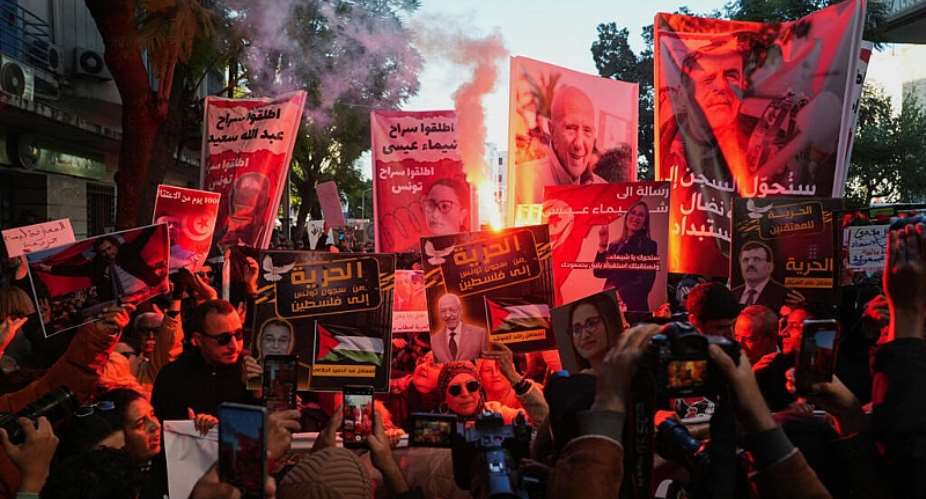
Authorities have prosecuted at least 47 people linked to non-governmental groups and held at least 10 in preventive detention for longer than 14 months, the maximum allowed under Tunisian law, the rights group said.
At least 14 people connected to civil society have been convicted and sentenced to prison after trials in 2025 and 2026. Human rights activist Saadia Mosbah was sentenced on 19 March to eight years in prison and a heavy fine on what HRW described as abusive financial crime charges.
“It is clear that the authorities are abusing every tool at their disposal to close the space for civil society in Tunisia and shut these organizations down,” said Bassam Khawaja, the group's deputy director for the Middle East and North Africa.
Tunisia court frees NGO workers accused of helping migrants
Migrant aid under pressure
Between May and December 2024, the government arrested workers from groups helping refugees, asylum seekers and migrants, and from organisations fighting racism and discrimination, HRW said.
Authorities have used laws criminalising assistance to foreigners with irregular immigration status and Tunisia's 2015 counterterrorism and money-laundering law to bring what the rights group described as abusive charges against human rights defenders and NGO workers.
Five employees of asylum groups have been convicted on charges linked to their work. The targeted organisations have since stopped operating.
“The government has used abusive, arbitrary prosecutions, detentions, financial investigations and suspension of organisations in an attempt to stifle these voices,” Khawaja told German broadcaster DW.
Two years on from EU deal, violence against migrants in Tunisia remains rife
Following the money
At the end of 2024, Tunisia's Tax Evasion Investigation and Prevention Brigade notified at least a dozen associations, including Amnesty International's regional office and the anti-corruption group I Watch, that they were under investigation.
The investigations led to at least two associations having their bank accounts frozen. Private banks have also restricted access to hard currency, blocked or returned foreign funds and closed some groups' accounts, the report said.
Between July and October 2025, and again between April and May 2026, authorities used Decree-Law 2011-88, the law on associations, to suspend groups. HRW identified at least 20 suspended civil society associations but said the exact number was impossible to establish without official data.
Some associations did not receive the formal warnings required by law, while others tried to respond but received no reply. Lawyers told HRW that officials had dismissed appeals from about 30 associations.
Al Khatt, which publishes the independent media outlet Inkyfada, and the anti-racism group Mnemty are facing dissolution proceedings.
Tunisia flooding kills four as record rainfall shuts schools
Fear of speaking out
The pressure is also affecting whether activists speak, write or organise publicly.
“An activist or anyone interested in public affairs in Tunisia thinks twice before speaking, writing or organising an activity,” Rabie Kacem, a member of the Nafas civic collective, said.
“We are talking about an environment where civic and human rights work itself has become linked to the possibility of being prosecuted, defamed or pressured.”
(with newswires)


 President Mahama urges African countries to fund own peace operations, warns aga...
 Govt to borrow GHS15.38 billion from domestic market, plans DDEP bond buyback
 Finance Ministry says all 2026 ABFA allocations reserved for Accra-Kumasi expres...
 'Surprised and disappointed' — GTA CEO Efua Houadjeto responds to Abeiku Santana...
 Police arrest NDC delegates for allegedly photographing ballots at Bimbilla cons...
 Gambia’s Chief Justice pays courtesy call on Asantehene at Manhyia Palace
 NDC Constituency polls: Delegates invoke 'Antoa' deity over alleged album manipu...
 NDC Oforikrom constituency election stalls over ballot paper delays
 Former NDA CEO Sumaila Abdul-Rahman, three others fined GH¢84,000 each over proc...
 Wa: Abandoned newborn baby boy rescued at Sombo


