




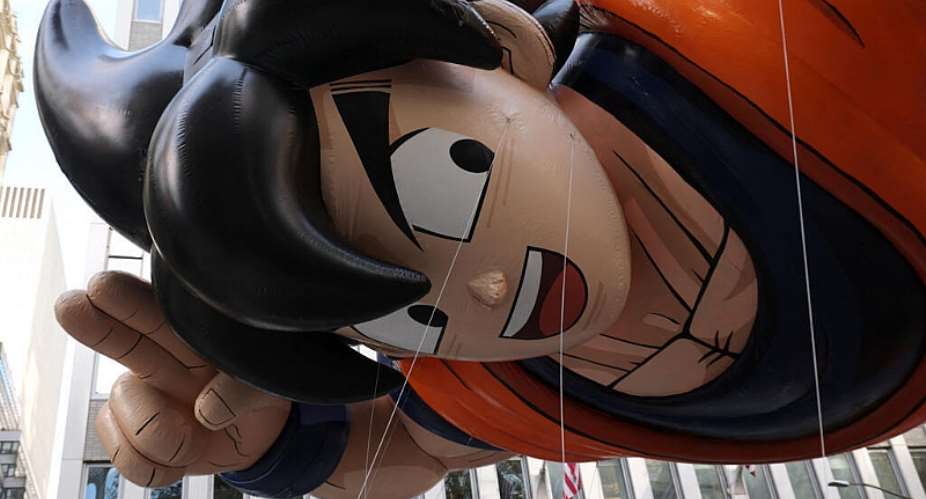
Fans of Dragon Ball, the iconic Japanese manga series, are accustomed to characters merging in the heat of battle to magnify their skills and strength. Few would have anticipated France teaming up with Saudi Arabia to write a new chapter in one of the most successful media franchises of all time.
As the gaming website Polygon put it, “this is one pairing we didn't see coming”.
The French presidency has announced plans to build three theme parks near Paris under a €6 billion ($7 billion) deal agreed with Saudi Arabia. The “colossal” development is expected to include a manga-themed park, which President Emmanuel Macron's entourage said would be inspired by the Dragon Ball franchise.
Read more Saudi Arabia to invest €6 billion in theme parks near Paris, Macron says
“You know my interest for manga,” Macron – who owns an original Dragon Ball drawing among other gifts related to the manga – wrote in a post on X last week, hailing an investment not seen “since Disneyland Paris”.
The announcement capped a two-day state visit to France by Saudi Arabia's Crown Prince Mohammed bin Salman, which saw the two leaders attend the Esports World Cup final. An aide to Macron said the project stemmed from a previous discussion between the two leaders about their “shared passion” for Japanese comics, “in particular Dragon Ball”.
“No, you're not dreaming: Dragon Ball is coming to Ile-de-France,” declared a beaming Valérie Pécresse, the head of the Paris region, in a video message posted shortly after Macron's message. “Son Goku will have his own theme park, just a stone's throw from Paris,” she said, citing the fictional character created by the late Akira Toriyama.
As manga experts were quick to point out, there was no mention of Toriyama's home country Japan, nor of the various Japanese companies that own licensing rights for the myriad comics, animes, video games and merchandising spawned by the hugely successful saga.
A manga park – without Japan?
French media have suggested the new parks could be built on the site of the former Mirapolis theme park in Cergy-Pontoise, northwest of Paris, which closed in 1991 just four years after its opening. The new project will be led by Qiddiya Investment Company (QIC), owned by Saudi Arabia's sovereign wealth fund, which in 2024 announced plans to build a Dragon Ball theme park near the country's capital, Riyadh. The entrance to the Mirapolis park, featuring a giant statue of Rabelais' hero Gargantua, pictured in 1987.
That plan, however, was unveiled as part of a “strategic partnership” with Japan's Toei Animation, the powerful studio behind the Dragon Ball cartoon and films, notes Julien Bouvard, a manga expert and senior lecturer in Japanese language and civilisation at Jean-Moulin Lyon-III University.
“When the Saudi park was presented, Toei confirmed its involvement through social media posts. Whereas this time, they've said nothing,” said Bouvard. “Their silence suggests that the Paris theme park is still only a proposal, and that the astronomical investment figures put forward are far from definitive.”
Negotiating licences is a tricky business in Japan, where copyright law offers strong protection and where companies can impose draconian conditions on the use of a character or license. In Dragon Ball's case, licensing rights are split between multiple companies, including Toei, the publisher Shueisha (best known for the manga hit-machine “Weekly Shonen Jump”), video game giant Bandai Namco, and Toriyama's own company Bird Studio.
“It's very difficult these days to launch a new project based on Dragon Ball, as you need the consent of each of the rights holders,” said Bouvard, stressing that Japanese companies are also very particular about the use of their characters abroad.
“Manga publishers in France are forced to go back and forth constantly, sending their French versions to Japan for verification. Sometimes the colour balance changes slightly during printing, and the Japanese publishers don't like that,” he added. “Qiddiya will also have to go back and forth to build its parks. This is a project not just for three, four or five years, but probably a lifetime's work to convince everyone.” The Shenron dragon in the centre of the planned Saudi park will contain a giant rollercoaster ride.
According to promotional videos, the park near Riyadh will include a 70-metre-tall statue of the magical dragon Shenron, who grants a wish when the seven “dragon balls” are gathered, among other attractions covering a million square metres. No official opening date has been announced and little information has emerged regarding the site's development. Critics already question whether the project will ever be completed, noted the International Business Times, “pointing to Saudi Arabia's record of announcing large‑scale developments, including the Neom 'Line' project, that are later scaled back or abandoned”.
The Paris project is yet to get its own design, on top of licensing rights and other likely hurdles, including the transport woes that hampered the short-lived Mirapolis park, which was also spearheaded by a Saudi investor, millionaire Ghaith Pharaon.
A cherished culture
News of the French and Saudi plans has raised eyebrows in Japan, including in Toriyama's hometown Kiyosu, near Nagoya, where local officials expressed surprise at the lack of Japanese involvement and warned that the theme park would struggle to win over license owners.
In an interview with France Info, the mayor of Kiyosu, Sumio Nagata, recalled that even Toriyama had faced “huge restrictions” when drawing a logo for the town. Others, like local councillor Tetsuo Takahashi, lamented the failure to build an amusement park on home soil.
“Toriyama's works are global, and so is he, but his roots are here,” Takahashi told the French broadcaster. “We must take care of our cultural heritage.” A mural depicting Akira Toriyama, inspired by the Dragon Ball series, in Lima, Peru.
The councillor also warned against projects motivated solely by financial gain, echoing past criticism of the Saudi theme park voiced by Kazuhiko Torishima, the influential manga editor who helped discover Toriyama and create the Dragon Ball franchise.
At last year's Japan Expo in Paris, an annual fair dedicated to Japanese popular culture, Torishima warned that “expanding the license just for the goal of making money” would fatally undermine the country's treasured manga culture. He doubled down in a recent interview with Japanese business website Diamond Online, stating that he would never have approved the Saudi park if he had still been in charge.
“To act purely for short-term profit is to lose sight of manga's true essence,” he said, highlighting the bond between Japanese comics and their loyal – and youthful – readership back home. “Nowhere else in the world do children spend their own money to buy a magazine,” he added. “That's why I believe we must not ignore the culture that Japanese children have built.”
France's 'Gagaballiens'
Bouvard said Japanese reactions to the French-Saudi venture, and the apparent lack of Japanese involvement, feed into an underlying narrative about the country's relative decline – a narrative he also associated with the French.
Another trait France shares with Japan is a passion for manga, in which Dragon Ball holds a special place, making it a legitimate host for a theme park in the eyes of many observers.
“France is the world's second-largest manga market after Japan. And with Japan Expo, Paris is home to the most popular manga event, which attracts over 200,000 people a year,” said Bouvard. “It wouldn't be surprising to have a manga-themed park as well.”
He pointed to the early success of new attractions at the Spirou amusement park in southern France, based on the popular manga series “Naruto”.
Bouvard said France was fortunate to have early French-language adaptions of the Dragon Ball manga, the cartoon and subsequent video games, generating a powerful media mix that turned Goku and his companions into household names in the 1990s. Dragon Ball-mania even spawned the term 'Gagaballiens' to refer to fans who were gaga about the series and “only loved manga through Dragon Ball”.
Saudi 'parkwashing'
Saudi Arabia's interest in the world created by Toriyama has shallower roots, driven in large part by the crown prince's personal taste for manga and gaming.
The country that once issued a fatwa against Pokemon has since performed a U-turn on such media franchises, investing heavily in Japan's animation and gaming industries, and playing a leading role in global esports events (competitions involving video games). The planned Dragon Ball park near Riyadh is part of the broader Vision 2030 platform to grow its own entertainment and tourism industries.
Critics have labelled the project an example of “parkwashing”, arguing that high‑profile entertainment investments are a way to soften Saudi Arabia's image and distract from its record on human rights, including curtailing women's rights and the criminalisation of homosexuality, which can carry the death penalty.
Macron was one of the first Western leaders to meet Bin Salman in the wake of the 2018 killing of journalist Jamal Khashoggi, which US intelligence says was ordered by the Saudi crown prince. When asked about entrusting an amusement park to Riyadh despite scrutiny of its human rights record, Macron's office replied: “At no point, when we attract a project, do we seek to lecture others.”
Some Dragon Ball fans, however, have expressed reservations about the Saudi link on social media, saying it ran counter to the spirit of the manga series.
“Toriyama's stories are frequently built around characters standing up to tyranny and oppression, which makes the funding source feel uncomfortable to a segment of the fandom. None of this means the park won't happen, but it does explain why the reaction hasn't been pure excitement,” wrote manga enthusiast Sora Tanka.
Such qualms may well disappear over time if the planned parks end up being a success, Bouvard cautioned.
“Everyone would have preferred it to have been a deal between France and Japan, without Saudi Arabia. But that's where the money comes from,” he added. “A lot of people are sceptical – and a little sad, too – but if they end up building the parks, and doing a good job, I expect many fans will be thrilled to go there.”


 Obuasi SHTS headmaster resigns as Juaben NDC secretary, withdraws chairmanship b...
 NDC reverses decision, directs Obuasi SHTS headmaster to step aside from Juaben ...
 Africa must turn mineral wealth into jobs and shared prosperity – Mahama
 FDA shuts Franko Herbal Centre factory, recalls mixture over drug adulteration
 'Despicable!’ – Prof. Prempeh blasts GES, NDC over handling of Obuasi SHTS alleg...
 Police search for missing fishing canoe and seven crew members off Axim
 October 20: Cedi sells at GHS12.25 on forex market, GHS11.67 on BoG interbank
 'Very distasteful’ – Selorm Branttie blasts NDC for clearing Obuasi SHTS headmas...
 Power fluctuation destroys MTN mast power plant worth GH¢200,000 in Begoro
 Koku Anyidoho calls for Ablakwa’s dismissal over South Africa evacuation allegat...


