




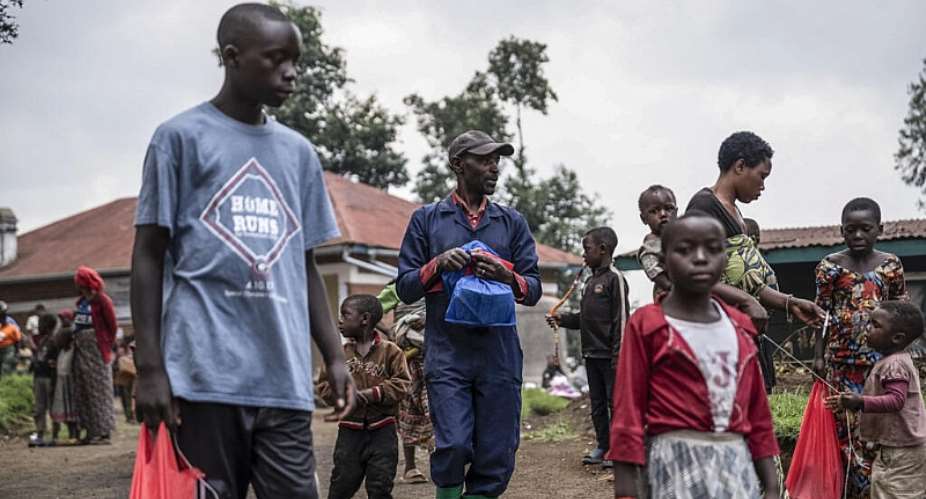
Across most of the Democratic Republic of Congo, schools were due to reopen for in-person classes on 1 September, with the government also reiterating that public primary education is free and urging school officials to comply with existing rules on fees.
The start of the 2026–2027 school year will also see the launch of 78 pilot school canteens – three in each province – as well as new "citizen monitoring clubs", according to the Education Ministry.
But in a statement released on 31 August, Minister of State for National Education and New Citizenship Raïssa Malu acknowledged that the new term was beginning in a "challenging context".
"Wherever conditions permit, school must resume," she said, expressing particular concern for pupils and teachers affected by insecurity and conflict.
The return to classrooms comes amid three major challenges: the Ebola epidemic, the situation in territories controlled by the AFC/M23 armed group and a labour dispute involving some teachers.
Ebola cases near 4,000 as DRC struggles to contain fast-spreading outbreak
Three-tier response to Ebola
The health crisis is directly affecting six provinces – Ituri, North Kivu, Haut-Uélé, Tshopo, South Kivu and Bas-Uélé.
According to the latest situation report, dated 29 August, 60 of 151 health zones across those provinces have been affected since the outbreak began.
Ituri remains the main epicentre, accounting for 82.3 percent of confirmed cases, with 28 of its 36 health zones affected.
The Education Ministry has adopted a three-tier system based on local risk. Schools in green zones will remain open with basic preventive measures, while orange zones will operate under reinforced health protocols and closer coordination with health services.
In high-risk red zones, teaching will temporarily shift to a lighter form of remote learning, using worksheets and, where available, radio or television programmes.
Of 138 education subdivisions in the affected provinces, 40 had been hit by the epidemic and 18 were classified as high risk as of 20 August.
Resources are also being prioritised according to risk, with red zones receiving the most support for educational continuity and health protection, followed by orange areas requiring logistical and hygiene assistance.
A 29 August health report said awareness campaigns were already under way in some areas, including Nia-Nia in Ituri, but warned of continuing problems with contact tracing and the implementation of preventive measures.
Deadly DR Congo Ebola outbreak spreads to rebel-held South Kivu
Schools under rebel control
The start of the school year presents a different challenge in territories controlled by the AFC/M23.
In Bukavu, South Kivu, the movement's authorities summoned school officials and teachers on 31 August to reassure them and confirm that classes would resume on Tuesday, according to information gathered by RFI.
Despite the de facto control exercised by AFC/M23, the education system remains closely linked to the central government in Kinshasa, with primary and secondary school teachers continuing to be paid by the state.
The result is an unusual arrangement: the local organisation of the school year is taking place under AFC/M23 authority while a crucial part of the system's financing continues to come from Kinshasa.
Teachers have also called for stronger security guarantees amid continuing armed conflict in areas that are partly beyond the central government's control.
DRC and M23 rebels agree on roadmap for peace in eastern Congo
Strike call remains
In Ituri, the health crisis is also being compounded by divisions among teachers.
Union representatives who had considered boycotting the start of the school year are split, with some agreeing to return to classrooms while others remain reluctant.
A member of an inter-union delegation interviewed by RFI said current conditions still did not provide sufficient guarantees that pupils and teachers would be adequately protected against Ebola.
Labour tensions extend beyond the epidemic-hit areas.
The Congo Teachers' Union, Syeco, one of the country's main teaching unions, is maintaining a strike call and has urged parents to keep their children at home.
The union is demanding that teachers' monthly salaries be raised to $500, or the equivalent in Congolese francs, along with the formal registration and payment of teachers and newly recruited staff who are currently unpaid.
Its demands also cover pensions, health insurance, the payroll system and conditions for school inspectors.
The ministry says it is continuing work on regular salary payments, retirement arrangements and social protection.
Malu met a coalition of teachers' unions on 28 August, with discussions covering unpaid and newly appointed staff, retirement, employment statutes and payroll issues.
But there has been no confirmation that Syeco's separate strike call has been withdrawn.
The key test now is whether the measures announced by the Congolese government can be implemented effectively in schools facing very different health, security and staffing pressures.
This story has been adapted from this report in French by RFI Afrique journalist Patient Ligodi and edited for clarity.


 New Winneba clash: Get into the community and arrest perpetrators — Afenyo-Marki...
 PRESEC-Legon reaches NSMQ semi-finals after kicking out defending champions, Mfa...
 'Correct misinformation visibly, quickly with same prominence' — Cybersecurity A...
 'You become the nation’s steady hand when you report truthfully during tension' ...
 No NPP General Secretary who lost election has ever been retained – Boakye Antwi
 G.Bissau votes 'yes' in referendum for new constitution
 IMF reaches agreement with Senegal on new $2.2 bn loan programme
 Police arrest suspected armed robber over Accra-Kumasi Highway robberies
 NPP demands answers over disappearance of Dambai resident
 Three killed, 15 injured in violent land dispute at New Winneba

