




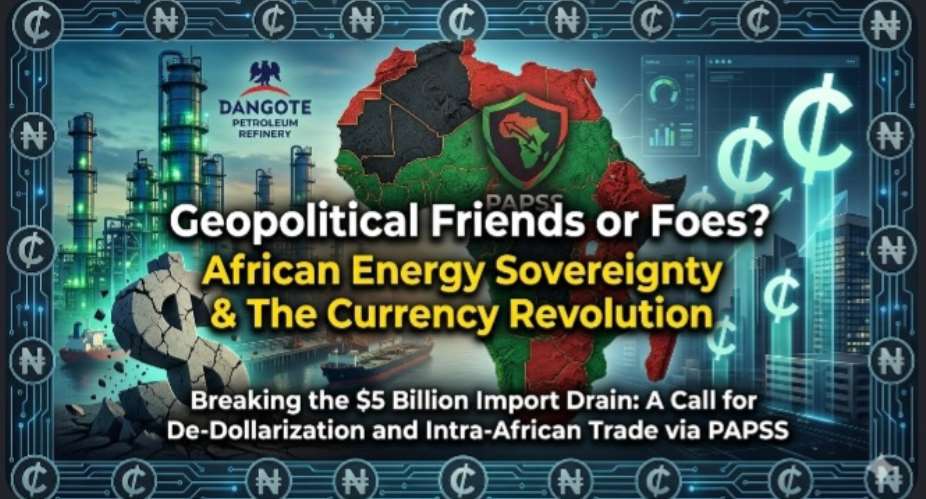
The escalating structural and legal friction surrounding the Dangote Petroleum Refinery in Nigeria—coupled with its planned expansion into East Africa—is not a mere corporate dispute. It represents an acute geopolitical conflict over the control of African resource wealth. For decades, the African continent has operated under a neo-colonial trading architecture, characterized by the export of cheap raw commodities and the subsequent import of high-value refined goods. This structural asymmetry is artificially sustained by Eurocentric maritime routes, Western trading indexes, and the systemic hegemony of the United States Dollar (USD).
For Ghana, this vulnerability is not theoretical; it is directly reflected in persistent fiscal deficits, domestic inflation, and the chronic depreciation of the Cedi. True economic liberation cannot be achieved through passive diplomacy. It requires a radical structural break from external dependency. To insulate local markets, African states must aggressively execute intra-continental trade frameworks, bypass Western financial intermediaries, and systematically weaponize localized transaction clearing systems.
The Geopolitical Paradox: The United States as a Structural Adversary to African Autonomy
In international political economy, evaluating a global superpower like the United States through moral binaries such as "friend" or "foe" is analytically flawed. Hegemonic powers operate exclusively on the basis of national self-interest, economic dominance, and the preservation of global supply chains.
- The Reality of Strategic Extraction: US capital integration and energy trade are strictly extractive. When American financial institutions or premium feedstocks (such as West Texas Intermediate Midland crude) penetrate African downstream sectors, they serve to maximize Western corporate margins and ensure supply-chain security, not to subsidize African industrial self-sufficiency.
- The Dollar Chokehold as Financial Warfare: The global financial architecture, anchored by the USD, functions as a mechanism of macroeconomic subordination. Forcing African refiners and state actors to execute regional bulk fuel transactions in greenbacks forces African central banks to continually deplete their foreign exchange reserves to facilitate trade between neighboring states.
- The Subversion of Local Industrialization: Western commodity trading conglomerates and institutional lenders derive substantial arbitrage profits from Africa's lack of refining capacity. Consequently, any domestic industrial initiative capable of achieving complete energy self-sufficiency directly threatens Western market monopolies, turning nominal diplomatic allies into active economic adversaries.
The Macroeconomic Drain: Deconstructing Ghana’s Fuel Import Crisis
An empirical evaluation of Ghana’s macroeconomic data highlights the severe unsustainability of its external trade profile, which is heavily compromised by refined petroleum dependence:
- The Massive Foreign Exchange Hemorrhage: According to full-year data from the Chamber of Oil Marketing Companies (COMAC) and the Bank of Ghana, Ghana’s annual fuel import bill reached a staggering US$4.95 billion. This massive cash flight represents an average national drainage of roughly US$400 million every month.
- Dominance in the National Import Basket: Refined petroleum products have expanded to consume 30% to 32% of Ghana's total national import expenditure. Data from the Ghana Statistical Service (GSS) indicates that combined imports of diesel and light oils reached a colossal GH¢51.7 billion, accounting for more than one-fifth of the nation’s entire import bill.
- The Structural Failure of Local Refining: This import dependence is exacerbated by severe underutilization in domestic processing, with local refining capacity contracting significantly. This has forced the state to rely almost exclusively on foreign-sourced Euro-5 grade fuels, exposing the domestic economy to severe international market shocks and currency volatility.
Dethroning the Greenback: Weaponizing PAPSS for Domestic Traders
The resolution to this monetary crisis lies in the immediate, aggressive scale-up of the Pan-African Payment and Settlement System (PAPSS). Developed by Afreximbank in collaboration with African central banks, PAPSS serves as a revolutionary tool for financial de-colonialism.
- Elimination of Third-Party Currency Conversion: Historically, a Ghanaian trader purchasing goods from Nigeria or Kenya had to convert Ghanaian Cedis into US Dollars, route the transaction through a Western correspondent bank, and convert the USD into Nigerian Naira or Kenyan Shillings. PAPSS bypasses this entirely by facilitating instant cross-border payments directly in local African currencies.
- Elimination of Correspondent Bank Fees: By settling transactions directly across African central banks, PAPSS removes foreign commercial intermediaries. This eliminates high transfer fees, slashes processing times to under two minutes, and retains liquidity within the African financial ecosystem.
- Preservation of Central Bank Foreign Reserves: When Ghanaian Bulk Oil Distribution Companies (BDCs) and Oil Marketing Companies (OMCs) utilize PAPSS to clear fuel purchases via local bank rails, the Bank of Ghana is no longer required to provide scarce USD allocations to fund the trade. This shifts the burden off national forex reserves, helping to stabilize the Cedi.
Strategic Recommendations for Ghana and West African Policy Makers
To dismantle these systemic vulnerabilities and secure energy sovereignty across the sub-region, the following regulatory and commercial measures must be enforced:
- Institutionalize Currency Swap and PAPSS Fuel Clearances: The Ministry of Finance and the Bank of Ghana must mandate that all regional refined petroleum procurements be cleared strictly through the PAPSS network. This will permit local BDCs to settle transactions with regional producers using the Ghanaian Cedi.
- Establish Direct Bilateral Offtake Agreements: Ghana must bypass international commodity brokers and finalize long-term, direct sovereign offtake frameworks with localized mega-refineries like Dangote and a fully rehabilitated Tema Oil Refinery (TOR). This will guarantee supply security and eradicate mid-stream arbitrage.
- Harmonize the 'FOB West Africa' Fuel Pricing Benchmark: The National Petroleum Authority (NPA) must partner with regional regulators to formalize a unified West African fuel pricing and quality benchmark. This metric should be anchored around local ports rather than European indexes, insulating the sub-region from arbitrary Western price manipulation.
- Capitalize Regional Maritime and Distribution Logistics: State and private actors must deploy targeted capital into expanding local seaborne tanker capacity and upgrading port infrastructure. Enhancing these logistics will optimize bulk fuel transit across the Gulf of Guinea and position Ghana as an efficient energy hub.
The economic survival of Ghana cannot be outsourced to foreign powers or benevolent market forces. The structural warfare playing out in the African energy sector serves as a harsh warning: the incumbent global financial order will fiercely defend its monopolies. True economic sovereignty requires an uncompromising shift away from dependency. We must end the systemic absurdity of exporting raw commodities while spending billions of dollars importing refined alternatives. By shifting energy trade to intra-African networks, leveraging localized cross-border clearing systems like PAPSS, and trading in our own currencies, Africa can reclaim its economic destiny. The era of financial subordination must come to an end. True economic liberation demands radical structural execution.
✍️ Submitted by:
Retired Senior Citizen
For and on behalf of all Senior Citizens of the Republic of Ghana 🇬🇭
Teshie-Nungua
[email protected]


 Current successes make me wonder what we were doing in the past eight years — Ch...
 Community service targets misdemeanours, excludes serious crimes — Interior Mini...
 President Mahama dissolves boards of nine state institutions
 Call for Asiama’s removal from GoldBod Board must be based on facts — Kosi Dedey
 Roads Minister cautions contractors against ‘eye service’ after surprise site vi...
 SIGA Report: Don’t celebrate GETFund’s surplus as SOE profit — Adomako-Mensah
 Community Service Act will help reform offenders without prison contamination — ...
 How 300 mob from Gomoa stormed New Winneba, attacked residents and damaged prope...
 Ahmed Ibrahim says Mahama’s ministerial reshuffle was ‘divine intervention’
 NPP General Secretary race: Kodua supervised worse election defeat, must be vote...

