




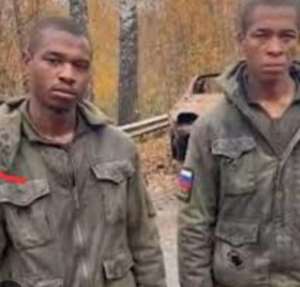
It has taken the grief of bereaved families to drag a long-suppressed reality into the open. Since August 2026, a Yaoundé-based collective calling itself "Bring Back Our Sons and Brothers" has drawn together relatives of victims and civil-society actors around one demand: answers about the young Cameroonians who left for Russia on promises of jobs or training, only to end up on the Ukrainian front line.
The group is pushing for victims to be identified, the missing to be located, remains to be repatriated, and the recruitment networks it considers fraudulent to be dismantled. Spokesperson Sylvère Paul Yede has described the affected families as devastated and overwhelmed.
THE SCALE OF THE PROBLEM
The pattern is now well documented. Facing heavy losses in Ukraine, Russia has widened its recruitment drive to the Global South, with Africa bearing a disproportionate share of the burden.
Data compiled by the investigative collective All Eyes on Wagner, through its INPACT project, puts the number of African fighters who have joined the Russian military since February 2022 at well over 1,400, drawn from 35 countries.
Cameroon ranks among the earliest and hardest-hit source countries, alongside Egypt and Ghana, with investigators citing roughly 335 Cameroonian nationals recruited and 94 deaths the highest toll recorded on the continent. Moscow has itself confirmed sixteen of those deaths to authorities in Yaoundé.
The recruitment method rarely varies: an attractive job offer, promises of study or legal status, a cooperating travel agency, and a starting salary of roughly $1,200 enough to draw in urban youth with few other prospects.Recruits typically sign Russian-language contracts they cannot read, only discovering after arrival that they have effectively enlisted for military service. The article cites the case of Joël, a surveyor from Douala and a young father, who disappeared weeks after arriving in Russia.
A DELAYED OFFICIAL RESPONSE
Cameroon's government has not been entirely silent on the matter. On April 7, 2026, the Minister of External Relations summoned the Russian ambassador in Yaoundé, an encounter during which Moscow acknowledged the deaths of sixteen Cameroonian contract soldiers. But no consolidated national toll has followed, and the true scale of Cameroonian involvement remains uncertain a gap the citizen-led collective has stepped in to fill.
PART OF A WIDER AFRICAN PATTERN
Cameroon's experience mirrors a broader continental trend that this column has tracked closely, including in Ghana, where official figures point to 62 Ghanaians killed and 15 still missing after enlisting with Russian forces. Nigeria, Ghana and Botswana have all formally asked Moscow to halt the recruitment of their citizens.Kenya, after tallying close to a thousand nationals drawn into the scheme, sent its foreign-affairs chief to Moscow and secured the repatriation of some recruits.
South Africa recovered seventeen citizens in February 2026 and opened its own investigation, while Ghana has confirmed at least one national taken prisoner in Ukraine. In each case, it has been sustained pressure from families and public opinion rather than diplomatic engagement alone that has forced Moscow to act on individual cases, even as it continues to deny broader involvement.
Côte d'Ivoire is reported to have close to a hundred nationals recruited under similar pretexts, while Equatorial Guinea secured the repatriation of one citizen who had been forcibly enlisted and sent to the front after sustained diplomatic effort. The networks, the false promises, and the toll on young lives are strikingly consistent from one West and Central African country to the next.
WHY THE CAMEROONIAN MODEL MATTERS
What distinguishes Cameroon's moment is not the scale of the tragedy, which is comparable to what Ghana, Nigeria and others have already documented, but the fact that grieving families organized publicly to force the issue onto the national agenda after officialdom moved too slowly.
That is a lesson this column has long argued applies well beyond Cameroon: where families speak out and civil society mobilizes, governments and even Moscow itself have occasionally been compelled to respond. If similar coalitions took root across every affected country on the continent, the pressure on Russia's recruitment machine would be considerably harder to ignore.
Mustapha Bature Sallama
Medical/Science communicator, Private Investigator, Criminal Investigation and Intelligence Analysis,United States Institute of Peace (USIP), [email protected] +233555275880
Reference
Source article on Cameroon's "Bring Back Our Sons and Brothers" collective and Russian recruitment of African nationals, provided as background material, August 2026. Cites data from the All Eyes on Wagner collective and its INPACT project.


 Niger coup attempt: 'Russians saved the day' analyst tells RFI
 IGP decorates officer promoted for saving lives during Aboso fire
 Kumasi Inner Ring Road to close for six hours on September 6 for GRIDCo power tr...
 Eastern region: Seven killed in galamsey pit collapse at Asamang Tamfoe
 Anti-corruption fight has so far yielded positive results – PTAAM-Africa
 I've not done anything to embarrass myself, family or NPP – Afenyo-Markin reject...
 ‘Complete falsehood’ – Dr Srem-Sai rejects OSP claim of AG collaboration snub
 Police arrest six suspected members of armed robbery syndicate in Ashanti Region
 AU welcomes Sudanese-Sudanese dialogue initiative to end conflict
 ‘I was alone when it mattered most’ – Victoria Hamah opens up on painful past

