




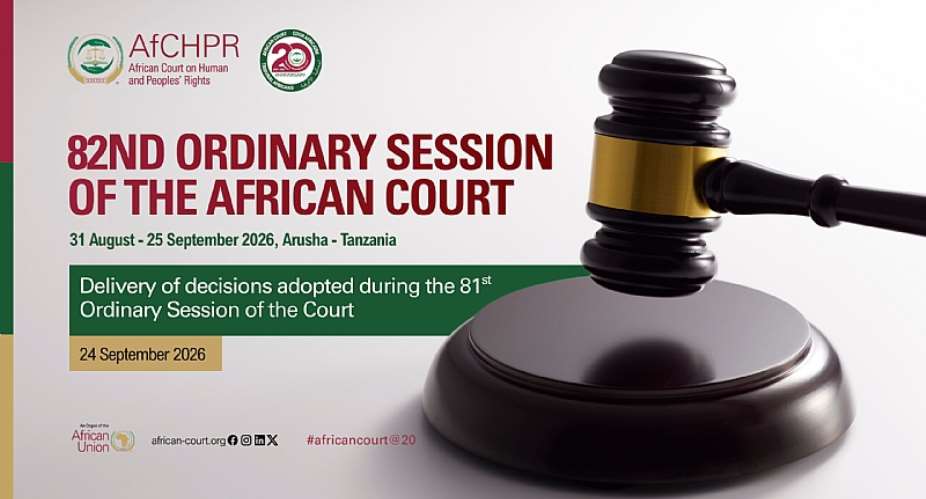
The African Court on Human and Peoples’ Rights has commenced its 82nd Ordinary Session in Arusha, Tanzania, with proceedings scheduled to run from August 31 to September 25, 2026.
The session will consider applications pending before the continental court and facilitate deliberations on other judicial and administrative matters.
As part of the session, the Court will also outline plans and activities for its 20th anniversary celebrations, which are being marked throughout 2026 with a series of initiatives across Africa.
The anniversary activities are intended to highlight the Court’s achievements, challenges and contribution to the protection and promotion of human and peoples’ rights over the past two decades.
In a statement copied to Modern Ghana News in Accra on Monday, the Court announced that it will deliver six decisions on Thursday, September 24, 2026.
The cases include Application No. 027/2019, Goore Bi Youzan Jean v. Republic of Côte d’Ivoire; Consolidated Applications Nos. 028/2019, 030/2019, 031/2019, 033/2019, 047/2019, 051/2019 and 053/2019, Fea Charles and Others v. Republic of Côte d’Ivoire; and Application No. 031/2020, Ibrahim Touré v. Republic of Mali.
The other matters are Application No. 014/2021, Souleymane Camara v. Republic of Mali; Application No. 003/2022, Mohamed Al Bousifi v. Republic of Niger; and Application No. 004/2022, Kambeyo Ka Kaunda & Another v. Republic of Malawi.
The Court said the sitting for the delivery of the decisions would be open to the public, both physically at its seat in Arusha and virtually.
The African Court is a continental judicial institution established by African Union Member States to protect human and peoples’ rights across the continent. It complements and strengthens the work of the African Commission on Human and Peoples’ Rights, based in Banjul, The Gambia.
The Court is composed of 11 judges elected in their individual capacities from among nationals of AU Member States. It holds four ordinary sessions each year and may convene extraordinary sessions when necessary.
Its mandate includes hearing cases and disputes concerning the interpretation and application of the African Charter on Human and Peoples’ Rights, as well as other human rights instruments ratified by the states concerned.
Mahama’s call for stronger rule of law
The 82nd Ordinary Session forms part of activities marking the Court’s 20th anniversary, which was officially launched during the opening of the 2026 Judicial Year in Arusha on March 2.
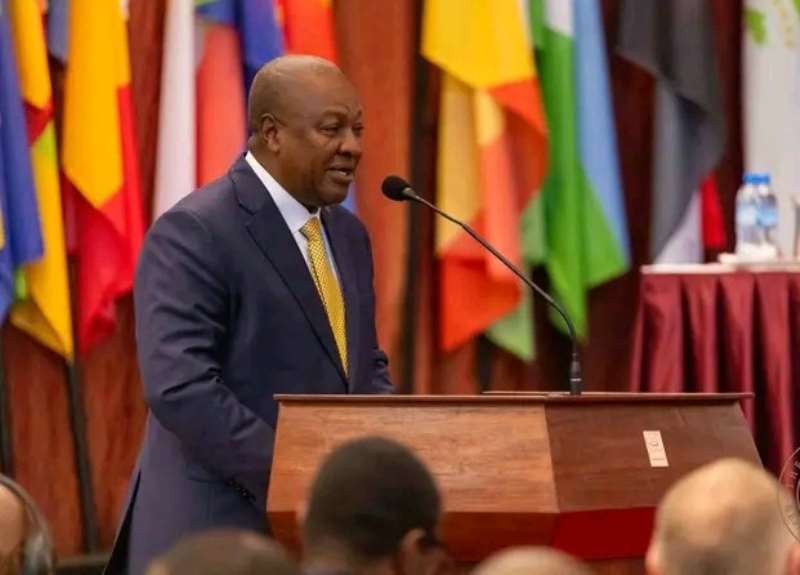
President John Dramani Mahama, who served as special guest of honour at the ceremony, urged African governments to uphold the rule of law regardless of political position, social status, traditional or religious affiliation or economic influence.
“No individual and no institution should stand above the law. Justice delivered without fear or favour is essential to building trust between citizens and the state,” President Mahama said.
Speaking on the theme, “20 Years of Service in Protecting Human and Peoples’ Rights,” he stressed that the rule of law must remain central to Africa’s democratic development.
President Mahama said the strength of African democracies would ultimately be determined by their commitment to the rule of law, describing it not only as a constitutional principle but also as a foundation for peace, development and social stability.
“Without independent courts and respect for judicial decisions, rights become promises on paper. African states must safeguard judicial autonomy and protect legal institutions from undue political pressure,” he stated.
He expressed concern over constitutional tensions, disputed elections and governance challenges across the continent, saying such developments had tested public confidence in state institutions.
According to him, strong and impartial judicial systems remain an important line of defence for citizens seeking justice, particularly during periods of political and institutional uncertainty.
He therefore urged governments to demonstrate practical commitment to the Court by complying with its decisions and strengthening domestic legal systems.
President Mahama said the opening of the 2026 Judicial Year should mark a renewed commitment by African states to deepen cooperation, strengthen judicial independence and protect the dignity and rights of citizens.
The President, together with the President of the African Court and other judicial stakeholders, including officials of the African Union Commission, also launched the Court’s 20th anniversary celebrations.
As part of the anniversary programme, the Court hosted the Fourth International Human Rights Forum involving the African Court, the European Court of Human Rights and the Inter-American Court of Human Rights from March 3 to 4, 2026, in Arusha.
The African Court is marking two decades of its operations, having begun its journey in 2006 as part of continental efforts to strengthen the protection of human and peoples’ rights in Africa.
The 20th anniversary commemorations will continue throughout 2026 with activities across the continent.





 Supreme Court dismisses Solomon Asamoah’s injunction bid in Skytrain Trial
 Over 6,000 phone numbers linked to scams as 50% traced to TikTok — TrustGH
 Supreme Court nominee explains why he opposes the idea of separate Bail Act
 Krobohene praises community for embracing Christianity after ancestral deity goe...
 Accra: FDA seizes cigarette-shaped lollipops, arrests key suspect
 August 31: Cedi sells at GHS12.20 on forex market, GHS11.26 on BoG interbank
 SOEs swing from GHS2.25bn loss in 2024 to GHS19.8bn profit in 2025 – SIGA
 56 years on: How Edward Akufo-Addo became Ghana’s President
 UDS graduate working as head porter gets second chance to return to University
 Amenfi Central MP Joana Gyan Cudjoe ends relationship with KECHE

