




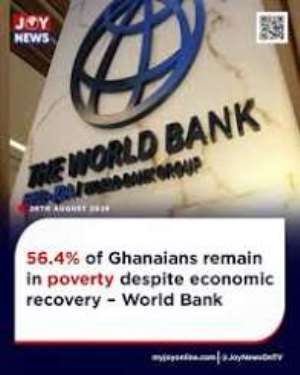
Ghana’s recent economic recovery presents an encouraging picture on paper, but the latest World Bank assessment raises an important question: how much of that recovery is being felt in the everyday lives of ordinary Ghanaians?
According to the World Bank’s 10th Ghana Economic Update, Reset for Growth, launched in Accra on August 26, 2026, an estimated 56.4 per cent of Ghanaians remain in poverty under the poverty measure cited in the report.
This comes at a time when several key macroeconomic indicators have improved. Ghana’s economy grew by 6.0 per cent in 2025 and recorded growth of 6.4 per cent in the first quarter of 2026. Inflation has declined significantly, while the public debt-to-GDP ratio has also improved.
These are important achievements. Macroeconomic stability is essential for investment, business confidence and sustainable development. Ghana should therefore acknowledge the progress that has been made.
However, economic recovery cannot be judged by headline indicators alone. Ultimately, growth must translate into jobs, incomes and improved living standards.
The World Bank has drawn attention to a disconnect between Ghana’s headline economic growth and the conditions experienced by a significant proportion of the population. One explanation is the structure of the economy itself.
Much of Ghana’s growth continues to come from sectors that have relatively limited capacity to absorb the country's rapidly growing labour force. Mining, gold and other capital-intensive activities can contribute significantly to Gross Domestic Product and foreign exchange earnings without necessarily creating large numbers of jobs.
The result is an economy that may be expanding without employment opportunities growing at a comparable rate.
This is particularly worrying for Ghana's young population. Thousands of young people leave universities, technical institutions and senior high schools every year looking for opportunities. Economic growth means little to them if they cannot find productive employment or establish sustainable businesses.
Ghana therefore needs to broaden the foundations of its economic recovery.
Agriculture and agribusiness must become major engines of employment. Instead of exporting agricultural commodities largely in their raw state, Ghana should encourage processing and value addition closer to farming communities. Cocoa, cassava, cashew, fruits, vegetables and other commodities can support thousands of businesses and jobs when connected to processing industries.
Manufacturing must also receive greater attention. A country cannot sustainably address unemployment while importing many of the products it has the capacity to manufacture locally.
Small and medium-sized enterprises are equally critical. Poverty cannot be defeated through social interventions and handouts alone. Social protection remains necessary for vulnerable citizens, but sustainable poverty reduction ultimately requires productive economic activity.
A small business employing five people may appear insignificant in national statistics. Multiply that enterprise by tens of thousands across Ghana and the employment impact becomes enormous.
Government policy should therefore make it easier for businesses to start, survive and expand. Affordable financing, reliable electricity, reasonable taxation, access to technology, simplified regulation and stronger domestic markets can enable Ghanaian entrepreneurs to become major creators of employment.
The geographical distribution of development also deserves attention. If poverty remains concentrated in particular rural communities and regions, public investment must deliberately reach those areas.
Good roads connecting farms to markets, irrigation facilities, healthcare, technical and vocational education, reliable electricity, internet connectivity and agro-processing centres can transform rural economies and reduce migration to already congested cities.
The debate should therefore not be about whether Ghana's economic recovery is real. The stronger question is whether the recovery is sufficiently broad, inclusive and capable of creating opportunities for millions of citizens.
GDP growth is important, but jobs matter. Falling inflation is welcome, but household purchasing power matters. Debt reduction is necessary, but the ability of families to pay school fees, afford healthcare, secure decent housing and put food on the table matters just as much.
Ghana has made progress in restoring macroeconomic stability. The next stage must be transforming that stability into productive jobs, stronger businesses and rising household incomes.
An economy should ultimately be judged not only by how fast it grows, but by how widely the benefits of that growth are shared.
Until economic recovery reaches the farmer in Abomosu, the trader in Accra, the artisan in Kumasi, the young graduate searching for work and the entrepreneur struggling to expand a small business, Ghana’s recovery will remain incomplete.
Macroeconomic recovery is important. Household economic recovery is what ultimately changes lives.
I can also make it more forceful as an opinion column or shorten it to about 600 words for newspaper publication.


 US forces strike Iranian launchers on Larak island in Strait of Hormuz
 Over 1,000 victims arrested, exploitative street begging networks dismantled — G...
 Ghana attaches particular importance to sustainable African-owned financing of p...
 Mahama calls for urgent action to strengthen $1bn AU Peace Fund
 Oti Region: One dead, several injured in Abotaose Market fire
 Seven dead, four trapped after galamsey pit collapses at Asaman Tamfoe
 Niamey back to normal after soldiers' mutiny
 Bawumia donates GH¢50,000 to support St. Jude Catholic Church at Weija
 N/R: Two arrested over murder of Yidani Chief and son
 How improved roads brought new vehicle options to Tumu-Bolga, Tumu-Tamale, Tumu-...


Comments
Poverty reduction is perhaps the most visible impact of any economic recovery by properly measured standards. Thank you Frank Ayim Damptey for this brilliant exposition.