




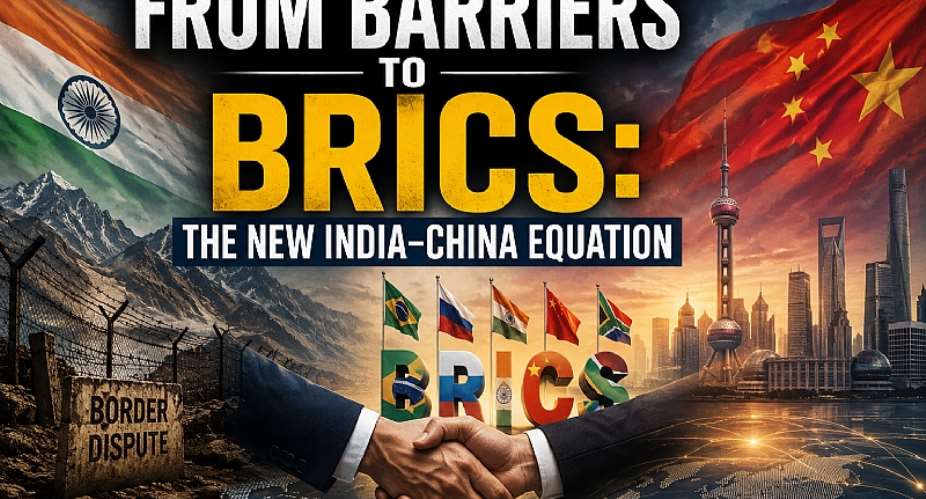
The world is a really fascinating place. One day, a disputed rival turns into a friend, and the next moment, a friend can turn into a disputed territorial land grabber. India–China relations have perhaps never been as adaptable as they appear to be today.
With the BRICS summit scheduled to be held in India on September 12–13, 2026, in New Delhi, the Indian foreign-policy establishment appears to be busy on several parallel diplomatic paths. While Dr. S. Jaishankar is expected to engage with Russia and President Vladimir Putin, India’s National Security Adviser, Ajit Doval, has turned towards Beijing and President Xi Jinping.
The main reason being forecast by the media is the settlement of border disputes. But perhaps the real story is much bigger. After nearly 25 rounds of talks and efforts to rebuild trust, the formal invitation to the Chinese president and the possibility of high-level engagement may not be simply about settling the border. It may also be about preparing the ground for a larger BRICS bargain.
The Chinese could be offered lucrative economic opportunities. With Iranian oil facing increasing restrictions and China remaining a major buyer, New Delhi may see an opportunity to open new channels of energy trade and financial cooperation involving China. Such arrangements could gradually challenge the monopoly of the petrodollar.
What can New Delhi offer?
India has one of the world's largest and fastest-growing digital markets. It could offer a vast economic space connected to the emerging debate over new-order currencies and alternative financial arrangements.
The combination of the ruble, rupee and Chinese currency could gradually create new mechanisms for trade settlement. Trump's tariff threats and the increasing use of economic pressure may actually be closing these deals faster rather than preventing them.
If the Chinese government sees genuine opportunities in India's expanding economy, it may find it increasingly difficult to ignore New Delhi's offer. India could provide China with greater economic room and market access, while in return seeking stronger energy arrangements and diversified trade.
India also needs secure energy sources. It cannot afford to remain dependent on any single strategic partner, including the United States. This is where economic pragmatism could begin to overcome geopolitical hostility.
What is Putin being offered?
The idea of a BRICS currency is no longer simply an idea. After the Iran war and the increasing weaponisation of the global financial system, the dollar monopoly appears more vulnerable than ever before.
Russia wants to take advantage of this changing environment. Moscow has already been searching for alternative payment systems and trade mechanisms that reduce dependence on Western-controlled financial structures.
India's massive crude oil market is particularly important in this equation. Russia sees India as a major strategic economic partner, while New Delhi benefits from diversified energy supplies. Moscow may therefore view the BRICS summit not simply as another diplomatic gathering, but as an opportunity to accelerate the construction of an alternative economic architecture.
The crude oil market, currency settlements and energy trade are becoming part of the same geopolitical contest.
What are the effects on the regional security architecture?
This is perhaps where Pakistan enters the larger equation. Pakistan has traditionally offered one of its strongest assets: its role in regional security architecture. From counterterrorism cooperation to strategic geography and connectivity, Islamabad continues to view security as an important source of geopolitical value.
India, however, may be attempting to counter this with something different—an economic architecture.
If Pakistan offers security architecture, India could respond with economic architecture. In geopolitical terms, that could become a powerful counterbalance, perhaps even a strategic checkmate.
Beijing may certainly take Islamabad into confidence, particularly because Pakistan remains one of China's closest strategic partners. But China cannot reject a major economic opportunity with India simply for Pakistan's sake. The interests of great powers rarely depend entirely on loyalty to one partner.
That is the new reality emerging across Asia.
From war to energy crises, from border barriers to BRICS, and from territorial disputes to currency competition, the Asian geopolitical battlefield is now operating on several fronts simultaneously.
Ajit Doval's visit to Beijing may therefore be about much more than settling a border dispute. The real question is whether New Delhi is trying to remove the barriers of the past—or whether it is borrowing diplomatic space from Beijing to build a stronger BRICS future.
The new India–China equation may not eliminate rivalry. But it could redefine how rivalry is managed. In the emerging Asian order, the battle is no longer only about borders. It is increasingly about energy, currencies, markets and the power to shape the economic architecture of the future.


 'Remember me in your prayers' – Nana Ama McBrown
 Turf war among OSP, A-G and EOCO undermines graft fight– Sulemana Braimah
 Here are 100 unrecognised universities listed by GTEC as of August 2026
 Mahama arrives in Luanda for AU Summit
 Fallen live electricity cable kills 10 cattle at Abrewanko
 Ketu South residents to demonstrate against ECG due to over-billing
 Ghanaians outraged over cigarette-shaped candy targeting children
 Volta NPP in turmoil over appointment of 10 regional officers
 Bolgatanga events ban beyond 8pm will make government unpopular – Gabriel Agambi...
 Irresponsible security reporting could worsen ethnic and religious tensions – Sh...

