




Arrival at the Energy Transition Junction
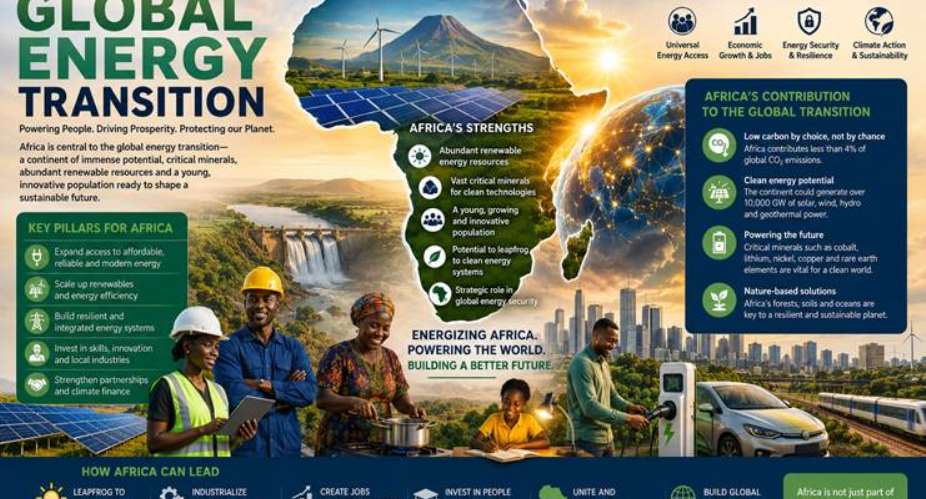
The global transition toward a low-carbon economy has fundamentally altered the geopolitical and economic landscape of energy markets. As the world shifts from fossil fuel-intensive systems to renewable energy and electrified transport, global energy security is pivoting from hydrocarbons to critical minerals. Africa, home to about 30% of the world's mineral reserves, stands at the epicentre of this paradigm shift.
However, as highlighted during the Africa Forward Summit held in Nairobi in May 2026, the continent faces a critical juncture. The mandate is to move from "aspiration to execution." The central economic and policy question is whether the influx of green investments will catalyze genuine industrial transformation across Africa or merely repackage historical models of resource extraction into a new paradigm of "green dependency." This report analyzes Africa's potential to benefit from the energy transition, utilizing current market data, supply-demand economics, and a specific case study of Ghana's mineral sector.
Africa's Critical Mineral Endowment
Africa's subsoil holds a disproportionate share of the minerals required for electric vehicle (EV) batteries, wind turbines, solar panels, and grid storage. The Democratic Republic of Congo (DRC) produces over 70% of the world's cobalt, while South Africa and Zimbabwe hold the vast majority of global platinum group metals (PGMs). The continent also has significant reserves of copper, manganese, graphite, and, increasingly, lithium.
Global Demand Dynamics for Transition Minerals
The demand for critical minerals is growing exponentially, driven primarily by the deployment of clean energy technologies. According to baseline projections aligned with global net-zero targets, the mineral requirements for clean energy technologies will quadruple by 2040.
Electric vehicles and battery storage are the primary catalysts. A typical electric car requires six times the mineral inputs of a conventional internal combustion engine vehicle. Consequently, the demand curves for lithium, cobalt, nickel, and graphite are shifting outward at an unprecedented rate.
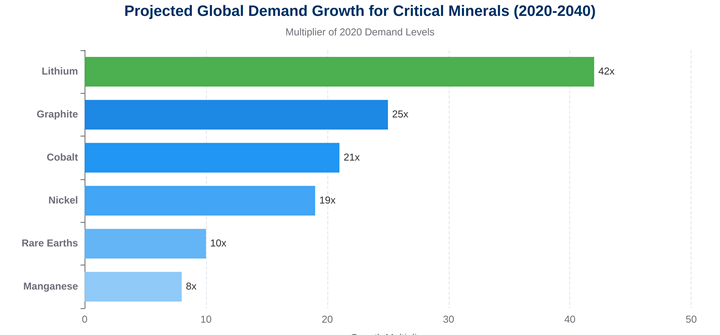 Data Source: Aggregated projections based on International Energy Agency (IEA) Sustainable Development Scenarios.
Economic Demand and Supply Analysis
Demand is driven by global legislative mandates (e.g., the EU's ban on new combustion-engine cars by 2035 and the US Inflation Reduction Act) and rapid technological adoption. This creates a highly inelastic demand curve in the short term; manufacturers must secure these minerals regardless of price spikes to meet production targets and regulatory requirements.
Conversely, the short- to medium-term supply of critical minerals is highly inelastic. The mining industry has long lead times. On average, a mining project takes 10 to 15 years to progress from initial discovery to commercial production. Supply chains are also geographically concentrated, creating bottlenecks and geopolitical vulnerabilities.
The intersection of rapidly growing demand and constrained, inelastic supply results in structural upward pressure on prices and significant market volatility. For Africa, this creates a "seller's market." However, high prices also incentivize substitution (e.g., the shift toward Lithium Iron Phosphate (LFP) batteries, which reduce cobalt and nickel requirements, or the development of sodium-ion batteries). Therefore, African nations must capitalize on the current window of opportunity before technological substitution erodes their comparative advantage.
Strategic Imperatives for African Nations
To ensure meaningful participation and avoid the pitfalls of historical resource curses, countries like Ghana must adopt three policy imperatives:
1. Sequencing Matters More Than Scale: Attracting massive green energy generation investments without fixing underlying grid infrastructure and tariff structures leads to stranded assets. In Ghana, the Energy Sector Recovery Programme (ESRP) highlights that adding renewable capacity to a system plagued by distribution losses and non-cost-reflective tariffs only compounds national debt.
2. Contractually Specified Technology Transfer: Local content cannot be rhetorical. Agreements for mineral extraction (like Ghana's lithium leases) and renewable installations must include enforceable schedules for skills transfer, component manufacturing, and domestic maintenance.
3. Building Institutional Capacity: African institutions must be co-designers of project pipelines, not merely co-signatories to externally designed deal structures. Active, technically grounded engagement is required to ensure capital deployment serves domestic industrialization.

Geological Blessing is not a Strategy
Africa possesses the geological endowment necessary to be a central pillar of the global energy transition. Surging global demand for critical minerals like lithium, bauxite, cobalt, and copper gives the continent unprecedented geopolitical leverage and economic potential.
However, as the economic analysis and the outcomes of the 2026 Africa Forward Summit demonstrate, geological wealth does not automatically translate into economic development. If Africa remains solely a site for raw material extraction and green energy deployment, it will fall victim to a new era of "green dependency." To truly benefit, African nations—exemplified by Ghana's strategic maneuvers in bauxite and lithium—must enforce policies that demand transformation finance. By prioritizing domestic value addition, contractually binding technology transfer, and rigorous sequencing of domestic energy reforms, Africa can leverage the energy transition to achieve lasting green industrialization.


 Highly influential people sponsoring Ghana Jollof TikTok activities – CID
 'Ghana Jollof' case: Bawumia's condemnation of nurse's arrest is hypocritical – ...
 Ahafo Ano South West MP involved in road accident
 Constitutional Review alone will not solve Ghana’s problems – Kwesi Pratt Jnr.
 East Legon Football Academy applauds NPA Boss for supporting youth football
 Gov't didn't show NPP enough respect in constitutional review process – Martin K...
 September 18: Cedi sells at GHS12.15 on forex market, GHS11.53 on BoG interbank
 Lawyer challenges two-week remand of Salomey over connection to wanted 'Ghana Jo...
 Minority calls for NSA boss Ampofo Ankrah, others to be dismissed over alleged 2...
 ‘You gave us GH¢60,000 to run 66 offices nationwide and expect us to function?’ ...


