




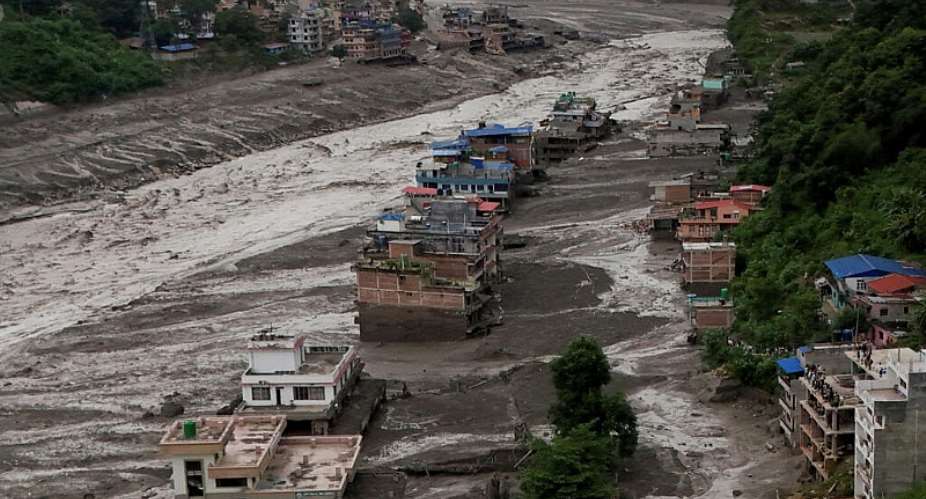
A wall of mud and rock on Wednesday collapsed into a river near Gyirong at the border between the Tibet and Nepal, triggering a flash flood that swept through towns and villages, washed way houses, roads and power projects.
At least 165 people have been reported dead, 162 in Nepal and three in Tibet. Nepal's disaster agency said 826 people were unaccounted for on Thursday, among them at least 579 Nepali and foreign tourists.
Tourists from all over the world
Hikers and climbers from around the world travel to Nepal to climb some of the world's highest peaks, including Mount Everest.
The French foreign ministry said 80 French nationals had registered their presence in Nepal. It added that other French people travelling through the country could also be in the affected areas.
“The top priority is to mobilise all available resources to search for and rescue missing people, evacuate and relocate residents in danger, provide prompt medical treatment to the injured and minimise the number of casualties,” Chinese President Xi Jinping said, according to state media.
The Chinese president does not usually comment on disasters unless the death toll is significant.
Chinese authorities have mobilised more than 1,500 personnel.
Aid coming in
The International Federation of Red Cross and Red Crescent Societies in Nepal said it has released just over €1 million in emergency funds to support rescue operations and provide drinking water and supplies such as blankets, first-aid kits, stretchers and body bags.
The European Union has activated its Copernicus satellite system to support rescue efforts and said it was ready to provide further assistance.
Neighbouring India will be providing military helicopters to help the search and rescue operations, and has sent 10 tonnes of humanitarian aid, including blankets, solar lamps and medicines.
Collapsed glacier
The flooding appears linked to a collapsing glacier.
Nepal's foreign minister initially said an earthquake may have triggered a landslide that blocked the Lhende Khola river and sent water downstream. The US Geological Survey later said the seismic activity initially was actually caused by a glacial collapse and debris flow.
The flooding “was caused by an avalanche of ice that fell into the Lhende River, but its exact cause remains to be confirmed,” Qianggong Zhang, a scientist at the International Centre for Integrated Mountain Development based in Kathmandu, told the AFP news agency.
Water levels in the Trishuli river, downstream from the blockage, reportedly rose by as much as 9 metres in just 30 minutes.
The blockage is still there and could create further flooding.
(with newswires)


 Justice Bernasko Essah explains why Supreme Court may depart from its previous d...
 Two NDC MPs whose ‘secret’ marriages have shocked Ghanaians
 All you need to know about Hon. Millicent Yeboah-Amankwa, wife of Hon. Mahama Ay...
 ‘A true trailblazer and cultural icon’ – Bawumia mourns Grace Nortey
 Vetting: 'Suspects should sue police if detained beyond 48 hours' - Supreme Cour...
 Speaker Bagbin outdoors uniforms for new parliamentary security guards
 Minority NPP boycotts vetting of three Supreme Court nominees over rushed timeta...
 Styrofoam ban is long overdue – Dr. Zanetor Agyeman-Rawlings
 Sustained credibility key to rebuilding Ghana’s debt market – BoG Governor
 MTN GH¢20m offer: 'Why did Ablakwa delay in announcing the rejection?' – Asafo A...

