




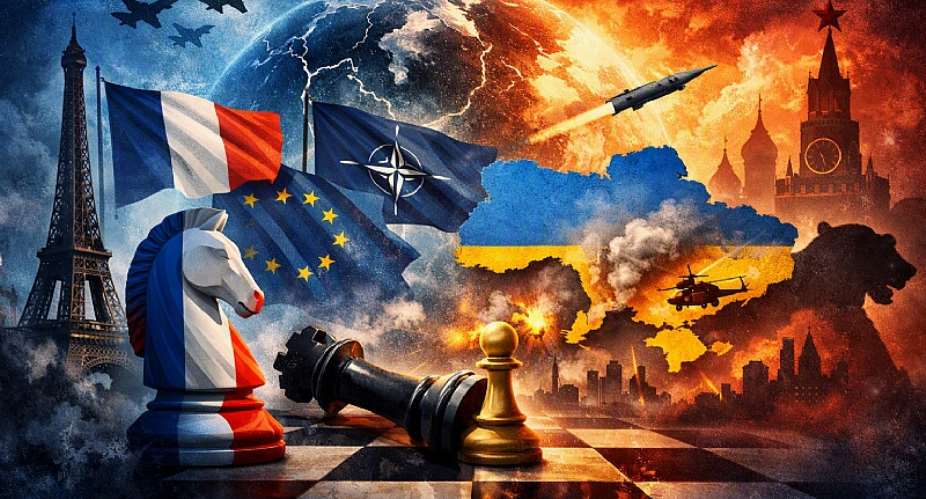
The Geopolitical Recession continues as the Russia-Ukraine war enters one of the longest conflicts in modern European history, surpassing the duration of the First World War. The question is no longer simply when the war will end, but whether the world is becoming more unsafe than it was during the late twentieth century. The prolonged conflict has transformed Ukraine from a regional battlefield into a wider test of global power, strategic alliances and the future of the international order.
The President of France, Emmanuel Macron, increasingly appears to be the most diplomatically active participant at the European Union’s strategic table. His independent positions, strict actions and willingness to challenge conventional European thinking have attracted both criticism and support. Yet the deeper rebellion against the existing diplomatic framework has not fully arrived. Following renewed attacks on Ukraine, Macron offered a swift response and signalled France’s readiness to provide additional assistance, particularly in strengthening Ukraine’s air-defence capabilities.
Why is Macron becoming more proactive than other European leaders? France appears to see the possibility of a settlement as far more important than simply maintaining peace talks without meaningful progress. Macron understands that Russia responds to strategic pressure and battlefield calculations as much as diplomatic initiatives. He appears to have recognised that Europe cannot remain permanently dependent on Washington for its security architecture. As uncertainty grows over the Trump administration’s long-term commitment to European security, the vacant strategic space may increasingly become a Macron-led European table.
French President Emmanuel Macron has promised to strengthen support for Ukraine through the delivery of interceptor missiles following a call with President Volodymyr Zelenskyy, during which they discussed Kyiv’s shortage of air-defence systems. The move comes amid a surge in Russian strikes that has increased civilian casualties. Macron has also said France will continue working with the Anti-Missile Coalition launched in Paris in July. The coalition includes 10 European countries seeking to develop an anti-ballistic missile capability as a potentially more economical alternative to expensive US Patriot systems.
Compared with the Patriot system, the French-led European interception capability could offer Europe greater economic and strategic flexibility. At the same time, France has discussed accelerating the deployment of the SAMP/T system to Ukraine and allowing Kyiv to manufacture interceptor missiles, as well as SCALP long-range cruise missiles and other munitions. Zelenskyy has welcomed the acceleration of French equipment deliveries and the possibility of licences for domestic missile production. Such cooperation could gradually shift Europe from being merely a consumer of American security technology to becoming a more independent defence actor.
The war is increasingly heading towards an uncertain and potentially unending scenario in which the European Union cannot remain a distant observer. Putin’s strategy continues to place pressure on Europe as the battlefield expands, while wider instability surrounding the Iran-US confrontation adds another layer of geopolitical risk. Macron has stressed that Ukraine must be given the necessary means to defend its skies and resist Russian aggression. The Patriot remains particularly important because of its ability to intercept high-speed ballistic missiles used by Russia. These weapons can reach their targets within minutes, leaving civilians with little time to reach underground shelters.
What does Putin gain from this war, and what is his game plan?
At the broader strategic level, Putin appears determined to challenge the monopoly of the unipolar world order centred on Washington. His objective may be to accelerate the relative decline of American power to a point where US dominance can no longer constrain Russia’s strategic ambitions. Putin has described Ukrainian attacks on Russian interests as opening a “Pandora’s box” for retaliation. Meanwhile, the Coalition of the Willing, led by France and Britain, is seeking to increase pressure on Moscow. Diplomacy has stalled despite earlier US-brokered rounds of direct negotiations between Kyiv and Moscow, while Washington’s attention has increasingly shifted towards other global priorities.
Whatever the underlying reason, the world is paying the price of this Geopolitical Recession. It is no longer merely a theoretical concept; it is becoming a visible indication that the international system cannot safely depend on a single dominant power. The alternative should not be another form of rivalry between competing blocs, but a joint international framework for peace, conflict prevention and anti-war legislation. The real question for our generation is simple: are we creating a safer world for the next generation, or leaving behind an increasingly uncertain world of warheads, confrontation and permanent insecurity?


 'We don't reject partnerships, but those partnerships must be on our terms' — Ma...
 Mahama receives five reports ahead of Ghana’s 2027 AU chairmanship
 Police arrest suspect in GH¢1.1m fake gold deal in Berekum
 C/R: Wildlife Guard shot dead by suspected poacher at Kakum Forest Reserve
 Here are areas affected by planned power interruption on Sunday from 3 AM to 6 P...
 Upper East youth raise concern over ‘snail-paced’ development
 Gold buyer reportedly shot dead in daylight robbery at Manso Adubia
 50 Aspirants Pick Forms for 11 National Executive Positions in NPP Elections
 Amoah: Minority’s Questions on GoldBod Are Legitimate and Necessary

