




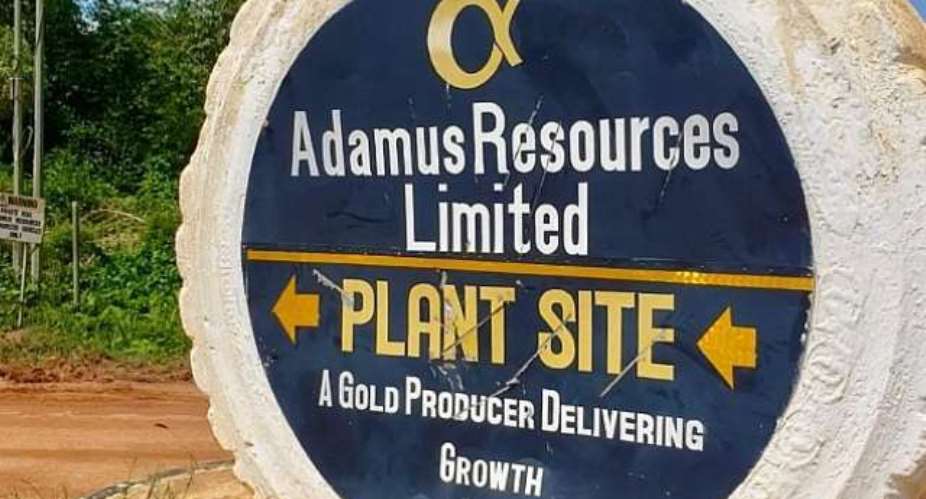
The Ministerial Review Committee set up to examine the revocation of Adamus Resources Limited’s mining leases has uncovered significant financial, regulatory and reporting discrepancies, including more than GH¢205 million in outstanding statutory obligations owed to the state.
According to the Committee’s findings, Adamus Resources was in arrears of GH¢86.78 million in royalties payable to the Minerals Income Investment Fund (MIIF) dating back to 2020.
The company also had GH¢119.04 million in tax arrears owed to the Ghana Revenue Authority (GRA) from 2023, as well as US$2.56 million in annual payments due to the Minerals Commission.
The outstanding obligations amount to approximately GH¢205.83 million, excluding the US$2.56 million owed to the Minerals Commission.
The Committee said the figures represented substantial revenue that should have accrued to the state from the company’s exploitation of Ghana’s mineral resources.
Millions transferred to related parties
The Committee’s review also raised questions about significant financial transfers made by Adamus Resources to related parties while statutory obligations remained outstanding.
According to the report, Adamus transferred more than US$224.61 million to related parties between 2020 and 2024.
Of that amount, approximately US$123.14 million was transferred to Segala Mining Corporation SA, Semico1 and Semico 2 in Mali.
The Committee said the transfers weakened the explanation that the company’s failure to meet its statutory obligations was solely the result of cash-flow difficulties or temporary financial constraints.
It noted that substantial amounts were transferred within the corporate group while payments due to the Ghanaian state remained outstanding.
Questions over gold production and shipment records
The Committee also identified discrepancies in the quantities of gold reported by Adamus Resources to different state institutions.
It said the company failed to produce its statutory Gold Production Book, compelling the Committee to rely on Form 16A monthly returns and royalty returns submitted to the GRA.
The records reviewed by the Committee showed significant differences in reported gold volumes.
For the period 2020 to January-March 2026, the GRA records indicated 72,194.94 ounces of gold, while the Minerals Commission records showed 71,553 ounces.
Adamus Resources’ own shipment records, however, reportedly showed 74,375.14 ounces.
The Committee identified additional variances between the records, including one estimated at approximately US$12.02 million and another at about US$21.30 million.
It said the discrepancies were significant because the volume of gold produced and exported directly affects the royalties and taxes payable to the state.
The Committee subsequently described some of the records as “suspicious” and concluded that they had been prepared with the purpose of evading statutory liabilities.
The findings raise questions about whether the discrepancies could have resulted in the under-declaration of gold production and exports, although any criminal liability arising from the findings would require determination through the appropriate investigative and legal processes.
The Committee also questioned why the Gold Production Book was not made available to it, noting that the document could have provided an independent basis for verifying the actual volume of gold produced and shipped by the company.
More than US$1 billion in gold
Records from the GRA further indicate that Adamus Resources produced approximately 8.8 tonnes of gold between 2020 and January-March 2026, with the output valued at more than US$1 billion.
The Committee’s findings indicate that, under the applicable arrangements, 10 per cent of the relevant proceeds was expected to be paid to MIIF.
However, the company reportedly defaulted on its obligations to MIIF while also accumulating tax arrears with the GRA.
The Committee’s findings have therefore raised broader questions about the extent to which Ghana benefited financially from the gold extracted and exported by Adamus Resources during the period under review.
Outstanding debts and community concerns
The Committee also identified other outstanding debts owed by Adamus Resources, including obligations to the Ghana Oil Company (GOIL) and the Ghana Grid Company (GRIDCo).
It indicated that further details of some of the outstanding debts would be released in due course.
The Eastern Nzema Traditional Area also raised concerns over an alleged US$2.5 million outstanding balance from a US$10 million Community Development Fund.
The Traditional Council further alleged that mineral royalties due to the area had not been paid for eight years.
It also cited concerns about inadequate infrastructure, poor roads, flooding and challenges associated with the Salman Resettlement Project.
Questions over environmental permits
The Committee’s review also brought into focus the timing of environmental permits issued to Adamus Resources by the Environmental Protection Agency (EPA).
Two permits covering the company’s mining and processing operations in the Ellembelle District were examined.
The first, EPA/EMP/313, covered operations at Salman for the period July 20, 2017 to July 19, 2020. However, the certificate was issued on December 19, 2024, more than four years after the stated validity period had expired.
A second permit, EPA/EMP/316, covering the NzemaGold Mining and Processing Operation, was stated to be valid from December 21, 2023 to December 20, 2026. The certificate was issued on December 16, 2024.
The timelines have raised questions about the regulatory processes surrounding the company’s environmental authorisations and how operations were conducted during periods when the relevant documentation had not formally been issued.
The Committee’s findings suggest that the circumstances surrounding the issuance and renewal of the permits warrant further scrutiny.
Committee backs revocation
The Ministerial Review Committee was established by the Minister for Lands and Natural Resources, Emmanuel Armah-Kofi Buah, after Adamus Resources petitioned against the revocation of its Nkroful, Akango and Salman mining leases.
Following its review, the Committee concluded that the breaches identified against the company were serious and fundamental to the integrity of its mining leases.
It consequently recommended that the revocation be upheld and called for further regulatory, environmental and financial enforcement measures, including a comprehensive audit of Adamus Resources’ activities.
The findings have intensified scrutiny of the company’s operations and raised broader questions about revenue assurance, regulatory enforcement and Ghana’s ability to obtain the full economic value of its mineral resources.
The Committee’s report suggests that the Adamus case goes beyond a dispute over the revocation of mining leases, touching on outstanding taxes and royalties, related-party transactions, discrepancies in gold production records, environmental permitting and obligations to host communities.
At the centre of the matter is the question of whether Ghana received the full financial and developmental benefits due from the extraction of its gold.
While arguments have been made that Adamus Resources is Ghanaian-owned and should therefore retain its mining leases, Ghanaian ownership does not, in itself, exempt a company from complying with applicable tax, mining, environmental and reporting requirements.
The Committee’s findings therefore place renewed focus on the need for stronger monitoring of mining companies, accurate reporting of mineral production and exports, timely payment of statutory obligations and effective enforcement of Ghana’s mining and environmental laws.

 Adamus fails to pay millions of Ghana Cedis in taxes and royalties — Ministerial...
 Police gun down three suspects over robbery of GH¢430,000 at Buipe cattle market
 Wontumi chairmanship bid: 'Nothing stops anybody from buying NPP form but eligib...
 CLOGSAG Executive Secretary Dr Isaac Bampoe Addo dies
 Controller warns public institutions against opening unapproved bank accounts
 Supreme Court explains dismissal of Oppong Nkrumah’s bid to halt legal vacation ...
 Muntaka orders police to crack down on vigilante groups, unauthorised guards
 Wontumi campaign team picks NPP National Chairman nomination forms despite 20-ye...
 Water supplier jailed six months for 'If you don’t kill me, I will kill you in t...
 62 Ghanaians Dead, 15 Missing: Ablakwa Sounds Alarm Over Illegal Recruitment Int...

