




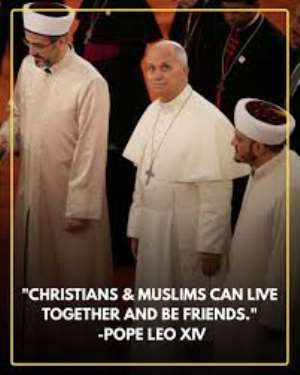
One of the things that continues to fascinate me about the relationship between Christianity and Islam is how much they share, yet how little ordinary believers sometimes know about that shared heritage. Muslims and Christians often speak as though they belong to completely separate religious worlds. Yet open the Qur’an and one encounters many of the familiar figures of the Bible: Adam, Noah, Abraham, Isaac, Jacob, Joseph, Moses, David, Solomon, Jonah, John the Baptist and Jesus, among others. The Qur’an does not treat these figures as strangers. They are presented as part of a long chain of divine guidance. Indeed, Muslims are required to believe in all the prophets of God. The Qur’an says: “We make no distinction between any of His messengers.” … Qur’an 2:285. This is one of the fundamental differences between the Islamic understanding of revelation and the way many Christians understand Islam. Muslims do not regard Jesus as an impostor or reject Moses, Abraham or the prophets of Israel. On the contrary, they regard them as genuine messengers of God. And Jesus occupies a particularly important position in Islam.
Jesus in the Qur’an
The Qur’an calls Jesus Isa ibn Maryam, Jesus, son of Mary. He is described as the Messiah and a messenger of God. His miraculous birth is affirmed, and several miracles are attributed to him by God's permission. Muslims also believe in the virgin birth of Jesus. But perhaps even more striking is the Qur’an's treatment of Mary. There is an entire chapter of the Qur’an named Maryam (Mary) --- Surah 19. Mary is also discussed extensively in Surah 3, Al Imran. The Qur’an presents her as a woman specially chosen and purified by God. This should fascinate anyone interested in comparative religion.
A Christian who reads the Qur’an carefully may be surprised by how much familiar biblical material appears there. A Muslim who reads the Bible carefully may likewise discover how deeply Islam is connected to the prophetic tradition represented in the Hebrew Bible and the New Testament. Perhaps, therefore, we should be reading these scriptures more carefully instead of simply arguing about them.
Was Jesus a Christian?
Here we need to distinguish between Jesus himself and the religion that historically developed around his followers. Jesus was a Jew. He lived, taught and worshipped within the Jewish religious environment of first-century Palestine. He did not walk around calling himself a “Christian.” The term Christian emerged among his followers later. The New Testament itself says that the disciples were first called Christians at Antioch (Acts 11:26).
So there is a legitimate historical question here: what did Jesus himself call his religious mission, and how did the movement that emerged after him develop into what we now call Christianity? Islam answers that question differently from Christianity. Islam regards Jesus as one of a long succession of prophets and messengers who called humanity to submit to the One God. This brings us to an important question: What does “Muslim” actually mean?
What Does Muslim Mean?
The Arabic word Muslim is related to the concept of submitting oneself to God. In the theological sense, therefore, a Muslim is one who submits to Allah --- the One God. This is why Muslims can describe Abraham, Noah, Moses and the other prophets as people who submitted themselves to God. The Qur’an itself uses language of this kind in describing Abraham's submission to God. But there is an important distinction. Historically, Islam as the name of the religious community associated with the Prophet Muhammad emerged in seventh-century Arabia. It would therefore be misleading to suggest that Noah or Abraham historically belonged to a seventh-century religious institution.
The Islamic theological claim is different: the essential message of the prophets was submission to the One God, even though the communities and legal systems associated with them differed across history. That distinction is important if Muslims want Christians and others to take the argument seriously.
The Bible and the Qur’an: A Conversation across Centuries
The Qur’an repeatedly refers to earlier scriptures and prophets. It speaks of the Tawrat (Torah), the Injil (Gospel), the Psalms and other revelations. It presents itself as confirming aspects of the revelations that preceded it. This creates an extraordinary opportunity for comparative study.
Take Joseph, for example. The biblical story of Joseph appears in Genesis, while the Qur’an devotes an entire chapter --- Surah 12, Yusuf --- to Joseph. Moses (Musa, a.s) appears repeatedly throughout the Qur’an. Abraham (Ibrahim, a.s) is central to both traditions. Noah (Nuhu, a.s) appears in both. David (Dawud, a.s) and Solomon (Suleyman, a.s) appear in both. Jesus (Isa, a.s) and Mary (Mariam, a.s) appear in both. The similarities are sometimes striking, although there are also important differences. And those differences are precisely what make comparative reading worthwhile.
What About Muhammad in the Bible?
This is where the conversation becomes more controversial. Many Muslim scholars argue that the coming of Prophet Muhammad is anticipated in the Bible. Among the passages frequently discussed are Deuteronomy 18:15–18, Isaiah 42 and Song of Solomon 5:16. Muslim interpreters have examined the original Hebrew and argued that these passages contain indications of Muhammad. Christian and Jewish scholars generally reject these interpretations and understand the passages differently. This disagreement should not be hidden.
If we genuinely want to pursue truth, we should put the competing interpretations on the table and examine them. For example, Deuteronomy speaks of a prophet who would arise “from among their brothers.” Muslim scholars have historically argued that this could point to the descendants of Ishmael and therefore to Muhammad. Christian and Jewish interpreters generally understand the passage within the history of Israel and interpret it differently. The important question is not whether one side can shout louder. The question is: What does the original text actually say?
Was the Bible Simply “Adulterated”?
This is another area where Muslims and Christians need to be precise. We need to distinguish between textual transmission, translation, interpretation and theological doctrine. The Bible is not one single book written in one language at one time. The Hebrew Bible was written primarily in Hebrew, with portions in Aramaic. The New Testament was written in Koine Greek. Ancient biblical manuscripts exist in Hebrew, Greek, Aramaic, Latin and other languages. There are textual variations among ancient manuscripts. Biblical scholars have spent centuries studying these differences through textual criticism.
That does not automatically establish the sweeping claim that everything Christians read today was deliberately fabricated. Nor does it mean that Muslims must accept Christian theological conclusions. A more intellectually defensible position is that the history of the biblical text is complex and deserves to be studied from the earliest available manuscripts and languages rather than simply accepted or dismissed through slogans. The same intellectual honesty should apply to the Qur’an and Islamic tradition.
Can a King Rewrite Scripture to Favour the Powerful?
There is another issue worth considering. Throughout human history, political power has influenced religion, religious institutions and the interpretation of sacred texts. Kings, emperors, governments and religious authorities have sometimes sought to use religion to legitimize political authority. But we should be careful not to turn that historical observation into an unsupported claim that particular biblical passages were fabricated simply because they appear favourable to rulers. That requires evidence. The better question is: How have political authorities, religious institutions and ordinary believers interpreted scripture over time? That is a question historians, theologians, sociologists and anthropologists can investigate. And the findings can sometimes be uncomfortable for everyone.
Christians Should Read the Qur’an --- and Muslims Should Read the Bible
I would encourage Christians who have never seriously read the Qur’an to do so. Not because they must become Muslims. Not because they should abandon Christianity. But because an intelligent Christian should know what Islam actually teaches about Jesus, Mary, Moses, Abraham and revelation before dismissing Islam.
The same challenge applies to Muslims. A Muslim who has never seriously read the Bible is not well placed to criticize Christianity. We should read the Bible. We should read the Qur’an. We should examine their historical contexts. We should study the original languages where possible. We should consult Jewish, Christian and Muslim scholarship rather than relying exclusively on the arguments of our own religious tradition. And, above all, we should distinguish between what the texts actually say and what later communities have claimed that they say.
We Are Not Learning Enough
Perhaps this is our real problem. Christians and Muslims frequently debate each other without knowing enough about their own scriptures, let alone the scriptures of the other. A Christian may have strong opinions about the Qur’an without ever having read Surah Maryam. A Muslim may attack the Bible without having read Genesis, Exodus, Isaiah or the Gospels carefully. We inherit conclusions from our parents, religious teachers and communities and sometimes defend those conclusions passionately without investigating the evidence ourselves. That is not the pursuit of knowledge. Religious conviction does not require intellectual laziness. Faith and inquiry can coexist.
The Common Ground Is Too Important to Ignore
There are profound theological differences between Christianity and Islam. Christians generally believe that Jesus is the Son of God, crucified and resurrected. Muslims reject the Christian understanding of Jesus' divinity and crucifixion and regard him as a mighty prophet and Messiah. Those differences are real. They should not be concealed. But neither should they prevent us from recognizing the enormous common ground. Both traditions affirm one God. Both honour Abraham. Both honour Moses. Both honour David and Solomon. Both honour John the Baptist. Both honour Jesus. Both honour Mary. Both believe in revelation, prophecy, angels, divine judgement and accountability before God. And both ultimately challenge human beings to live morally and responsibly before their Creator.
My Thoughts: Let Us Read Before We Argue
My appeal, therefore, is simple. Let us stop shouting at one another long enough to read. Let Christians read the Qur’an. Let Muslims read the Bible. Let both read critically and honestly. Let those interested in the question of Muhammad's place in biblical prophecy examine the relevant Hebrew passages rather than relying on claims made in sermons or social media. Let us examine the earliest manuscripts. Let us consult scholars who disagree with us. And let us be willing to say, when the evidence demands it: I was wrong. That is not weakness. It is intellectual honesty.
The Qur’an repeatedly encourages human beings to think, reflect and use their understanding. The Bible likewise contains a strong tradition of seeking wisdom and knowledge. Perhaps, then, Muslims and Christians have more in common than they realize, not only in the prophets they honour, but also in the obligation to seek truth.
The real tragedy is not that Christians and Muslims disagree. The tragedy is that we often disagree about books we have never seriously read. The Bible and the Qur’an deserve better from us. And so does the truth.
FUSEINI ABDULAI BRAIMAH
+233208282575 / +233550558008
[email protected]

 Over Half of African Youth Eye Emigration — Advocates Urge Creation of Opportuni...
 Bono Police Arrest 36‑Year‑Old in GH¢1.1M Fake Gold Deal; Hunt for Three Others ...
 South Korea ship to test alternative Arctic route as Mideast conflict disrupts s...
 Russian strikes in Ukraine kill at least two people, injure several others
 It’s unlawful for landlords to increase rent charges without approval from us — ...
 Rent Control Boss directs landlords, hostel operators to issue rent cards
 Turkey seeks international arrest warrant against Israel's Netanyahu over Gaza f...
 “What type of scholarship pays only 25%; If you can’t spell it, don’t write it” ...
 Government gives Adamus Resources 12-month reprieve to revive mining operations
 ’We must unite to win 2028 elections’ - Bawumia tells new NPP executives

