





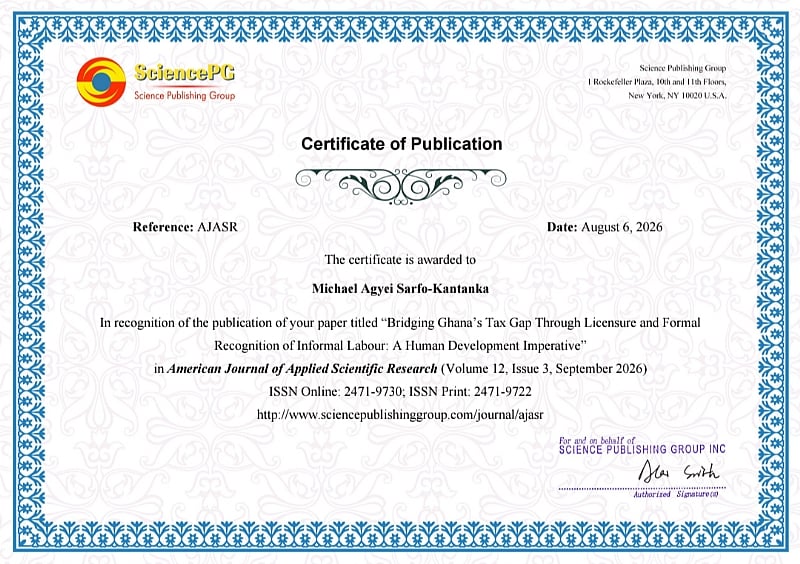
A significant recognition has been bestowed upon a research piece that examines one of Ghana's most persistent development challenges; the fiscal imbalance between the formal and informal sectors. The article, titled "Bridging Ghana's Tax Gap Through Licensure and Formal Recognition of Informal Labour: A Human Development Imperative," by Michael A. Sarfo-Kantanka, also known in public political circles as Hon Abilolo Billionaire, has been successfully published in the American Journal of Applied Scientific Research following a rigorous international peer review process.
The journey to publication began with a nomination that followed a request by the journal for the original manuscript, upon seeing it online. An unexpected email arrived offering the human development enthusiast, a rare opportunity for free publication. This according to the mail, was in recognition of the manuscript's exceptional quality as a policy research material. The editors had reviewed the work and determined it met their highest standards. After completing the required revisions, the article was accepted and has now been assigned a DOI (10.11648/j.ajasr.20261203.15) and made available to readers worldwide.
A certificate of publication has been awarded to the author, Mr. Michael A. Sarfo-Kantanka, a Human Development Practitioner with specialty in Monitoring and Evaluation of Development Outcomes. Even more than academic recognition, this credential represents a validation of a framework that has already begun to reshape how Ghana's informal sector interacts, grows, and thrives in The Artisans Hub Ghana Project, a revolutionary project by Six Grace LTD, a company owned by the author.
For a developing country, the published article tackles a paradox that has long troubled Ghana's economic development. A relatively small formal sector carries a disproportionately heavy tax burden, while the vast informal economy; which employs the majority of Ghana's workforce remains largely untaxed. Successive governments have struggled to broaden the tax base, and the International Monetary Fund has repeatedly identified inadequate domestic revenue mobilization as a critical weakness in Ghana's economic framework.
The research offers a distinctive perspective. Instead of advocating for enforcement and punitive measures, which have repeatedly failed across West Africa, the author proposes a voluntary licensure framework that transforms formalization into a value proposition for workers. Under this system, professional certification would be linked to concrete benefits: legal recognition, access to financial credit, and inclusion in social security and health insurance schemes.
The evidence is compelling. By analyzing both successful and failed efforts in neighbouring West African countries, the research demonstrates that building trust and offering immediate rewards are consistently more effective than coercion. The proposed framework is not theoretical idealism, but one grounded in observable outcomes and practical realities.
The article also outlines a phased implementation roadmap that leverages digital identification and existing trade associations to foster inclusive economic growth and a fairer tax base. This approach recognizes that lasting change cannot be imposed from above; it must be embraced by those it affects.
For a human development practitioner, Mr Sarfo-Kantanka did not leave the research confined to academic journals. It has since become the philosophical foundation for The Artisans Hub Ghana Project by Six Grace LTD, a practical intervention that tests the voluntary formalization framework in real-world conditions.
The Artisans Hub Web App serves as a digital platform where skilled artisans including electricians, plumbers, painters, carpenters, tilers, and welders, can create professional profiles, showcase their work, manage service requests, and build reputations through customer reviews. The platform is more than a marketplace; it is a demonstration that formalization can be a choice workers make because it serves their interests.
By participating in the platform, artisans gain visibility and access to economic opportunities without being subjected to punitive measures. They are voluntarily formalizing their businesses because it helps them thrive, not because of compulsion or coercion. This aligns with broader national efforts to digitize and formalize Ghana's micro, small, and medium enterprises, including initiatives under the United Nations Joint SDG Digital Transformation Programme involving UNCDF, UNDP, and UNCTAD.
The publication of this research in an international journal, with fees waived based on the quality of policy research, represents a significant validation of the ideas underpinning The Artisans Hub Ghana Project. The certificate of publication signals that the international academic community recognizes the value of a human development approach and proposals of same, to fiscal policy; one that centres the needs and aspirations of workers rather than viewing them solely as revenue sources.
The author's professional background as a Human Development Practitioner with specialty in Monitoring and Evaluation of Development Outcomes brings particular credibility to this work. The lens through which the research was conducted; emphasizing measurable outcomes, participatory approaches, and evidence-based advocacy, ensures that the recommendations are grounded in practical realities rather than abstract theory.
This monitoring and evaluation perspective demands accountability. Any framework for formalization must demonstrate that it improves lives, not just revenue collection. The research article makes this case explicitly, arguing that immediate rewards and trust-building are more effective than coercive enforcement.
The significance of this work extends well beyond Ghana's borders. The challenges addressed like fiscal imbalance, informal sector exclusion, and the need for trust in governance systems, are shared by many developing economies across Africa and beyond.
The Artisans Hub model, rooted in voluntary participation and tangible benefits, offers a template that could be adapted in other contexts. It suggests that formalization does not have to be a zero-sum game in which workers lose autonomy in exchange for state recognition. Instead, it can be a pathway to empowerment, professional development, and economic inclusion.
The research also contributes to ongoing policy conversations in Ghana. The Ghana Revenue Authority has been engaging stakeholders to gather recommendations for reshaping the tax system, with a focus on creating frameworks that reflect grassroots input and are tailored to the country's unique economic environment. The voluntary licensure framework offers a practical alternative to enforcement-heavy approaches that have historically yielded limited results.
To the author and his exemplary interest in human development, this publication marks a significant milestone, but it represents only the beginning. A more potent story is already being developed; one that will share the story of what has been built from the research. The Artisans Hub Ghana Project is evidence that policy ideas, when grounded in rigorous analysis and infused with a genuine commitment to human development, can move from academic journals into communities where they make a tangible difference.
Artisans who once operated in the shadows now have a platform to showcase their skills. Customers seeking reliable services now have a trusted way to find them. And the informal sector long treated as some albatross that Ghanaian politicians have struggled to unravel, is being reimagined as a space of opportunity.
This is human development in practice. Not abstract theory, but practical intervention and an enablement! A shift from the usual bureaucratic top-down imposition to voluntary participation driven by shared benefits.
Michael A. Sarfo-Kantanka is a Human Development Practitioner with Specialty in Monitoring and Evaluation of Development Outcomes. His research focuses on Health Policy, Community Development, fiscal policy, informal sector formalization, and the intersection of digital innovation and human development.
Thank you for reading!
[email protected]

 Ghana joins International Big Cat Alliance to strengthen wildlife conservation
 FBI says nearly $10m in losses identified in Ghana scam-centre crackdown
 PAC grills GHS over transport officer who allegedly sold seven state vehicles wi...
 Pentecost Church elder was arrested over GH¢200,000 fraud case, not kidnapped – ...
 Banning preaching in vehicles will not succeed, we will even preach at the back ...
 Banks threaten to suspend new loans to public sector workers over Controller rep...
 PAC summons Takoradi Hospital doctor over GH¢341,229 salary paid during study le...
 FBI dismantles alleged scam operation in Ghana; 130 suspects arrest and over 300...
 PABF appoints Dr Oscar Sam Ugoh as Executive Vice President for West Africa
 Community watch committee arrest three illegal miners at Jema


