




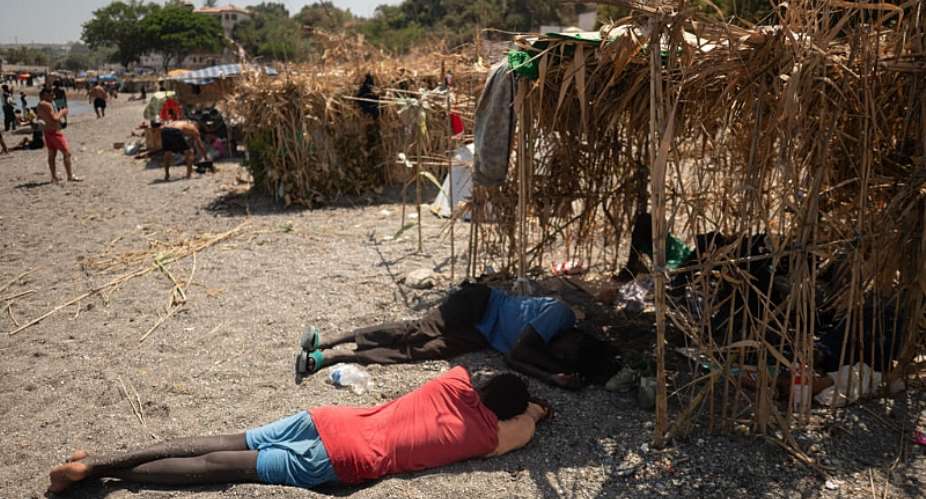
From a distance, the reed huts lined up on a beach in Ceuta, a Spanish enclave in North Africa, appear part of an idyllic summer vacation scene. Sounds of laughter occasionally rise above the background swish of the sea and the smoke rising from tents on an August weekend could well be coming from beach barbecues.
But upon approach, a completely different scene unfolds. Tattered clothes flap in the sea breeze while their owners, barefoot and exhausted from long journeys, hang around the beach.
No one here is on a seaside vacation.
They are part of an estimated 2,000 to 5,000 migrants who remain after a late-July surge that saw more than 70,000 people cross the border between Morocco and Ceuta. The vast majority voluntarily chose to return home in the following days.
For those who opted to stay, it's been more than two weeks of milling around a strip of coastline while awaiting a legal decision. They all have their own stories, their own hopes, their own dreams. But for now, they've all ended up on the same beach: El Trampolin. Migrants lie on the sand of El Trampolín beach in Ceuta on August 15, 2026.
One of the most striking things about this gathering on the beach is the mix of languages and nationalities. Along with migrants from North Africa and sub-Saharan Africa, there are also Bangladeshis, Iraqis, Indians, Palestinians, Syrians, and Yemenis.
The tents here appear to be organised by nationality or along linguistic lines. Built from reeds, scraps of fabric and other available materials, they hold almost nothing under their shaky roofs: a few personal belongings and pieces of cardboard used for sleeping.
Clothes are washed in the sea, and essential resources, such as water and food, are shared. All around them, police cars are parked on-site, alert to any security incidents.
One dream: Europe
Kamara, a 35-year-old Nigerian, has just finished preparing his first meal after nearly 24 hours without eating.
By begging and with the help of a few benefactors, Kamara manages to either gather a little food or a few euros each day, which he uses to buy something to stave off his hunger. Migrants from sub-Saharan Africa prepare a meal on El Trampoline beach in Ceuta, August 15, 2026.
“I'm tired of this whole situation, but I don't see returning to Morocco as a viable option. I'll stay here until they decide our fate,” he says.
Like most of the migrants from sub-Saharan Africa on the beach, Kamara spent years in Morocco before traveling to Ceuta in late July. It was a long journey that brought him to a European beach in North Africa – but it has not yet led to the life of his dreams. While Ceuta is part of EU territory, it is outside the bloc's Schengen open-travel zone.
Mamadou faces a similar situation. A Senegalese national, he made the same journey, enduring the same hardships. He has filed an asylum claim and calls on the Spanish authorities to fulfill their responsibilities.
“I'm 35 now, but I feel like my life is going up in smoke. I see people my age who have jobs, travel freely, and live normal lives, while I'm living in the midst of suffering that grows by the day,” he says.
Despite this, he still has a dream. He says he wants to reach France, where he has a brother who tells him about Paris, its lights and its job opportunities.
“The problem now isn't just reaching Europe,” he says, “but the uncertainty about what comes next: How long will I stay here? Will my asylum application be accepted? Will I be able to continue on my journey or will I be forced to return to Morocco? I haven't the slightest idea,” he says.
'We're still suffering'
Abdelmajid, a young Yemeni national, swam nearly eight kilometres to reach Ceuta. He was driven by a single dream: Europe. Arriving in the Spanish enclave a day before the massive wave of migrants arrived, Abdelmajid discovered a very different reality, far from the one he had imagined.
“When the events of July 30 and 31 began, the migrants were removed from the city's shelter, and I found myself outside, homeless,” he explains.
Read more Around 60,000 migrants cross into Spain's Ceuta exclave from Morocco
Since then, his living conditions have been difficult. But Abdelmajid clings to the hope that his asylum case will be reviewed and that he will finally gain legal status in Europe.
“Yemen is at war, and the most basic conditions for a dignified life are being violated: no water, no electricity, no security or safety,” he says. Abdelmajid (centre) and his fellow Yemeni migrants share a makeshift shelter on El Trampolin beach in Ceuta, August 15, 2026.
Not far from him, Tarek and Ramadan, two Egyptians, recount a long journey across North Africa: From Egypt to Libya, then Tunisia and Algeria, before finally arriving in Morocco.
The journey, Tarek recounts, was arduous and at times horrific. “We walk long distances before getting close to the border fences, then turn back, only to try again,” he explains. “In Libya, we were exposed to violence, gunfire, and situations that left deep scars on us, and we're still suffering today.”
Ramadan says a significant number of Egyptians have arrived in Ceuta. He estimates the number at around 55 people. “We're clinging to the hope of regularising our status and continuing on our journey to Europe,” he says.
While the vast majority of migrants arriving in Ceuta are men, there are also several young women who risked their lives to get here. Among them is Sabah, an 18-year-old Moroccan woman, who stands in a long line to receive her only daily meal, distributed by the Red Cross. Spanish Red Cross paramedics treat injured migrants on El Trampolín beach in Ceuta, August 15, 2026.
Sabah was relatively lucky, as she managed to secure a spot inside the temporary migrant shelter in Ceuta. But she's anxious about her fate. “I still don't know what will become of me. Being cut off from my family only adds to my fear and sadness,” she explains.
'What do they plan to do with us?'
Sabri, a young Tunisian man, arrived in Morocco about eight months ago. When he made it into Ceuta in late July, he hoped the city would be his gateway to Europe. But his dreams clashed with reality on this beach and he is now seeking a clear answer from the authorities. “What do they plan to do with us?” he asks, urgently. “For me, it means everything. Are they going to deport us? Or are they going to transfer us to other centres within Spain?” he wonders. Moroccan migrants wash their tent on El Trampolin beach, Ceuta, on August 15, 2026.
Rachid, a 45-year-old Algerian national, arrived in Ceuta on July 27. Since that day, he has survived on a single meal a day and life has been exceptionally difficult. He even tried to return to Morocco, but was denied entry because he does not hold Moroccan citizenship.
“I came looking for a more organised, more advanced, and freer society, but I found myself facing conditions that have led me to consider returning to Algeria,” he explains. “I advise my Moroccan brothers who can return to their country to do so, rather than remaining in these conditions.”
An exceptional situation
Many migrants have crossed multiple borders to get here, but the hurdles they now face do not appear on maps. These include legal procedures, awaiting decisions from authorities, a lack of housing, hunger and the fear of the unknown.
Mohamed Sano, a lawyer specialising in migration and asylum issues in Madrid, believes the living conditions of migrants in Ceuta require “urgent intervention”, noting that Spanish authorities – both national and local – are facing an exceptional situation “for which, so far, there do not appear to be any immediate solutions to manage it”.
While everyone has the right to seek asylum, Sano explains that filing an asylum application does not necessarily mean it will be granted. The decision rests with immigration authorities and the relevant agencies after each case has been reviewed. War or conflict in countries of origin can be a factor in the review process, but they do not automatically guarantee approval.
Bassim Salem, a specialist in migration and asylum issues, explains that asylum applications involve medical examinations and security reviews (identity and background checks) as well as an assessment to determine whether a person fleeing their country of origin is entitled to protection.
For people coming from countries that the EU classifies as “safe countries of origin”, their chances of having their applications approved may be limited. If their applications are denied, they may be subject to return procedures to their home countries or to a third country, in accordance with existing agreements.
The latest migration crisis in Ceuta resulted in 141 deaths, according to NGOs, many of them from drowning. For those who survived and remain in the enclave, “the situation remains extremely difficult”, explains Ramses Mohamed Azoumik, an activist with the Elin association, which has been addressing the situation of migrants and refugees in Ceuta for 21 years. In his view, “the Spanish authorities, as well as the authorities in Ceuta, have so far failed to provide a solution that guarantees these people the minimum standards for a dignified reception”.
The activist demands, above all, that “these people's rights and dignity be respected, that they have access to legal procedures, and that they receive water, food, and a suitable place to stay”.
Europe is not far, geographically, from El Trampolin beach. But for those who have made it to this sandy strip, the life they dreamed of is still very far away.
This article is a translation of the original in Arabic.


 Afenyo-Markin insists National Cathedral should be completed
 ‘GoldBod’s structure encouraging galamsey, buys whatever aggregators bring’ – Af...
 Mahama holds discussions with India's External Affairs Minister
 Afenyo-Markin leads NPP MPs to Christian Council over US$1.7 billion GoldBod los...
 Government moves to restore chiefs’ powers to summon subjects
 I’ll sue NPP if the constitutional amendment at delegates conference goes throug...
 NPP executives are like lions being led by a goat – Odike
 Two final-year students killed by speeding tipper truck in Ekumfi
 The Abanga twins: Two brothers, two parties, one political family
 Afenyo-Markin cautions NPP members against working secretly to undermine party


