




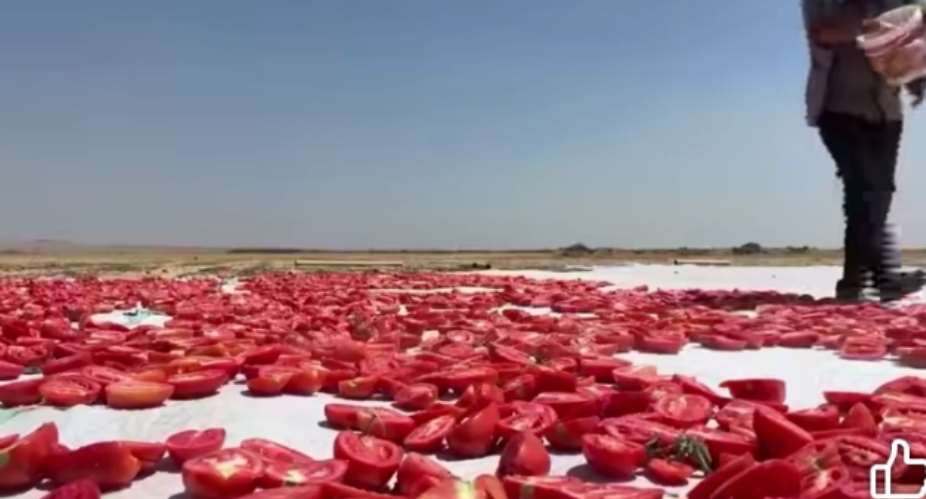
Every summer, in the scorching foothills of Karacadağ near Diyarbakır in southeastern Türkiye, hundreds of thousands of tomatoes are laid out under a punishing sun to dry before being shipped abroad, destined to become the tangy sauce spread across pizzas and pastas from Rome to New York.
A harvest that begins in April and peaks in the heat of summer
The process starts months before the drying fields fill with red. In April, farmers in the Karacadağ area plant seedlings across hundreds of decares of land, then spend the following weeks fertilizing, hoeing, and irrigating the crop before the tomatoes are ready for harvest. Once picked by the ton, the tomatoes are hauled to open drying grounds where seasonal workers cut them in half by hand, lay them out on white sheeting, and salt them so the flesh keeps its color and firms up as it dries.
The work is deliberately timed to the hottest weeks of the year. Temperatures in the region regularly climb past 40°C and, according to one Diyarbakır businessman overseeing production, sometimes reach 45–48°C during the drying season. Workers begin their shifts as early as five in the morning and continue until early afternoon to avoid the worst of the midday sun, describing the labour as exhausting but necessary the heat itself is what allows the tomatoes to dry properly.
Seasonal labour and a four-month season
Much of the workforce is seasonal, drawn from across Diyarbakır and neighbouring districts such as Siverek, with entire families sometimes relocating to the growing areas for the season. One worker, who has returned to the fields every summer for roughly a decade, explained that the tomatoes are salted to stop them from blackening and to help them reach the right texture, and that after salting the fruit takes about a week to dry fully before being loaded and shipped onward. Farmers describe the full cycle from planting in April through harvesting, slicing, salting, and drying as a demanding four-month undertaking that defines their yearly income.
From Karacadağ's fields to European and American kitchens
Once dried, the tomatoes are not sold directly to consumers. They are transported to processing facilities in Türkiye's western provinces, where they are cleaned, sorted, and packaged before being exported, chiefly to the United States, Italy, and the Netherlands. Producers describe the product as central to some of the world's best-known pizza and pasta sauces, with one grower noting simply that dried tomatoes are what give many popular pizzas their flavor.
This regional trade in Diyarbakır mirrors a much larger national industry. Türkiye is among the world's leading producers of sun-dried tomatoes, and in the first half of 2026 alone the country earned close to $61 million from dried tomato exports to 91 countries, with the United States as the top buyer at just over $16 million, followed by Italy and the United Kingdom. Industry figures in Türkiye's western provinces, where much of the processing takes place, say the sector is targeting $100 million in exports for the year, with dried tomatoes increasingly finding their way into American and Brazilian dishes such as hamburgers, alongside their traditional use in Italian pasta and sauce.
Hard labour behind a global delicacy
What reaches supermarket shelves in Milan or Amsterdam as a jarred delicacy begins as physically demanding work in one of Türkiye's hottest agricultural regions. Workers in Karacadağ describe the toll the heat takes on the body, even as they acknowledge that the same heat is indispensable to the product itself the tomatoes simply will not dry properly without it. For many seasonal laborers and smallholder farmers in Diyarbakır, this brief, brutal window each summer remains one of their most important sources of annual income, linking a rural, sun-baked hillside in southeastern Türkiye directly to dinner tables across Europe and North America.
Why Ghana should look at Türkiye's dried tomato model
Diyarbakır's export success offers Ghana a lesson worth studying, and even a practical opening: importing dried tomatoes, rather than relying so heavily on fresh tomatoes and imported paste, could ease some of the pressure on Ghana's own tomato economy while it rebuilds domestic processing capacity.
A hedge against Ghana's lean season. Ghana's tightest supply window falls in the first half of the year, when domestic irrigated production in the north has ended and rain-fed supply from the forest zone has not yet reached the market precisely the gap that fresh Burkinabè tomatoes have filled for decades. Dried tomato, unlike fresh produce, does not spoil during shipping delays or market gluts, giving traders and processors a shelf-stable option to bridge that seasonal "tough time" without depending on a single, insecure land corridor.
Insulation from the Burkina Faso security risk. The February 2026 attack on Ghanaian traders in Titao, and the export ban that followed, exposed how a single security incident on one trade route can shut down supply overnight. A dried tomato import stream sourced from diversified markets such as Türkiye, which already exports to 91 countries, would give Ghana's food system a buffer that does not run through the same volatile corridor.
Lower logistics losses than fresh imports. Fresh tomato imports are vulnerable to Ghana's own post-harvest and transport losses, estimated at 20–50 percent across the value chain. Dried tomato's low moisture content (14–20 percent in well-processed batches) means far less spoilage in transit and storage, stretching the value of every cedi spent on imports.
A cheaper, more flexible input for local processors. Ghanaian food manufacturers currently rely on imported bulk paste for roughly 93 percent of processed tomato products [8]. Dried tomato can be rehydrated into paste, sauces, or powder domestically, letting local factories diversify their raw-material sourcing and reduce exposure to price swings in any one paste-exporting market.
A template, not just a supplier relationship. Beyond the import itself, Türkiye's Karacadağ model organized seasonal labour, salting and sun-drying, then centralized processing before export is close to the low-cost solar-drying approach Ghanaian researchers have already piloted domestically. Importing finished dried tomato in the short term does not preclude Ghana building its own version of this value chain for the long term, using dried tomato imports to stabilize the market while local drying capacity scales up.
Handled carefully, dried tomato imports would not be a substitute for developing Ghana's own tomato sector that remains the more durable fix but they could serve as a practical stopgap that reduces the country's exposure to fresh-tomato shocks while the harder work of building domestic processing and storage capacity continues.
Mustapha Bature Sallama.
Medical/ Science Communicator,
Private Investigator, Criminal investigation and Intelligence Analysis.
International Conflict Management and Peace Building.USIP
[email protected]
+233-555-275-880
References
Mücadele Gazetesi, "Diyarbakır'ın güneşinde kuruyor: Karacadağ domatesi dünya pazarında." https://www.mucadelegazetesi.com.tr/diyarbakirin-gunesinde-kuruyor-karacadag-domatesi-dunya-pazarinda
Gazetevatan, "Diyarbakır'da kavurucu sıcakta zorlu hasat başladı! İtalya, ABD ve Hollanda'dan sipariş yağıyor." https://www.gazetevatan.com/galeri/diyarbakirda-kavurucu-sicakta-zorlu-hasat-basladi-italya-abd-ve-hollandadan-siparis-yagiyor-2397012
Amida Haber, "Diyarbakır'ın güneşinde kuruyan domatesler dünya pazarında." https://amidahaber.com/diyarbakir/diyarbakirin-gunesinde-kuruyan-domatesler-dunya-pazarinda-234633h
Yeni Şafak, "Kırmızı altın mesaisi: Diyarbakır'da kavurucu sıcakta zorlu hasat başladı." https://www.yenisafak.com/galeri/gundem/kirmizi-altin-mesaisi-diyarbakirda-kavurucu-sicakta-zorlu-hasat-basladi-italya-abd-ve-hollandadan-siparis-yagiyor-4847877
NTV Haber, "Sadece sıcakta oluyor. Diyarbakır'dan dünya sofralarına gönderiliyor." https://www.ntv.com.tr/yerel-haberler/galeri-sadece-sicakta-oluyor-diyarbakirdan-dunya-sofralarina-gonderiliyor-1737123
Kocatepe Gazetesi, "Diyarbakır Güneşinin Altında Kuruyor, ABD ve Avrupa'ya Gidiyor." https://www.kocatepegazetesi.com/diyarbakir-gunesinin-altinda-kuruyor-abd-ve-avrupa-ya-gidiyor/408681
Türkiye Today, "Türkiye generates $61M from dried tomato exports to 91 countries in 1st half of 2026." https://www.turkiyetoday.com/business/turkiye-generates-61m-from-dried-tomato-exports-to-91-countries-in-1st-half-of-2026-3224696
Bazaar Times, "Turkiye Earns $60.99 Million From Dried Tomato Exports in First Half of 2026, Targets $100 Million." https://bazaartimes.com/turkiye-earns-60-99-million-from-dried-tomato-exports-in-first-half-of-2026-targets-100-million/


 Two BOGISS watchmen accused of sexually abusing 14-year-old student as family de...
 Gabriel Agambila blasts Upper East Airport critics, says opposition reflects ‘st...
 ‘I don’t think we need a shoot-to-kill approach to solve galamsey’ — Sukparu
 GoldBod has plugged $5bn gold revenue leakage — Dr Steve Manteaw
 Bawumia can only be president of old students’ association, not Ghana — Solomon ...
 GES denies releasing 2026 SHS prospectus
 ‘You can attack our personality but post-regime accountability awaits you’ – Afe...
 'We will continue to spend more on soldiers to stay in forests to fight illegal ...
 Legal vacation: ‘Stop using media to challenge judicial decisions, inflame passi...
 Education Minister appeals to striking university administrators for a one-month...

