




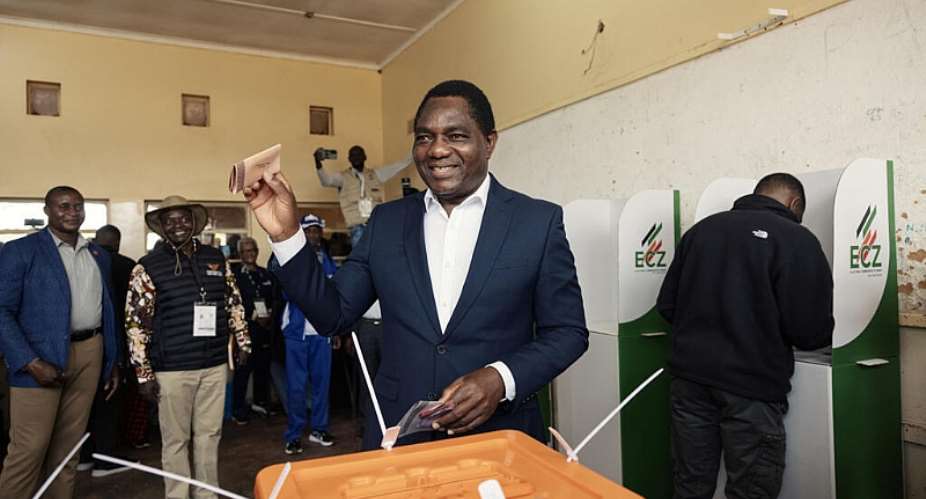
After restructuring Zambia's debt in his first term, Hakainde Hichilema says there is more work to be done in his second and wants to double the size of the economy, create more jobs and expand opportunities for households.
The 64-year-old won a second term on Tuesday with roughly 60% of the vote, defeating his main challenger Brian Mundubile after campaigning on a promise to build on Zambia's economic recovery.
Since taking office in 2021, Hichilema has steered Zambia through a major debt restructuring and restored relations with international lenders. But while supporters credit him with reviving the economy , critics say poverty and hunger remain widespread and accuse him of increasing intolerance of dissent.
From barefoot to businessman
Few African leaders have spent as long chasing the presidency. Hichilema suffered five defeats before finally unseating then-president Edgar Lungu in 2021.
Born in Monze district in southern Zambia, Hichilema often presents himself as a self-made businessman who walked barefoot to school before earning a government bursary to attend the University of Zambia and later studied business administration at Britain 's University of Birmingham.
Popularly known as "HH", Hichilema worked in the corporate sector and became one of Zambia's richest men through a career in financial consulting, property and cattle ranching.
His political profile rose in 2017 when he spent four months in prison on treason charges after his convoy allegedly failed to give way to Lungu's motorcade. The charges were later dropped.
He used the episode to bolster his image among supporters as a politician persecuted under Lungu's government.
Throughout the campaigns leading up to the 2021 election, Hichilema argued Zambia needed disciplined economic management and that he was best placed to revive the economy.
Read more Zambia suspends vote count nationwide amid reports of violence, ballot theft
Economic repair job
When Hichilema finally took office in 2021, Zambia had defaulted on its debt the previous year and was facing one of its worst economic crises since independence.
He secured major debt restructuring agreements with international creditors, repaired relations with global lenders and attracted investment to the copper sector, the backbone of the economy.
Despite expectations of austerity , Hichilema expanded social spending. He introduced free secondary education – bringing an estimated 2.3 million children back into classrooms – while increasing social cash transfers and funding for community projects.
"He has shown that he is sensitive to social needs and to the lives of ordinary voters," said O'Brien Kaaba, a lecturer at the University of Zambia.
Still, many Zambians cite living costs and food prices as major concerns.
Concerns over dissent
Hichilema has brought the same corporate management philosophy to his government.
Unlike former president Michael Sata, whose popularity rested on his image as a charismatic "man of the people", Hichilema's brand is built on managerial efficiency and problem-solving.
Analysts say this focus has concentrated decision-making around the presidency, leaving limited room for dissent.
"I've come to know that it's difficult to advise him, and many people close to him have admitted that he doesn't take advice simply," said Neo Simutanyi, a Lusaka-based political scientist and independent consultant.
Although Zambia has a history of democratic transitions, the opposition has accused Hichilema of restricting its ability to campaign and suppressing political dissent.
The approach has also drawn criticism from civil society groups, rights organisations and church leaders.
In November 2024, Catholic bishops accused Hichilema of using law enforcement to stifle opponents – as was done to him when he was in opposition.
A UN special rapporteur said in a 2025 report that there was "increasing concern" that the criminal justice system was being "weaponized to silence legitimate expression " and called for legal reforms.
Later that year, Zambia passed a cyber law that rights groups say is vaguely worded and allows authorities to intercept electronic communications.
Hichilema rejects allegations that his government has used law enforcement agencies to suppress dissent and restrict democratic freedoms.
"Arresting and prosecuting lawbreakers is not equivalent to loss of democratic space and human rights ," he told parliament last year.
(FRANCE 24 with Reuters)

 GoldBod warns buyers as new XRF gold purity rules take effect September 1
 Africa must lead together with global insights for local impact – Kafui Prebbie
 S.Africa asks regional summit for unity after anti-migrant backlash
 Lamour leaves key FIFA position after criticising Infantino
 EOCO leading AKSA bribery probe because case may involve money laundering not un...
 Ghana Cedi appreciates against US dollar from GHS11.75 to 10.94 in one week
 COCOBOD deploys directors to all 16 regions to improve cocoa production
 Bongo: Completed Gurigo mortuary abandoned for six years, families still travel ...
 New Defence Minister Kenneth Gilbert Adjei officially takes charge
 ECG announces planned power outages in Greater Accra, Ashanti and Central region...

