




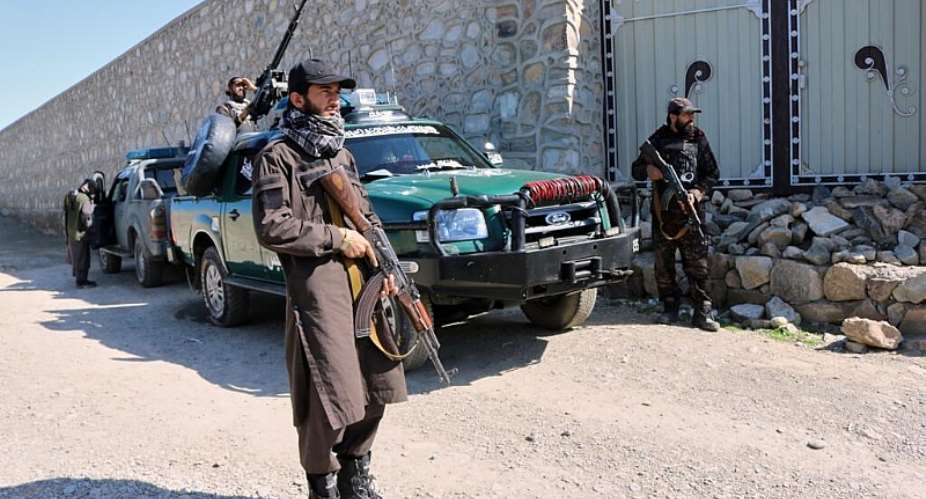
Since Kabul fell to the Taliban on 15 August 2021, Afghanistan has found itself isolated.
Russia remains the only country to officially recognise the Taliban government, and many states are hesitant to engage.
Most Western countries cut their aid packages in 2021 and have demanded to see domestic reforms on human rights before considering any formal recognition.
Nevertheless, countries including the United Kingdom and members of the European Union have since had exchanges with Afghanistan's leaders, driven largely by practical considerations.
In June, a delegation of Taliban officials flew to Brussels for talks with 15 EU nations about returning failed asylum seekers to Afghanistan.
The decision to invite Taliban representatives drew criticism, including from EU lawmakers, while rights watchdogs slammed moves to return Afghans to a country where women and girls have been all but banished from public life and dissent of any kind remains dangerous.
EU's push to deport Afghan refugees brings the Taliban back to the table
'Graveyard for human rights'
The United Nations has characterised the Taliban's restrictions on women's education, employment and freedom of movement as "gender apartheid".
Earlier this week, the UN reported that some 2.4 million girls are now denied access to secondary education in Afghanistan.
Girls were barred from secondary schools in March 2022, with universities closed to young women later that year – a policy the Taliban authorities justify based on their interpretation of Islamic law. Afghan girls read the Quran inside a classroom at an Islamic school in Salihan village, in Kandahar's Panjwai district, on 8 July 2026.
The number of girls denied access to secondary school has risen by 200,000 since last year and could reach nearly 4 million by 2030 if the ban persists, said the UN's cultural and educational agency Unesco.
The agency estimates that the ban on higher education will push hundreds of thousands of women out of the workforce, increase the risks of early marriage and cost the economy $9.6 billion (€8.3 billion) in lost income by 2066.
Afghan women also remain banned from a host of public spaces including parks, gyms and beauty salons, as well as UN premises.
These and other abuses – including public executions and floggings, internet blackouts, arbitrary arrests and media restrictions – have made Afghanistan "a graveyard for human rights", according to UN human rights chief Volker Turk.
'All they dream of is leaving': the reality of life for women under the Taliban
Pragmatism
Afghanistan's economy contracted sharply after the Taliban took over, while repeated earthquakes have damaged drinking water and sanitation infrastructure.
The return of millions of Afghans from other countries in the region has put further strain on limited resources.
Hard hard by international funding cuts, the Taliban authorities have sought support from a slate of other countries.
Their diplomatic strategy has involved hosting envoys in Kabul from China, Japan, Turkey, Saudi Arabia, the UK and elsewhere, while sharing photos of the visits widely.
This year, officials from Tajikistan, Turkmenistan, Kyrgyzstan, Uzbekistan and Kazakhstan gathered in Kabul as the Taliban government seeks to leverage Central Asian countries' interest in establishing trade routes through Afghanistan to access the sea beyond.
Erica Gaston, who was part of a team mandated by the UN Security Council to identify strategies for addressing the challenges in Afghanistan, told French news agency AFP that regional nations were "always more pragmatic" in dealing with the Taliban authorities.
"You had much more receptivity among regional member states to say, 'this is the reality that we have in our region and engagement is inevitable'," said Gaston, who heads the Conflict Prevention and Sustaining Peace Programme at the United Nations University Centre for Policy Research.
How should Europe engage with the Taliban?
Sanctions rethink
Taliban officials have also been touting cross-border infrastructure projects to boost the country's fragile economy.
Seeing potential in untapped natural resources, the government has expanded the mining sector, attracting firms from China and elsewhere.
But foreign funds have remained as investors continue to be wary of a government not recognised by most other states, and many countries have restricted further ties until they see changes in Afghanistan.
Aid agencies have called for greater international engagement with the Taliban authorities to help deliver humanitarian aid and support long-term development.
Some analysts also argue that bringing Afghanistan out of political isolation would serve Western countries' interests by preventing further crises and displacement, while limiting opportunities for other fundamentalist groups to establish a foothold.
In June, India's UN envoy suggested a rethink was necessary on sanctions – a travel ban, asset freeze and arms embargo – that target dozens of Taliban members.
Diplomat Harish Parvathaneni said: "The political reality of Afghanistan has changed in the last five years, and the current UN sanctions regime must take that into account."
(with AFP)


 Trump says record Navy deployment in Iran operations 'not nearly long enough'
 Cambridge’s Youngest Black Professor Jason Arday Found Dead Days After Resignati...
 Govt disburses GH¢23.1 billion to clear road contractors' arrears - Roads Minist...
 Mahama commissions Paga SHS E-Block
 Ghana to expand pharmaceutical manufacturing capacity - Mahama
 Wiawso College of Education student produces raincoat and umbrella from empt wat...
 We will hold referendum on proposed constitutional amendments in 2027 - Mahama
 Roads Minister announces 267km of road projects for Upper East Region
 Feed Ghana Programme drives sharp fall in food inflation to 2.2% — Agric Ministe...
 Government to establish Ghana Scholarships Authority to improve scholarship admi...

