




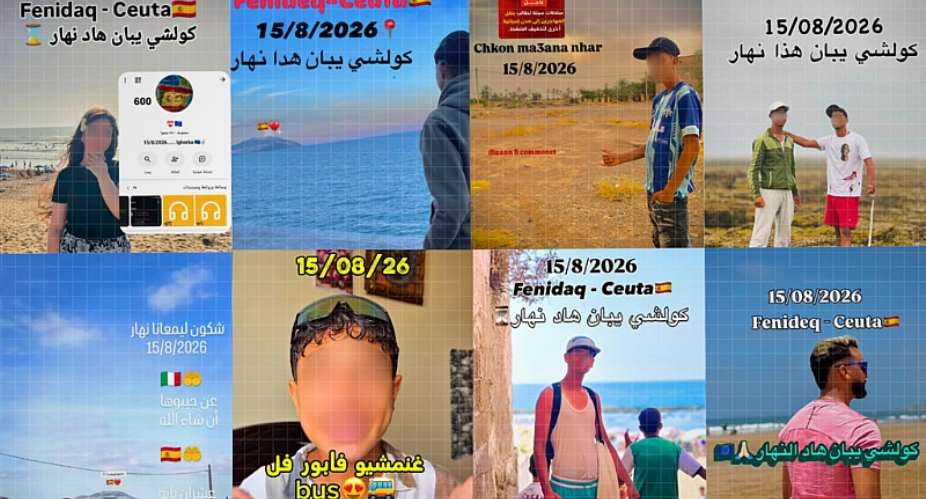
The campaign emerged just two weeks after more than 70,000 people entered the territory illegally in one of the worst migration crises in Ceuta's history. More than 141 people died during the surge, Moroccan NGOs said.
Authorities on both sides of the border are treating the new calls seriously.
Morocco has reinforced security around Ceuta and neighbouring Melilla, while Spain has tightened controls around the enclaves. The response reflects concerns that online mobilisation could once again have real-world consequences.
The latest campaign began circulating on Instagram and Facebook on 30 July, while thousands of mainly Moroccan migrants were still attempting to reach Ceuta. Posts promoting a new crossing on 15 August appeared even before the previous crisis had ended.
At the centre of the campaign was a false claim that the Ceuta border crossing would be exceptionally opened because the day is a public holiday in Spain. The rumour was viewed millions of times online and encouraged would-be migrants to gather around a specific date.
"The border with Spain is closed and it will not open. New security barriers have been installed. If you cross them, you will be sent back. Don't be fooled," Spain's Guardia Civil said in an Instagram post on Tuesday, addressing people considering trying to enter.
Morocco steps up border security over fears of new mass crossing into Ceuta
A web of fake accounts
RFI's investigation could not establish who launched the campaign, but it uncovered multiple signs of manipulation.
Around 10 suspicious Instagram accounts were found to have actively promoted the rumour. Most had been created recently, some only in July or August 2026. They had generic profiles, few followers and little activity beyond posts linked to the planned crossing.
Some videos attracted millions of views, suggesting the movement had been artificially amplified, although the investigation could not determine by whom.
Other accounts appeared to exploit social media algorithms. Several videos carried captions in Japanese copied from an unrelated viral Vogue social media post in an apparent attempt to increase visibility.
Posts repeatedly used hashtags such as "haraga" and "spanish", suggesting a form of astroturfing – the creation of a false impression of grassroots support.
In North African Arabic, haraga or harraga means roughly "those who burn". It refers to migrants who immigrate unlawfully and destroy their identity documents on arrival to avoid being identified and deported.
"The harragas are the burners. At first they were the paper-burners, because when Moroccans entered Ceuta or Melilla without authorisation they were immediately turned back. By extension, the burners became border-burners," Mehdi Alioua, a sociologist and associate professor at the International University of Rabat, told RFI.
"There is an irrational element on both sides, a lack of migration policy and a powerful hope that by burning through borders you can be reborn and find a better life."
Ceuta migrants caught between humanitarian disaster and diplomatic row
Border towns transformed
Once the campaign gained momentum, it was picked up by genuine accounts, including some with more than 100,000 followers. One young Moroccan influencer offered followers a free bus trip to the Spanish border if they subscribed to his social media channels.
Whatever its origins, the campaign has already produced consequences on the ground.
In Fnideq, the Moroccan town bordering Ceuta, security forces have spread across roads leading to the frontier. Police trucks, an armoured vehicle and large numbers of officers have been deployed around the Tarajal crossing, the same route used by tens of thousands of migrants during the late July surge.
Roadblocks have also been set up between Tangier and Fnideq, with buses and shared taxis searched for would-be migrants. Police, gendarmes, auxiliary forces and plain-clothes agents have all been mobilised.
Residents said the atmosphere has changed noticeably.
"It has really changed. Before, when we came every year, there was never this many police or security services. This year there is far more," Wissem, a beachgoer in Fnideq, told RFI.
The events of two weeks ago continue to weigh heavily on local people. The departures have left some neighbourhoods transformed.
"All my friends are in Ceuta. All of them, all of them," said Adam, a 17-year-old with Moroccan and Spanish roots.
"Now I am alone in my neighbourhood. They were like family to me and now the streets are empty."
Morocco steps up border security over fears of new mass crossing into Ceuta
Virtual movement, real frustrations
The scale of the online campaign does not necessarily reflect genuine mobilisation.
To gauge its real reach, RFI journalists joined several private WhatsApp groups promoted in viral posts. The largest had nearly 800 members whose identities could not be verified – far fewer than the more than 20 million views generated by posts promoting Saturday's crossing.
Some users openly discussed trying to reach Ceuta by swimming or sought contacts who could help organise crossings. Yet many people contacted by RFI said they had joined out of curiosity and had no intention of attempting the journey. Several said they planned to stay "warm at home".
Experts say the popularity of such messages reflects deeper social and economic frustrations.
"A social crisis" has been developing in Morocco for years, Alioua said, driven by the frustrations of young people who see few opportunities for the future. At the same time, many believe Europe still offers the possibility of a better life.
Morocco's economy grew by 4.9 percent in 2025, but many young people feel excluded from the benefits, he added.
In Fnideq, one mother whose son crossed into Ceuta without telling her described a pattern of frustration.
"They are young and, in a way, I understand them. I could never find decent housing or a decent life," she said.
"That is why our children leave for over there, because they were lied to about life, lied to about the future."
Ceuta and Western Sahara at heart of US-Morocco rapprochement
Beyond Saturday
"What is unfolding around 15 August goes beyond the security question alone," migration expert Mohamed Ali Lahlou told RFI.
"We are looking at an official unemployment rate that is falling, but underuse of the young workforce remains huge, at around 45 percent."
He does not believe social media alone can create a migration movement on the scale seen in late July.
"Social media can act as an accelerator. It is not the cause," Lahlou said.
"A viral appeal, however widely shared, only produces a movement of several thousand people if it lands on social ground that is already fertile."
He compared the current situation to the 2021 Ceuta crisis, when around 10,000 migrants crossed the border and social media also played a role in spreading information.
Lahlou said reinforced security around Ceuta and Melilla made a repeat of the late July crisis unlikely, even if the online campaign had become more organised.
Alioua said the movement should also be understood as a symbol.
"They just want to show they are ready for anything and that no fence will stop them from searching for a dignified life," he said.
Both experts said similar online campaigns were likely to continue, regardless of how effective border controls become.
This piece has been adapted from the original version in French by RFI's Grégory Genevrier and Sophiane Amazian.


 Mahama summons TDC, TMA officials over disputed Tema development project
 Govt disburses GH¢23.1 billion to clear road contractors' arrears - Roads Minist...
 Mahama commissions Paga SHS E-Block
 Ghana to expand pharmaceutical manufacturing capacity - Mahama
 Wiawso College of Education student produces raincoat and umbrella from empt wat...
 We will hold referendum on proposed constitutional amendments in 2027 - Mahama
 Roads Minister announces 267km of road projects for Upper East Region
 Feed Ghana Programme drives sharp fall in food inflation to 2.2% — Agric Ministe...
 Government to establish Ghana Scholarships Authority to improve scholarship admi...
 Legal vacation trials: ‘Where is the constitutional violation?’ – Prof Azar quiz...

