




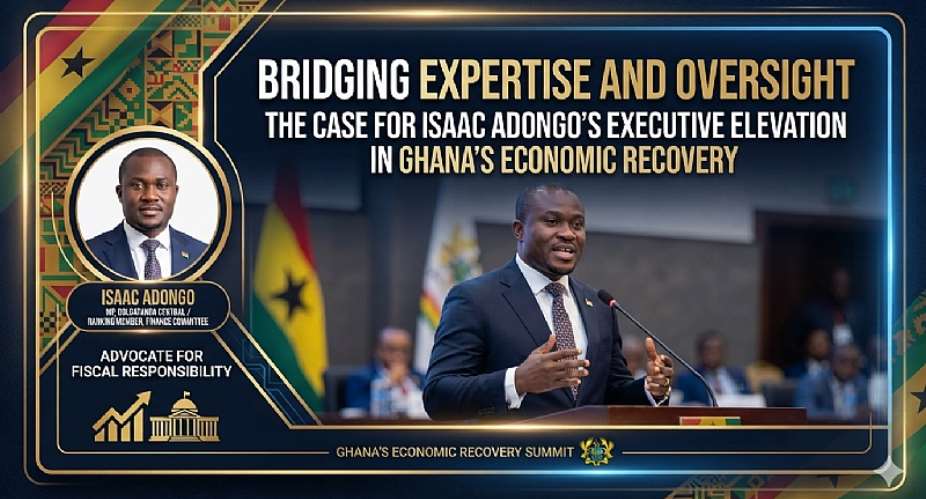
The Dilemma of Unused Political Capital
Ghana's economic landscape stands at a critical juncture, demanding absolute clarity, unmatched technical competence, and uncompromised institutional oversight. In the theater of Ghanaian public finance, few figures command as much attention, respect, and debate as Honorable Isaac Adongo, the Member of Parliament for Bolgatanga Central. Renowned for his razor-sharp forensic analysis, data-driven critiques, and fierce loyalty to the National Democratic Congress (NDC), Adongo has long been the frontline soldier in the battle for fiscal discipline.
However, his deployment under the current administration has sparked intense national conversation. Serving simultaneously as the Chairman of Parliament’s powerful Finance Committee and a Non-Executive Director on the Bank of Ghana (BoG) Board, Adongo finds himself caught in a political paradox. To some observers, he resembles George Orwell’s "Boxer"—the indefatigable worker whose immense utility is confined to the legislative backrooms while others hold the executive reins. To others, his dual roles present a worrying structural conflict of interest.
Worse still, keeping him on the legislative sidelines creates a dangerous regional undercurrent. This article explores Adongo’s current footprint in Ghana's economic governance, analyzes the structural debates surrounding his positions, highlights the ticking political timebomb in the Upper East Region, and makes a data-backed case for why it is time to move him from behind-the-scenes oversight into a substantive executive Ministry of State.
1. Internal Architect: Adongo’s Reform Push on the BoG Board
Transitioning from a fierce external critic to an internal institutional policymaker, Adongo has used his seat on the re-constituted Bank of Ghana Governing Board to advocate for deep structural changes:
- Taxpayer Protection in Recapitalisation: He heavily scrutinizes the central bank’s multi-year recapitalisation framework, aggressively warning that the six-year process must not be converted into a deferred fiscal cost shifted onto ordinary citizens.
- Ending Fiscal Dominance: He advocates for strict institutional parameters to prevent the central bank from printing money to arbitrarily fund state deficits, ensuring currency creation matches real economic output.
- Defending Emergency Stability Measures: Internalizing his board mandate, he has publicly defended aggressive monetary interventions necessary to stabilize the Cedi and moderate severe inflation shocks.
2. The Constitutional Paradox: The Dual-Role Conflict of Interest
The decision to place Adongo on the central bank board while he chairs the legislative oversight committee has triggered intense pushback from the Minority Caucus and civil society watchdogs:
- The Principle of Natural Justice: Opponents invoke Nemo Judex in Causa Sua (no man should be a judge in his own cause), arguing that Adongo cannot credibly chair the committee that audits and reviews the BoG's bi-annual forex reports.
- Constitutional Violations: Critics cite Article 184(1) of the 1992 Constitution and Standing Order 228(2), asserting that a sitting MP overseeing monetary transactions from within the central bank compromises the separation of powers.
- The Majority Defense: NDC leadership counters that no express constitutional or statutory provision in Ghana explicitly bars a legislator from serving as a non-executive director on a state board.
3. Legislative Record: Accountability from the Finance Committee
As head of the Finance Committee, Adongo’s tenure is defined by meticulous, numbers-driven scrutiny and an unyielding defense of public funds:
- Banking Sector Inquiries: He has consistently pushed for forensic accountability regarding the multi-billion Cedi 2017–2019 financial sector clean-up and the handling of revoked commercial bank licenses.
- Loan and Bond Vetting: He instituted a rigorous evaluation framework for international loan agreements, forcing the Executive to present verifiable repayment strategies before receiving committee clearance.
- Restructuring State-Owned Banks: He has led critical legislative discussions focused on saving the National Investment Bank (NIB) from insolvency to protect local micro-depositors.
4. The Ticking Timebomb: Political Risks in the Upper East Region
Beyond structural and legal debates, delaying Adongo’s elevation to a substantive ministerial role creates immediate, severe electoral and political vulnerabilities for the NDC in its Upper East stronghold:
- Perceptions of Marginalization: Grassroots supporters and local chiefs increasingly view the omission of their most vocal economic champion from the core cabinet as an institutional snub to the region.
- Apathy and Depressed Voter Turnout: If the party’s fiercely loyal support base feels that their hard work and top-tier talent are routinely sidelined for others, voter enthusiasm will plummet, depressing crucial turnout in future general elections.
- Exploitation by the Opposition: The New Patriotic Party (NPP) will weaponize this perceived neglect, using it as potent campaign leverage to paint the NDC as a party that exploits northern political capital without offering equitable executive rewards.
Recommendations and Policy Suggestions
To optimize Hon. Isaac Adongo’s extensive technical capacity while preserving the integrity of Ghana’s democratic institutions, the following actions are highly recommended:
- Appoint Adongo as a Substantive Minister of State: The President should elevate Adongo to a cabinet-level role, such as Minister of State at the Ministry of Finance or Ministry of Economic Planning. This leverages his forensic accounting expertise for executive delivery rather than just legislative pushback.
- Resolve the Oversight Conflict Immediately: Moving Adongo into a formal executive portfolio would naturally require him to step down from the Finance Committee chairmanship, instantly curing the structural conflict of interest gripping Parliament.
- Grant Statutory Teeth for Expenditure Control: In an executive role, Adongo should be tasked with executing the aggressive fiscal discipline, expenditure caps, and inflation-control measures he championed while in opposition.
- Maintain Political Equity in the Upper East Region: Elevating Adongo satisfies a growing grassroots demand within his constituency, reassuring party loyalists that meritocracy and fierce dedication are rewarded with executive governance.
From Oversight to Execution
Honorable Isaac Adongo has proven beyond doubt that he possesses a rare blend of macroeconomic literacy, forensic prowess, and street-level political communication. Keeping a political and economic asset of this magnitude restricted to a controversial dual legislative-board setup diminishes his potential impact on Ghana's financial recovery and actively damages the NDC's political capital in the north.
If Ghana is to navigate its complex debt obligations, stabilize its currency, and build a resilient economy, it must put its best players on the field, not keep them on the sidelines or in structural loops. Elevating Isaac Adongo to a substantive Minister of State is no longer just a matter of political reward—it is a strategic necessity for robust, transparent, and aggressive economic execution. The time has come to shift his brilliant analytical mind from pointing out errors to actively executing state solutions.
✍️ Submitted by:
Retired Senior Citizen
For and on behalf of all Senior Citizens of the Republic of Ghana 🇬🇭
Teshie-Nungua
[email protected]

 Mahama summons TDC, TMA officials over disputed Tema development project
 Govt disburses GH¢23.1 billion to clear road contractors' arrears - Roads Minist...
 Mahama commissions Paga SHS E-Block
 Ghana to expand pharmaceutical manufacturing capacity - Mahama
 Wiawso College of Education student produces raincoat and umbrella from empt wat...
 We will hold referendum on proposed constitutional amendments in 2027 - Mahama
 Roads Minister announces 267km of road projects for Upper East Region
 Feed Ghana Programme drives sharp fall in food inflation to 2.2% — Agric Ministe...
 Government to establish Ghana Scholarships Authority to improve scholarship admi...
 Legal vacation trials: ‘Where is the constitutional violation?’ – Prof Azar quiz...

