




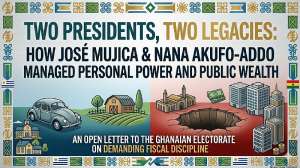
The Moral Weight of the Public Purse
True political leadership is not measured by the height of state monuments, but by the depth of a leader’s fidelity to the ordinary citizen. Across the developing world, the management of public funds serves as the ultimate litmus test for presidential integrity. When a state faces severe macroeconomic distress, the lifestyle of its executive and the allocation of its scarce resources cease to be mere political choices—they become profound moral statements.
This article presents a comparative analysis between the austere, citizen-centered governance of Uruguay’s former President, José "Pepe" Mujica, and the expansive, institutional legacy of Ghana’s former President, Nana Addo Dankwa Akufo-Addo. By examining how both men managed their personal lives and public wealth—symbolized heavily by Ghana's controversial National Cathedral project—we offer a roadmap for political reform, civic education, and fiscal discipline for the Ghanaian populace.
Personal Wealth vs. State Opulence
The contrast between the daily realities of these two leaders highlights fundamentally different philosophies on what it means to hold executive power:
- José Mujica’s Absolute Austerity: During his presidency (2010–2015), Mujica famously rejected the luxurious presidential palace, choosing instead to live in a modest, one-bedroom rural farm. He declared an annual personal wealth of just $1,800—the value of his 1987 Volkswagen Beetle. Mujica famously donated 90% of his state salary to public housing charities and social programs, actively aligning his personal comfort with that of his poorest citizens.
- Nana Akufo-Addo’s Conventional Elite Status: Serving from 2017 to January 2025, Akufo-Addo maintained a traditional, high-stature approach to leadership. His administration was frequently scrutinized by civic groups and journalists for high-cost presidential travels, expansive ministerial appointments, and large state convoys that stood in stark contrast to the grueling daily economic struggles of the ordinary Ghanaian taxpayer.
Managing State Resources: Welfare vs. The "Expensive Hole"
A leader's spending habits inevitably shape the macroeconomic health of the country they govern. The division in resource management between the two administrations is stark:
- Uruguay’s Strategic Redistribution: Mujica treated state resources as a tool for immediate, widespread human transformation. Rather than committing public cash to legacy monuments, his government doubled the national minimum wage, eliminated extreme poverty (dropping it from 40% to 12%), and heavily funded public school infrastructure and free healthcare. He grew the GDP by 75% while keeping the state budget strictly disciplined.
- Ghana's National Cathedral Controversy: Under President Akufo-Addo, public resource management faced heavy criticism, epitomized by the National Cathedral in Accra. Initially promised to be entirely privately funded as a personal vow to God, investigations revealed that tens of millions of dollars in taxpayers' money were funneled into the project.
- The Physical Reality of Mismanagement: Today, the $400 million project sits completely stalled as nothing more than a "weed-choked, expensive hole in the ground" in central Accra. Valuable state buildings and judges' homes were demolished to clear prime real estate, leaving behind an abandoned foundation that fills with rainwater while Ghana navigates a severe debt crisis and an International Monetary Fund (IMF) bailout.
Policy Recommendations and Suggestions for Ghana
To prevent future instances of wasteful vanity projects and protect the public purse, Ghana must enact structural governance reforms:
- Legislate Strict Caps on "Pet Projects": Parliament must introduce laws that explicitly prohibit the allocation of unbudgeted public funds to projects deemed "personal vows" or non-essential cultural monuments. Any state funding for such projects must require a two-thirds majority parliamentary approval.
- Review and Downsize Executive Privileges: Ghana must urgently audit and scale down the material perks of political office. This includes reducing the size of presidential convoys, setting strict limits on international travel expenditures, and reforming the controversial Article 71 ex-gratia payments.
- Empower Independent Fiscal Oversight: The Auditor-General and the Commission on Human Rights and Administrative Justice (CHRAJ) must be given absolute financial autonomy to audit state-sponsored foundations in real-time, ensuring that public money cannot be funneled into private trusts without immediate legal consequences.
- Prioritize Human Capital Over Concrete Legacies: Future Ghanaian governments must shift their economic focus away from low-utility infrastructure and instead anchor public funds in direct human welfare—such as stabilizing public school feeding programs, equipping existing hospitals, and cutting down national debt to curb rampant inflation.
A Call for Civic Awakening
The comparison between José Mujica and Nana Akufo-Addo reveals that the true wealth of a nation is not built on grand edifices of stone and mortar, but on the fiscal discipline and empathy of its leaders. Akufo-Addo’s National Cathedral stands as a cautionary tale of executive overreach—a multi-million dollar pit that symbolizes how personal ambition can override collective economic survival during a national crisis. Meanwhile, Mujica's legacy reminds us that a leader's power is amplified when they choose to walk alongside their people, not look down on them from ivory towers.
For Ghana to truly transform, citizens writing and reading on platforms like Modern Ghana must demand a new breed of leadership. We must reject the politics of luxury and grandeur. Moving forward, the Ghanaian electorate must reward leaders who promise to protect the public purse with actions, accountability, and an unwavering commitment to the modest, transparent management of our national resources.
✍️ Submitted by:
Retired Senior Citizen
For and on behalf of all Senior Citizens of the Republic of Ghana 🇬🇭
Teshie-Nungua
[email protected]

 Baffour Awuah may spend night in EOCO custody — Lawyer
 Suspend Ghana-Colombia port and visa deals over cocaine seizures — Minority
 Ghana Law Society proposes National Service for fresh lawyers
 'We cannot continue to be a Bar of Accra, by Accra, for Accra' — Ghana Law Socie...
 Stop speculation, premature conclusions; allow investigation to determine Baffou...
 Judge halts Ex-NAFCO CEO's trial until ruling on seized phones
 Manhyia South MP who resisted arrest reports to EOCO a day after arrest warrant ...
 "Show us evidence" —Upper West teacher unions demand proof of payment before end...
 Adenta: Bolt driver jailed 25 years for cutlass attack and robbery of beautician...
 EOCO drags Manhyia South MP to former law firm, residence for search


