




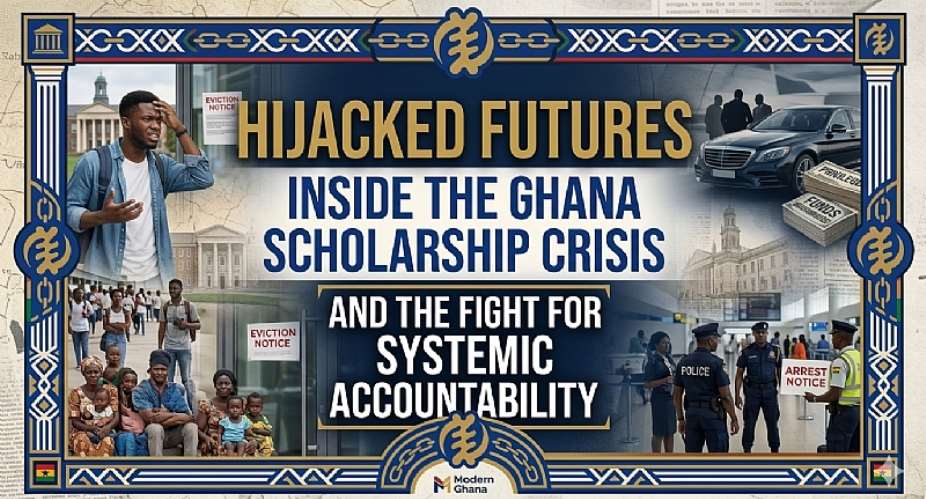
How a system meant for brilliant, underprivileged youth became a playground for the wealthy—leaving genuine scholars stranded abroad facing eviction while the state cracks down with high-profile airport arrests.
A Betrayal of the "Brilliant but Needy"
The core purpose of state-funded education in Ghana is being tested by institutional greed, political cronyism, and structural decay. For years, the Ghana Scholarship Secretariat was revered as a beacon of hope—an equalizer designed to guarantee that brilliant but financially underprivileged Ghanaian youth could access premium tertiary education globally. However, a series of explosive media investigations, audits, and subsequent security agency roundups have exposed a dark reality. Recent data indicates that state resources meant for the impoverished have been systematically diverted to fuel the lifestyles of the politically affluent and well-connected. As millions in state funds are exposed as misallocated, thousands of legitimate Ghanaian scholars find themselves stranded, blacklisted, and facing international deportation. This is no longer just an administrative failure; it is a profound moral and socio-economic betrayal that requires rigorous domestic prosecution, structural overhauls, and citizen vigilance.
The Anatomy of the Scandal: Wealth Over Worth
The widespread public anger surrounding this crisis stems directly from how deeply nepotism penetrated the awarding system.
- The "Sold" Scholarship Accusations: Public complaints submitted to state security agencies reveal that illicit intermediaries and corrupt officials heavily exploited the process. Scholarships worth between $15,000 and $250,000 were allegedly peddled, requiring massive bribe fees to guarantee selection despite state policy declaring the process entirely free.
- Funding the Privileged: Official reports from the transitioned administration reveal that instead of prioritizing needy applicants, the state was fully funding visa fees, luxury flights, and high-value stipends for the spouses and dependents of prominent political figures.
- The Double-Standard Doctrine: In documented instances, individual spouses of powerful state executives received all-inclusive sponsorships covering tuition (£17,875) and family living expenses (£16,008 per annum), plus additional hefty allowances for dependents, while everyday Ghanaians with perfect academic marks were locked out.
The Human Toll: Stranded Scholars and Blacklisted Institutions
While political elites benefited from state largesse, genuine Ghanaian students sent abroad became collateral damage:
- The Legacy Debt Mountain: Reckless award distributions left behind a staggering £35 million legacy debt owed strictly to UK and international higher education institutions.
- Degrees on Hold: At various institutions like Lavra University, the University of Lincoln, and Nottingham, finished Master’s and PhD students have had their degrees withheld and graduation certificates blocked due to massive outstanding arrears.
- Living in Crisis: Arrears on stipends stretching into multiple semesters left students abroad facing frozen university accounts, physical evictions, dependence on local food pantries, and active threats of visa revocation. Emergency interventions—such as the recent $1 million release to lower debts at the University of Memphis—act only as minor band-aids on a widespread systemic fracture.
The Legal Net Tightens: Arrests and Interrogations
Accountability is moving slowly from public outcry into active criminal processing by state security bodies:
- BNI and EOCO Dragnets: The Bureau of National Intelligence (BNI/NIB) and the Economic and Organized Crime Office (EOCO) have initiated extensive corruption investigations into past leaders. Former Registrar Dr. Kingsley Agyemang has been subjected to rigorous state questioning regarding administrative and financial anomalies during his tenure.
- Airport Interceptions: The state's enforcement net recently widened with the high-profile arrest of former Deputy Registrar Afua Gyasiwaa Gaisie by NIB officers at the Kotoka International Airport. She and other past actors are cooperating under strict reporting bails regarding charges of fraud and misapplication of public property.
- The Oath Controversies: In an attempt to manage the legacy crisis, the Ghana High Commission sought to mandate that overseas PhD scholars sign strict legal oaths under the Oaths Act to force their immediate return to serve the Republic upon graduation—a move fiercely rejected by student unions who label it a discriminatory distraction from the unpaid stipends.
Structural Reforms: Moving to the Ghana Scholarships Authority
To permanently sever the systemic rot, the old, insular "Secretariat" model has been dismantled:
- The Legislative Pivot: Parliament introduced the Scholarships Authority Bill, re-engineering the entity into a structured, board-governed Ghana Scholarships Authority (GSA). This shift legally eliminates the unilateral, un-monitored power previously wielded by a single registrar.
- Decentralized Digitization: Application protocols for the 2026/2027 academic cycle have transitioned to the Online Scholarship Application Portal. Selection criteria now theoretically mandate decentralized district-level validations, online aptitude testing, and face-to-face MMDA interviews to prevent backroom political hand-outs.
Strategic Recommendations and Suggestions
To safeguard the future of Ghanaian students and protect public resources, the following systemic actions must be prioritized:
- Establish a Dedicated Escrow System: The Ministry of Finance and the newly formed Ghana Scholarships Authority must isolate funding for active overseas scholars into an independent, ring-fenced escrow account. This guarantees that tuition and stipends are never delayed by shifting domestic fiscal constraints.
- Enact a Moratorium on New Foreign Awards: The state must enforce an absolute freeze on issuing new foreign scholarship slots until the £35 million international university debt backlog is fully erased. Focus must pivot to optimizing local public universities.
- Mandate Public Beneficiary Registries: The Ghana Scholarships Authority must legally publish the names, programs, and funding allocations of all beneficiaries online annually. Transparency is the ultimate antidote to nepotism.
- Criminal Prosecution and Asset Recovery: The Office of the Special Prosecutor (OSP) and the Attorney General must rapidly transition BNI investigative files into open court prosecutions. Any public official or affluent individual found to have fraudulently acquired or brokered state scholarship funds must face prison time and absolute asset confiscation.
Restoring the Public Trust
The crisis surrounding Ghana’s scholarship system serves as a stark reminder of how quickly vital social safety nets can break down when left unmonitored. Sponsoring well-connected elites while brilliant, impoverished citizens are denied local admission or left stranded abroad is a practice that cannot continue. The ongoing arrests, interrogation of past leadership, and structural transformation into a modernized Scholarships Authority represent a positive step forward. However, true reform will not be measured by the creation of new online portals or defensive legal oaths. It will be measured by the return of fairness, the open prosecution of those who exploited the system, and a verifiable guarantee that the wealth of a student’s family will never again dictate the reach of their intellect.
✍️ Submitted by:
Retired Senior Citizen
For and on behalf of all Senior Citizens of the Republic of Ghana 🇬🇭
Teshie-Nungua
[email protected]

 Five reported dead in multiple-vehicle crash at Ofankor barrier
 About 82,500 people in Ghana use drugs – NACOC
 'Stop using unqualified staff to manage patient data' – Allied Health Profession...
 ‘Unfinished business requires exceptional leadership’ — GHAPRO backs Mahama for ...
 Sedina Tamakloe-Attionu released after state withdraws stay application
 Bunkpurugu Police suspend funeral musketry over security concerns
 Police launch manhunt for man captured assaulting suspect in viral video
 Ghanaians give Mahama 72% approval; 60% say country heading right direction
 Colombia earthquake rescue efforts enter 'final phase' as death toll rises
 White House press secretary and Trump adviser Karoline Leavitt to leave role

