




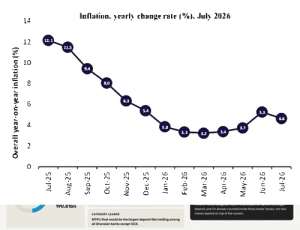
Ghana’s annual inflation rate fell to 4.6% in July 2026, down from 5.3% in June, driven largely by slower increases in food prices and offering further relief to households and businesses.
The latest Consumer Price Index (CPI) released by the Ghana Statistical Service showed that the decline marked the first drop in year-on-year inflation since March.
The CPI measures changes in the prices of goods and services purchased by households, with 2021 serving as the base year.
Monthly inflation stood at 0.1% in July, indicating that prices remained largely stable compared with the previous month.
Food and non-alcoholic beverages recorded an annual inflation rate of 3.1%, while non-food inflation stood at 6.1%.
Inflationary pressures, however, varied significantly across the country. The Bono East Region recorded the lowest rate at -3.8%, while the North East Region posted the highest at 10.8%. Six regions recorded inflation rates above the national average of 4.6%.
Government Statistician Alhassan Iddrisu attributed the decline largely to easing food inflation and said domestic factors continued to have the strongest influence on price movements.
"Food prices continue to stabilise, and that is helping to slow overall inflation. We also see that domestic costs remain the main driver of inflation, which means maintaining stability in transport, energy and local production is important," he said.
The Ghana Statistical Service estimated that more than 86% of the country’s inflation was generated by goods and services produced domestically, highlighting the significant role of local production costs in determining overall price trends.
Inflation outlook
The July inflation figure represents a substantial improvement from the 12.1% recorded in July 2025. Over the past year, the pace of price increases has more than halved, reflecting improved macroeconomic conditions.
The decline comes as the government maintains its macroeconomic targets outlined in the 2026 Mid-Year Budget Review, which cited stronger economic growth, fiscal consolidation and improved economic stability.
The easing inflation rate is also expected to provide businesses with greater certainty in planning and managing operating costs.
The Bank of Ghana, meanwhile, maintained its policy rate at its July meeting for the second consecutive time, stressing the need for continued caution to keep inflation within its medium-term target range of 6% to 10%.
Impact on businesses and households
The continued moderation in inflation is expected to ease cost pressures on businesses, particularly those that rely heavily on food inputs and locally sourced goods.
For households, sustained price stability could also help strengthen purchasing power by slowing the rate at which the cost of goods and services increases.
An economist said the latest figures pointed to improving price stability and could support investment and business confidence, although businesses would still need to monitor domestic cost pressures.
"The inflation numbers point to improving stability and that supports investment and business confidence. However, firms still need to monitor domestic costs closely because transport, utilities and other local factors continue to influence prices," she said.

 Ablakwa commends Church of Pentecost for sheltering stranded Ghanaians during xe...
 Broken high-tension poles plunge parts of Accra West into darkness
 Cyber Security Authority fines ORC GH¢240,000 for engaging unlicensed cybersecur...
 Wife, two workers arrested over suspected arson that claimed life of herbalist a...
 Ghana’s inflation falls to 4.6% in July as food price pressures ease
 Apostle Eric Nyamekye narrates how he escaped death in South Africa
 Three remanded over alleged violent attack on Obuasi SHS headmaster
 Sedina Tamakloe's lawyers must file habeas corpus to secure her release immediat...
 Release warrant signed for Sedina Tamakloe-Attionu after AG withdraws stay appli...
 Attorney-General withdraws motion to block Sedina Tamakloe-Attionu’s release

