




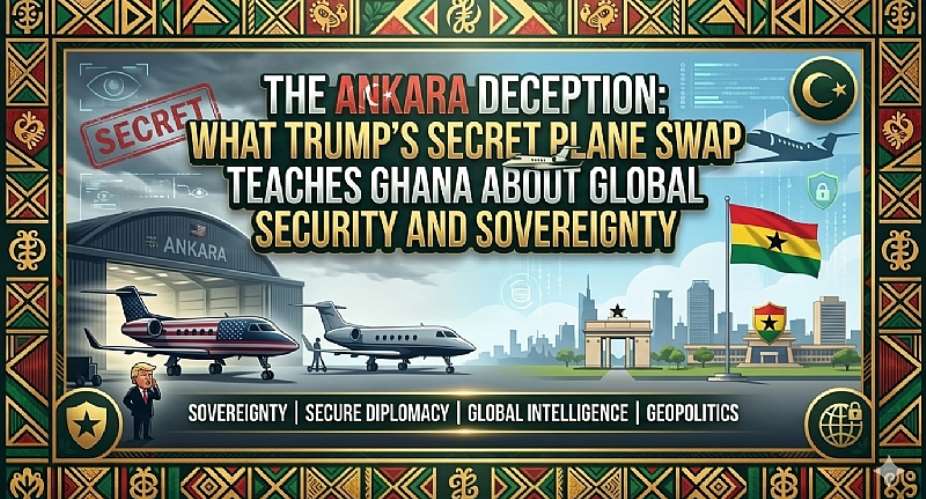
The volatile nature of contemporary global geopolitics was starkly demonstrated on July 8, 2026, when U.S. President Donald Trump was secretly smuggled off Air Force One via a catering truck. Confronted with an active, state-backed assassination plot from Iran, the United States Secret Service executed a high-stakes shell game at Ankara International Airport. The operation utilized a legacy aircraft filled with senior staff and civilian journalists as an unwitting decoy to draw potential missile fire away from the real target. For a developing powerhouse like Ghana, this dramatic event is not merely a distant headline; it serves as a critical, sobering case study in national security infrastructure, the ethics of leadership protection, and the vulnerabilities of relying on foreign-sourced technology.
Inside the Ankara Deception: The Critical Details
- The Immediate Catalyst: The operation took place immediately following the collapse of diplomatic negotiations and a fresh wave of U.S. airstrikes against Iranian military installations.
- The Intelligence Alert: Intelligence agencies intercepted highly specific data indicating that an Iranian operative equipped with a surface-to-air missile was tracking the President's departure layout in Turkey.
- The Vulnerability Failure: President Trump had originally traveled to the NATO summit on a luxury Boeing 747-8 gifted by Qatar. Security officials discovered too late that this newly retrofitted aircraft completely lacked standard military-grade missile defense suites.
- The Tactical Ruse: To protect the president, Trump publicly boarded the legacy presidential jet in front of cameras. Moments later, he was secretly lowered inside an airport catering food box out of public sight and transferred onto a darkened, unmarked C-32A transport jet flying under an anonymous call sign.
- The Human Decoys: The legacy jet took off under the official "Air Force One" designation, carrying high-ranking officials like Secretary of State Marco Rubio and the White House press pool. Passengers were kept completely unaware that they were flying inside an active decoy target.
Why This Matters to Ghana: Critical Lessons
The high-altitude theater over Turkey provides urgent lessons for the government in Accra regarding statecraft and the management of sovereign infrastructure:
- The Perils of Unverified Foreign Assets: Trump’s reliance on a luxury Qatari-gifted aircraft that lacked critical wartime protections exposed him to immense danger. Ghana must ensure that any asset utilized by the state—whether software, vehicles, or defense gear acquired via foreign partnerships—is subject to local vetting to avoid compromised security integrity.
- The Ethical Boundaries of Statecraft: The heavy domestic political backlash in Washington over using journalists as shields highlights a deep ethical line. National security protocol must never bypass the basic human rights and safety of civilian citizens or professionals.
- The Absolute Need for Adaptive Decoupling: The Secret Service successfully used an older, lower-profile C-32A plane to escape undetected. True national resilience requires having adaptable, localized backup configurations ready when primary systems fail.
Policy Recommendations for Ghana's Leadership
To protect national stability and safeguard institutional integrity in an increasingly unstable global environment, the government of Ghana should consider the following steps:
- Audit State Transport Security Suites: Conduct a comprehensive engineering and electronic audit of all aircraft, vehicles, and equipment used by the President, Vice President, and high-level diplomats to ensure they feature active, modern countermeasures against modern electronic or physical tracking.
- Establish Rigid Protocols for Non-Combatants: Formulate clear, binding directives through the Ministry of National Security to guarantee that Ghanaian journalists, civil servants, and technical staff are never deployed as structural or tactical decoys during domestic or regional operations.
- Enhance Domestic Strategic Autonomy: Invest systematically in localized cyber-defense architectures and sovereign communication channels. Reducing dependency on foreign-managed defense infrastructure ensures that external powers cannot monitor or disrupt the movements of the state's executive leadership.
A Sovereign Wake-Up Call
The Ankara incident proves that even the world’s most heavily funded military superpower is highly susceptible to sudden logistical vulnerabilities and intelligence failures. Security cannot be bought off the shelf, nor can it be safely outsourced to foreign donors without inheriting their geopolitical risks. As Ghana navigates its role as a regional leader in West Africa, the state must internalize the reality that true sovereignty rests on self-reliance, local accountability, and a defense architecture that values the lives of its citizens as deeply as the safety of its leaders.
✍️ Submitted by:
Retired Senior Citizen
For and on behalf of all Senior Citizens of the Republic of Ghana 🇬🇭
Teshie-Nungua
[email protected]

 Ablakwa commends Church of Pentecost for sheltering stranded Ghanaians during xe...
 Broken high-tension poles plunge parts of Accra West into darkness
 Cyber Security Authority fines ORC GH¢240,000 for engaging unlicensed cybersecur...
 Wife, two workers arrested over suspected arson that claimed life of herbalist a...
 Ghana’s inflation falls to 4.6% in July as food price pressures ease
 Apostle Eric Nyamekye narrates how he escaped death in South Africa
 Three remanded over alleged violent attack on Obuasi SHS headmaster
 Sedina Tamakloe's lawyers must file habeas corpus to secure her release immediat...
 Release warrant signed for Sedina Tamakloe-Attionu after AG withdraws stay appli...
 Attorney-General withdraws motion to block Sedina Tamakloe-Attionu’s release

