




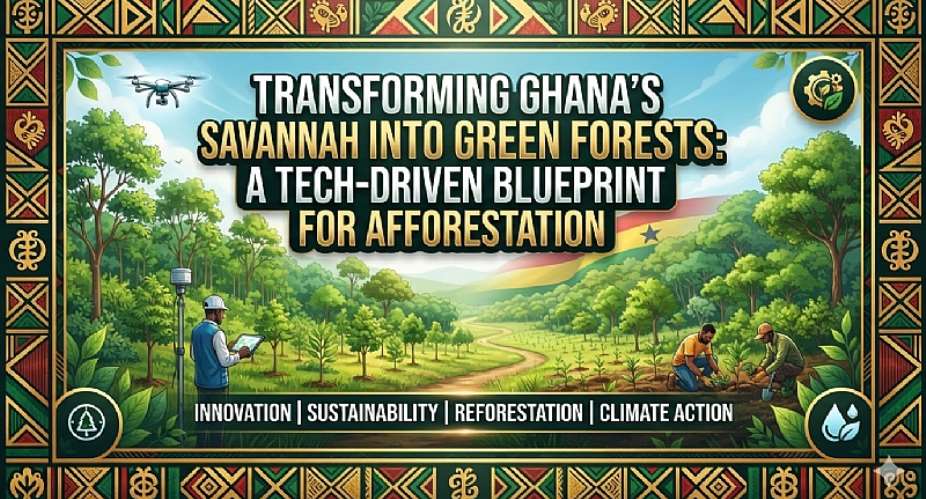
As climate change accelerates, Ghana stands at a critical environmental crossroads. The northern savannah landscapes face rapid degradation, erratic rainfall patterns, and the relentless creep of desertification. Traditional, manual tree-planting efforts—while well-intentioned—simply cannot keep pace with the scale of ecological loss. To safeguard our ecosystem, secure our food supplies, and unlock global green financing, Ghana must leapfrog into the future of conservation. By pairing state-of-the-art seed-planting drones with targeted artificial weather modification (cloud seeding), we have a historic opportunity to revolutionize national afforestation. This article serves as a strategic blueprint for the Sector Minister, policy makers, and all Ghanaians on how advanced technology can transform parched grasslands into thriving, self-sustaining forest economies.
The Vision: Why High-Tech Forestry is Ghana's Solution
- Speed and Scalability: Industrial, heavy-payload drones can map terrain and fire nutrient-packed seed pellets into the soil at lightning speed, covering up to 50 hectares a day—a feat that takes manual labor teams weeks to accomplish.
- Accessing Rugged Terrains: Drones easily bypass physical geographic barriers, safely planting across remote savannahs and rocky areas like the Gambaga Escarpment where vehicles and ground crews cannot go.
- Weathering the Dry Season: By utilizing localized cloud seeding (artificial rain) during critical early growth phases, we can ensure young saplings get the consistent moisture they need to survive harsh northern heatwaves.
- Drastic Cost Reductions: While initial equipment setup requires capital, drone-led afforestation reduces long-term planting costs by 40% to 70% when deployed at a large scale.
Species Selection: Planting for Community Wealth
A tech-driven forest must be built on native, climate-resilient trees that actively support the local economy, ensuring that northern communities become the ultimate guardians of the new woodlands.
- The Shea Tree (Vitellaria paradoxa): The economic backbone of the north; highly drought-resistant and vital for the women-led shea butter industry.
- Dawadawa (Parkia biglobosa): A leguminous tree that natively fixes nitrogen into degraded soils while producing high-value, nutrient-rich seeds for local markets.
- Baobab (Adansonia digitata): Celebrated for extreme climate resilience, its massive trunk acts as a natural water reservoir while supporting local food security.
- White Acacia (Faidherbia albida): A unique tree that drops its leaves during the wet season and grows them in the dry season, providing vital shade when the landscape needs it most.
- African Mahogany & Rosewood: Hardy timber varieties to form dense outer protection belts, blocking harsh winds and resisting seasonal bushfires.
Modern Science for Ecological Survival: Demystifying Artificial Rain
┌────────────────────────────────────────────────────────────────────────┐ │ TECHNICAL SIDEBAR: CLOUD-SEEDING SAFETY & FACTS │ ├────────────────────────────────────────────────────────────────────────┤ │ 🧪 MATERIAL USED: Eco-friendly Silver Iodide (AgI) / Natural Salts │ │ 💧 IMPACT ON WATER: Zero toxic accumulation; far below WHO safety caps │ │ 🌍 ECOSYSTEM EFFECT: Purely stimulates condensation; no chemical rain │ └────────────────────────────────────────────────────────────────────────┘
Technical Sidebar: Is Cloud Seeding Safe for Ghana?
As we explore artificial weather modification to nurture our newly planted savannah forests, public education is critical. To prevent misinformation, the technical, environmental, and safety realities of cloud seeding must be clearly understood:
- What is Dispersed? The process uses microscopic, eco-friendly particles—typically Silver Iodide (AgI) or natural hygroscopic salts (sodium chloride). These elements simply act as "ice nuclei," giving vapor a structural surface to cling to, which accelerates natural condensation into raindrops.
- Is the Water Toxic? Absolutely not. Decades of rigorous international environmental monitoring have confirmed that Silver Iodide concentrations in rainfall from seeded clouds are minuscule. The presence measures at less than 0.1 micrograms per liter—which is hundreds of times lower than the World Health Organization (WHO) safety standards for drinking water.
- Does it Alter Global Weather? Cloud seeding cannot "create" clouds out of thin air, nor can it steal rain from neighboring regions. It simply increases the precipitation efficiency of existing, moisture-rich clouds passing directly over the target reforestation zones, pulling down rain that would have otherwise evaporated back into the upper atmosphere.
- Impact on Local Wildlife and Soils: Silver Iodide is highly insoluble and binds rapidly to organic soil matter, meaning it does not accumulate in local water bodies or pose a risk to livestock, freshwater fish, or savannah biodiversity.
Financing the Future: Tapping into International Green Grants
Ghana does not need to bear this financial burden alone. Global climate funds are looking for forward-thinking, high-tech conservation projects to fund.
- Leveraging the Green Climate Fund (GCF): The GCF is already active in Ghana, previously backing the $30.1 million Ghana Shea Landscape project. A drone-led expansion aligns perfectly with their ongoing funding pipelines.
- The Access Pathway: To unlock these millions, Ghana’s National Designated Authority (NDA) under the Ministry of Finance must officially endorse the project concept.
- Strategic Partnerships: By routing the proposal through Accredited Entities like the UNDP, African Development Bank (AfDB), or Ecobank, Ghana can secure the international compliance needed to win massive green grants.
Concrete Recommendations for the Sector Minister
- Establish a High-Tech Forestry Taskforce: Form a collaborative team uniting the Ministry of Lands and Natural Resources, the Forestry Commission, Ghana Meteorological Agency (GMet), and local drone tech startups.
- Deploy Offline Drone Mission Frameworks: Standardize the use of open-source flight software like UgCS (for True Terrain Following over ridges) and QGroundControl, which allow flight paths to be mapped completely offline in remote northern zones lacking cellular networks.
- Build Regional Seed-Pellet Centers: Construct localized manufacturing hubs in the North to encapsulate native seeds into biodegradable clay pellets mixed with natural nutrients and charcoal to protect them from pests before drone dispersal.
- Integrate into the Green Ghana Project: Dedicate a specific percentage of the annual Green Ghana Day goals to automated drone planting to test, validate, and scale the technology in real-time.
The transformation of Ghana's northern grasslands into vibrant, productive forestlands is no longer a distant dream restricted to science fiction. The tools exist today. By blending the ancient resilience of our native Shea and Baobab trees with the modern precision of autonomous drones and weather-modification technologies, we can build a climate-impenetrable shield across our savannahs. This strategy will protect our soil, empower our rural communities, and position Ghana as the undisputed leader of green technology in Sub-Saharan Africa. To the Sector Minister and policy makers: the sky is no longer the limit—it is the launchpad. Let us deploy the technology, secure the international funding, and plant the seeds of a greener, wealthier, and more resilient Ghana today.
✍️ Submitted by:
Retired Senior Citizen
For and on behalf of all Senior Citizens of the Republic of Ghana 🇬🇭
Teshie-Nungua
[email protected]


 Ablakwa commends Church of Pentecost for sheltering stranded Ghanaians during xe...
 Broken high-tension poles plunge parts of Accra West into darkness
 Cyber Security Authority fines ORC GH¢240,000 for engaging unlicensed cybersecur...
 Wife, two workers arrested over suspected arson that claimed life of herbalist a...
 Ghana’s inflation falls to 4.6% in July as food price pressures ease
 Apostle Eric Nyamekye narrates how he escaped death in South Africa
 Three remanded over alleged violent attack on Obuasi SHS headmaster
 Sedina Tamakloe's lawyers must file habeas corpus to secure her release immediat...
 Release warrant signed for Sedina Tamakloe-Attionu after AG withdraws stay appli...
 Attorney-General withdraws motion to block Sedina Tamakloe-Attionu’s release

