




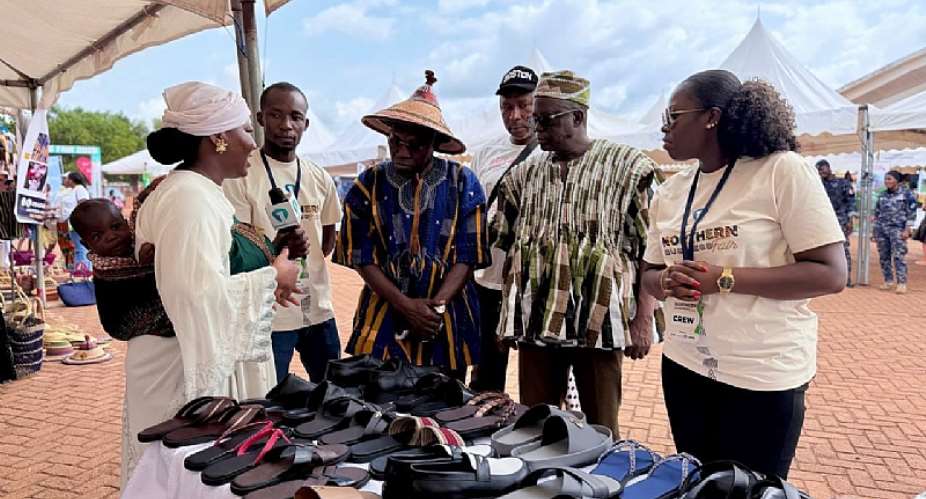
When we conceived the Northern Business Fair, our ambition extended beyond organising another successful event. We wanted to create a platform that would bring together entrepreneurs, investors, policymakers, financial institutions, development partners and business leaders from the Northern, North East, Savannah, Upper East and Upper West Regions to showcase the immense opportunities that exist in this part of Ghana.
What unfolded over the two days in Tamale exceeded our expectations.
As I walked through the exhibition stands, listened to entrepreneurs tell their stories, moderated conversations, and watched businesses forge new partnerships, one conviction became stronger than ever: Northern Ghana is ready for accelerated economic transformation.
Interacting with the Principal of the Dabokpa Technical Institute, Madam Mariam Mahama, it was clear that the institute is highly committed to empowering young people in Northern Ghana with the requisite technical skills to be self-employed. A vision that seeks to reduce the high rate of unemployment in the Northern part of the country.
The challenge is no longer whether the region has potential. The challenge is whether we, as a nation, are prepared to invest in that potential with the urgency it deserves.
Checking the beautiful Bolga baskets, hats, fugu and fabrics exhibited by Ritaasacks Enterprise, it was obvious that the country is missing out greatly on the economic prospects from the Upper East Region and by extension Northern Ghana.
Here are ten lessons I believe the government, investors and all stakeholders should take away from the Northern Business Fair.
1. Northern Ghana Is Rich in Enterprise
One of the biggest misconceptions about Northern Ghana is that opportunity is scarce. The fair proved the exact opposite.
We encountered entrepreneurs producing high-quality food products, shea-based cosmetics, textiles, leather goods, livestock products, innovative technologies and renewable energy solutions. Their creativity, resilience and determination were evident everywhere.
What many of these businesses lack is not vision—it is the resources to scale. The government should therefore focus on helping existing businesses grow into nationally and internationally competitive enterprises.
2. Agriculture Is Ready for Value Addition
One message echoed consistently throughout the fair: Northern Ghana must move beyond producing raw agricultural commodities.
The region has enormous potential in rice, maize, soybean, shea, groundnuts, livestock, sorghum and many other agricultural products.
The real opportunity lies in processing these products locally, creating jobs and retaining more value within the region.
If Ghana is serious about industrialisation, Northern Ghana should be at the centre of that conversation.
3. Finance Remains the Greatest Obstacle
Almost every entrepreneur I interacted with raised concerns about access to affordable financing. Many have viable businesses with growing demand but cannot expand because they struggle to secure investment or reasonably priced credit.
Zaaki Shoes is a footwear manufacturing company based in the Upper West Regional capital, Wa. Shoes from this company can compete globally; however, due to a lack of funding and large industrial equipment, they are unable to serve the entire nation.
Our SMEs do not simply need loans. They need patient capital, investment partnerships and financial products designed around their realities. Unlocking finance will unlock growth.
4. Northern Ghana Can Feed Ghana
The discussions at the fair reinforced a truth we sometimes overlook. Northern Ghana possesses the land, climate and agricultural capacity to become Ghana’s food basket on an even larger scale than it already is.
With improved irrigation, mechanisation, storage facilities and extension services, the region could significantly strengthen national food security while reducing our dependence on imported food.
This is not only an agricultural opportunity, it is an economic imperative.
5. Infrastructure Determines Competitiveness
In my conversation with the exhibitors, the CEO of KASI Collections in Bolgatanga, Ruth Abuntori, pointed to poor transport networks, inadequate storage facilities, unreliable utilities in some locations, and high logistics costs as barriers to growth.
These are not simply infrastructure challenges. They are business challenges. They influence the cost of production, the ability to compete and ultimately the willingness of investors to establish operations in the region.
6. Young People Are Ready to Build Businesses
One of the most inspiring aspects of the fair was the energy of young entrepreneurs like GirlFarmHub in Tamale. They are embracing technology, innovation and digital commerce while creating solutions to local problems.
They are not asking for handouts. They are asking for opportunities. Supporting youth entrepreneurship may be one of the most effective investments Ghana can make in reducing unemployment.
7. Women Continue to Drive Economic Growth
The presence and performance of women-owned businesses like pattyNat Foods, Lat and Lat Enterprise, IDH Women, Jay’s Adornment, among others throughout the fair was remarkable.
From agribusiness and food processing to fashion, retail and manufacturing, women demonstrated exceptional innovation and resilience.
Yet many continue to face disproportionate barriers in accessing finance and larger markets. Supporting women entrepreneurs is not merely about inclusion. It is smart economics.
8. Investors Need Better Access to Opportunities
The Northern Business Fair created important connections between businesses and potential investors.
However, many investors acknowledged that identifying investment-ready businesses in Northern Ghana remains difficult because information is fragmented.
The region needs stronger investment promotion, better business profiling, and more structured platforms that connect capital with opportunity.
9. Collaboration Is Becoming the Region’s Competitive Advantage
One of the most encouraging outcomes of the fair was the willingness of businesses from different regions to work together. Rather than viewing each other solely as competitors, entrepreneurs discussed partnerships, supply chains and market expansion.
This collaborative spirit could become one of Northern Ghana’s greatest economic strengths if properly nurtured.
10. It Is Time to Change the National Narrative
Perhaps the most important lesson from the fair is that Northern Ghana should no longer be viewed primarily through the lens of development challenges.
Instead, it should be recognised as one of Ghana’s greatest untapped economic opportunities. The region possesses abundant natural resources, entrepreneurial talent, a youthful population and significant investment potential.
What is needed now is strategic investment, deliberate policy support and sustained national attention.
Why Government Must Pay Greater Attention to Northern Ghana
Organising the Northern Business Fair gave our team a unique opportunity to engage directly with businesses across all five northern regions. Their stories revealed both extraordinary resilience and recurring barriers that require national action.
Investing in Northern Ghana is not about favouring one part of the country over another. It is about unlocking an economic engine capable of benefiting the entire nation.
When Northern businesses grow, Ghana creates more jobs. When agro-processing expands, we reduce imports and increase exports. When infrastructure improves, markets become more competitive. When SMEs flourish, government generates more tax revenue. When young people and women succeed in business, communities become more prosperous and resilient. These outcomes are not theoretical. They are achievable.
At Channel One TV, we believe the role of the media extends beyond reporting events. We have a responsibility to convene conversations, highlight opportunities and contribute to national development. The Northern Business Fair was created with that purpose in mind.
As we reflect on what we witnessed in Tamale, one message stands out above all others. Northern Ghana does not need sympathy. It needs sustained investment, enabling policies and committed partnerships.
If Ghana is looking for its next frontier of economic growth, it needs to look no further than the five regions of Northern Ghana. The future is already taking shape there. It is now up to all of us to ensure that this potential is fully realised.
With the huge success of this year's Northern Business Fair which is just the second edition, it is clear that the Fair has come to stay with traditional authorities, political leaders, exhibitors and patrons looking forward to an even bigger event next year.
Written By: Frema Adunyame Head of Events, Channel One TV & Project Lead, Northern Business Fair

 Chief Justice Baffoe-Bonnie was part of grand scheme to remove Torkornoo — Osahe...
 Gomoa West MP under fire for shoving off rival Captain Smart at 2026 Akwanbɔ Fes...
 Sycophants in NDC gov't seeking loopholes for Mahama's third term — Kwadwo Poku
 Police debunk viral flyer claiming AirPods, earpiece use while driving is illega...
 Tanker drivers suspend three-day strike after talks with BOSTenergies
 GNFS rescues trapped man, salvages GH¢50,000 in Suhum road crash
 GoldBod warns buyers as new XRF gold purity rules take effect September 1
 Africa must lead together with global insights for local impact – Kafui Prebbie
 S.Africa asks regional summit for unity after anti-migrant backlash
 Lamour leaves key FIFA position after criticising Infantino

