




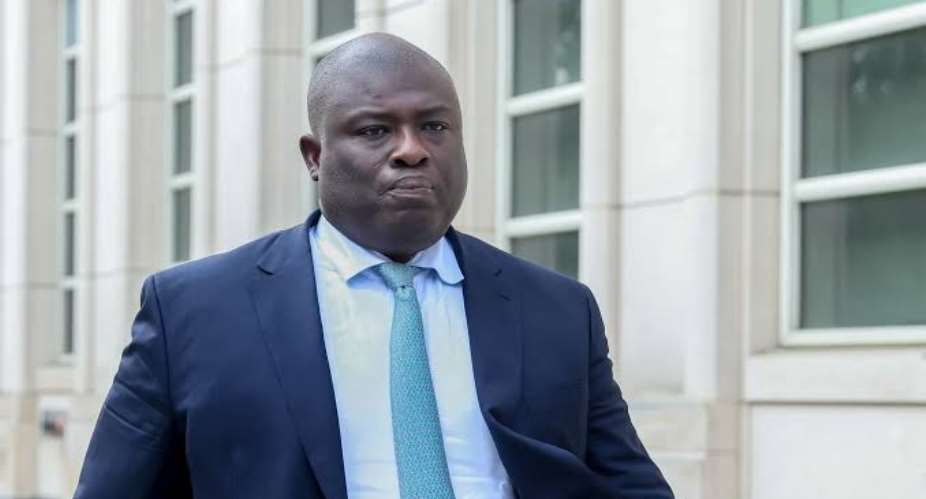
The conviction of Ghanaian investment banker Asante Kwaku Berko in the United States of America may result in criminal prosecutions in Ghana. The office of the Attorney General has revealed that it is collaborating with its US counterparts on the matter.
The office of the Special Prosecutor has also stated that it collaborated with the Department of Justice in securing the convictions.
Berko was convicted on three counts, including conspiracy to violate the Foreign Corrupt Practices Act (FCPA), violation of the FCPA, and conspiracy to commit money laundering.
The case involved a U.S. financial institution, Turkish energy companies, Ghanaian consulting firms and officials of Ghana’s Ministry of Power.
At the centre of the case was an effort by a Turkish energy company to secure an Emergency Power Agreement with the Government of Ghana for a power plant.
Asante Kwaku Berko
Asante Kwaku Berko was a senior executive at the U.S. Financial Institution involved in the transaction.
At the time of the alleged scheme, Berko was responsible for working on the transaction between the U.S. financial institution and the Turkish Energy Company.
The financial institution was the Turkish company’s client adviser and was involved in financing the project. Berko later returned to Ghana, where he served as Managing Director of Tema Oil Refinery.
The prosecution’s case was that Berko used his position and connections to facilitate payments of bribes to Ghanaian officials in an effort to secure the power agreement for the Turkish Energy Company.
The U.S. Financial Institution
The U.S. Financial Institution, Goldman Sachs, was a global investment banking, securities, and investment management firm.
It was the parent institution for which Berko worked and was involved in financing the Turkish power project.
The institution’s client was the Turkish Energy Company, which was seeking an Emergency Power Agreement with the Government of Ghana.
As part of the proposed transaction, the U.S. Financial Institution was to provide a US$190 million loan to the Turkish Energy Company. It was also to provide a US$75 million letter of credit to the Republic of Ghana, a requirement for completion of the deal.
The institution had an approximately 16% shareholding in the Turkish Energy Company and was expected to earn more than US$11.3 million in fees from the transaction.
The Turkish Holding Company
The Turkish Holding Company was the parent company of the entity responsible for the power plant.
It formed part of the corporate structure behind the Turkish Energy Company and was connected to the broader investment in the Ghanaian power project.
The Turkish Energy Company
The Turkish Energy Company was the company seeking to provide the power plant and secure an Emergency Power Agreement with the Government of Ghana.
It was a client of the U.S. Financial Institution.
According to the case presented against Berko, funds from the Turkish Energy Company were also used in transactions involving the Ghanaian consulting companies.
The prosecution’s case was that some of these funds ultimately facilitated payments to Ghanaian officials.
Ghana Consulting Company 1
Ghana Consulting Company 1 was one of the Ghanaian companies used by the co-conspirators in the movement of funds.
According to the case, the company was used to collect money from the Turkish Energy Company for purposes connected to the payment of bribes.
A director of the company is identified in the case as Co-Conspirator 1.
Ghana Consulting Company 2
Ghana Consulting Company 2 was another Ghanaian company involved in the alleged arrangement.
The company was allegedly used by the co-conspirators to collect reimbursement from the Turkish Energy Company for bribes allegedly paid by Berko and his co-conspirators to Ghanaian officials.
It was also used to invoice the Turkish Energy Company for payments due to Ghana Consulting Company 1.
Its principal is identified in the case as Co-Conspirator 4.
The co-conspirators
The case identifies four other individuals as co-conspirators. Their identities are not publicly disclosed in the descriptions provided in the case materials.
Co-Conspirator 1 was a director of Ghana Consulting Company 1.
The individual was involved with the Ghanaian company that was allegedly used to receive funds from the Turkish Energy Company for purposes connected to bribe payments.
Co-Conspirator 2 was a high-ranking officer of the Turkish Energy Company and a Turkish national.
Co-Conspirator 3 was also a Turkish national and a high-ranking officer of the Turkish Energy Company.
Co-Conspirator 4 was the principal of both Ghana Consulting Company 1 and Ghana Consulting Company 2.
The Ghanaian officials
Two Ghanaian officials are identified in the case materials. Their identities are not disclosed and they are referred to as Ghana Official 1 and Ghana Official 2.
Ghana Official 1 was an adviser to a high-ranking official at the Ministry of Power.
That superior is described in the case as the Senior Ghana Official.
Ghana Official 1 became a target of payments connected to the efforts to secure the power agreement.
Ghana Official 2 was a high-ranking official of the Ministry of Power.
The official’s position was significant because the Ministry was directly involved in the government’s consideration of the power project.
According to the case, payments to Ghanaian officials were intended to influence decisions necessary for the Turkish Energy Company’s power project.
The Senior Ghana Official
The Senior Ghana Official was a high-ranking official connected to the Ministry of Power and was the superior of Ghana Official 1.
The individual is not named in the case materials provided. The prosecution alleged that the Senior Ghana Official was among the government officials whose influence was important to the approval of the power project.
He was a signatory to the Emergency Power Agreement.
What the case was about
The central issue was an attempt to secure an Emergency Power Agreement between the Government of Ghana and the Turkish Energy Company.
The Turkish company needed government approval to establish and operate the power plant.
The U.S. Financial Institution had a significant commercial interest in the project because of its financing arrangements, equity interest and expected fees.
According to the prosecution, Berko and his co-conspirators devised a scheme to make payments to Ghanaian officials to influence the government’s decision-making.
The alleged payments were channelled through intermediaries, including Ghana Consulting Company 1 and Ghana Consulting Company 2. The prosecution said the arrangement involved more than US$1 million in bribes to Ghanaian government officials.
-citinewsroom
 I didn’t disrespect Nana Yaa Jantuah — Afenyo-Markin clarifies
 People and institutions at the centre of US trial and Asante Berko bribery convi...
 I’ll miss Mahama Ayariga, he doesn't hold grudges — Afenyo-Markin
 Ada Traditional Council summons NDC leadership, MP over disputed Asafotufiami ev...
 UTAG rejects GAUA discrimination claims over university remuneration disparities
 EOCO begins tracing assets linked to Asante Berko bribery conviction
 Nine suspects in Police grip over GHS30,000 Momo robbery and murder at Fiapre
 Busia has been treated unfairly in Ghana’s political history — Kufuor
 Government upholds Adamus mine lease revocation, assures workers of job security
 Ghana Maritime Authority facilitates repatriation of 12 stranded seafarers

