




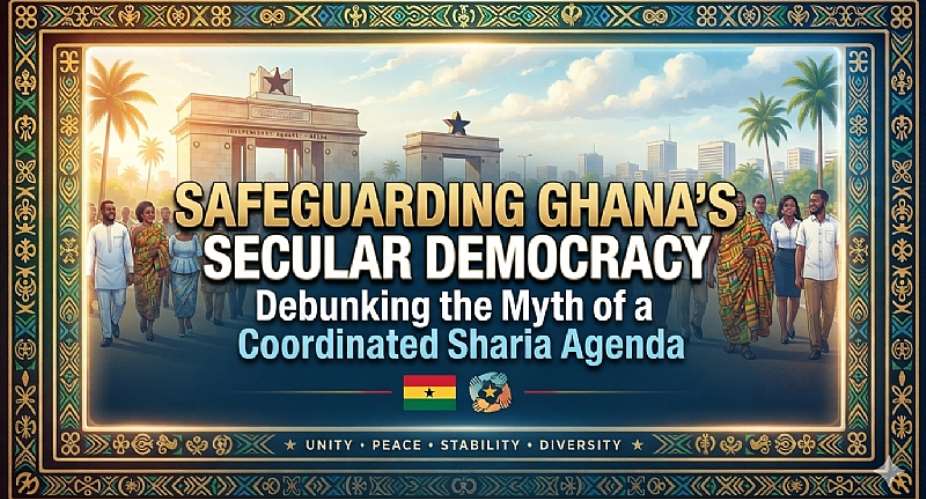
In recent months, a series of highly publicized socio-religious flashpoints have ignited fierce debates across Ghana’s digital public square and political landscapes. From the viral, extremist utterances of a radical cleric to complex standoffs over religious practices in historic mission schools, a palpable undercurrent of anxiety has emerged. Some commentators and citizens have advanced a troubling thesis: that these events are not isolated incidents, but rather a coordinated, state-backed agenda to systematically Islamize Ghana through the surreptitious introduction of Sharia law.
While these anxieties are a predictable sociological reaction to a rapid succession of highly charged headlines, a rigorous, evidence-based analysis reveals that the "Islamization agenda" is structurally impossible and legally unfounded. What the public is witnessing is not a subversive conspiracy, but rather the constitutional friction inherent in a developing pluralistic democracy. To preserve Ghana’s globally acclaimed record of interfaith cohesion, the public discourse must shift from reactionary speculation to institutional facts rooted in the supreme law of the land.
Fact-Checking the Fear: A Constitutional and Fact-Based Analysis
- The Supremacy of Secular Law over Extremist Rhetoric: The viral video of an Islamic cleric demanding extrajudicial violence over alleged blasphemy naturally provoked national outrage. However, the state’s legal structure explicitly neutralizes such decrees. Article 1(2) of the 1992 Constitution states: "This Constitution shall be the supreme law of Ghana and any other law found to be inconsistent with any provision of this Constitution shall, to the extent of the inconsistency, be void." Because Sharia penal codes contradict the fundamental human rights guaranteed under Ghanaian law, they hold no legal validity. Furthermore, the swift retraction of the statement—compelled by mainstream Islamic leadership, including the Office of the National Chief Imam—demonstrates internal containment of extremism rather than institutional complicity.
- Administrative Courtesy at the PAC vs. Legal Precedent: During an appearance before the Parliamentary Public Accounts Committee (PAC), the Headmistress of Islamic Girls’ Senior High School requested a separate repository box for the Holy Quran due to specific Islamic purification rites (ablution). While critics interpreted this as a rejection of other scriptures, official parliamentary records confirm she explicitly affirmed that both the Bible and the Quran are holy. The PAC’s subsequent acquiescence was a matter of administrative and religious courtesy, entirely separate from statutory law. Article 56 of the Constitution explicitly forbids Parliament from enacting any law establishing a state religion or creating a moving mechanism toward a non-secular state.
- The Basic School Language Policy and State Neutrality: The assertion that the Ministry of Education is using Arabic as a Trojan horse to institutionalize Islamic governance is contradicted by policy facts. The revised basic school curriculum categorizes French, Arabic, and Chinese strictly as optional electives, dependent entirely on local school resources and student choice. Crucially, the primary thrust of the state’s new language policy focuses on utilizing indigenous Ghanaian languages for instruction from Kindergarten to Primary 3 to improve foundational literacy. This aligns with Article 39(1) of the Directive Principles of State Policy, which mandates the state to foster the preservation of Ghanaian cultural values, rather than foreign religious frameworks.
The Legal Crux: Public vs. Private Status of Mission Schools
The ongoing friction surrounding institutions like Wesley Girls’ High School is frequently mischaracterized as a holy war, but it is fundamentally a constitutional debate over the jurisdiction of public funding versus institutional tradition.
To understand why demands for religious accommodation do not constitute an "Islamization plot," one must look at the public law status of these schools:
- The Partnership Acts and Legal Transition: Under the Education Act of 1961 (Act 87) and subsequently the Education Act of 2008 (Act 778), historic mission schools entered into a partnership with the state. By accepting state funding, absorbing public tax revenues for infrastructure, and placing their teaching staff on the payroll of the Ghana Education Service (GES), these institutions legally transitioned from private entities into public schools.
- The Burden of Public Law: In administrative law, once an institution is funded by the public purse, it is bound by the dictates of public law and constitutional mandates. It can no longer operate strictly as a private cloister. Therefore, when Muslim groups appeal for students to be allowed to fast or pray, they are invoking Article 21(1)(c) of the 1992 Constitution, which guarantees that all citizens shall have the "freedom to practise any religion and to manifest such practice."
- Balancing Autonomy with Freedom of Worship: While mission schools retain an interest in preserving their historical traditions and moral ethos—a right supported by freedom of association under Article 21(1)(e)—this autonomy cannot override the fundamental human rights of individual students. Article 12(2) mandates that fundamental rights must be respected by all persons and bodies, including school boards. Consequently, forcing a Muslim student to abandon a core tenets of their faith (like Ramadan fasting or private prayer) in a state-funded institution constitutes a violation of Article 35(5), which commands the state to prohibit discrimination on the grounds of religion. These demands represent an assertion of existing constitutional rights within public spaces, not a subversive attempt to dismantle Christian institutional heritage.
Strategic Recommendations and Policy Suggestions
To ensure that localized religious friction does not degrade into systemic national instability, state institutions and civil society must adopt the following structural measures:
- Codify a National Policy Blueprint for Public Institutions: The Ministry of Education, the National Peace Council, the Christian Council of Ghana, and the Office of the National Chief Imam must collaboratively draft a legally binding framework that balances institutional traditions with the constitutional rights of minority student populations. Relying on ad-hoc, reactionary solutions only deepens sectarian divides.
- Enforce Statutory Laws Against Incitement and Hate Speech: Security agencies and the National Media Commission (NMC) must rigorously enforce existing criminal statutes against individuals using digital platforms to incite religious animosity. Freedom of speech, as delimited by Article 21(2), does not permit declarations that threaten public safety or national security.
- Strengthen State-Sponsored Civic and Constitutional Literacy: The National Commission for Civic Education (NCCE) must launch a targeted campaign to educate the populace on the secular nature of the Ghanaian state. Misunderstandings regarding how the state functions allow misinformation regarding "religious takeovers" to thrive in echo chambers.
- Insulate Educational Policy from Sectoral Rhetoric: The Ministry of Education must maintain absolute transparency regarding curriculum adjustments. Public sensitization campaigns should precede policy implementation to prevent technical adjustments—such as expanding elective language options—from being weaponized by political or religious entrepreneurs.
Ghana’s enduring stability is not an accident of history; it is a conscious constitutional construct. The bedrock of this harmony is Article 35(5) of the Constitution, which strictly charges the state to "prohibit discrimination and prejudice on the grounds of place of origin, circumstances of birth, ethnic origin, gender or religion."
The recent controversies dominating the headlines are not symptoms of a hidden puzzle to enforce Sharia law. Rather, they are the predictable growing pains of a democratic society learning to negotiate the boundaries of religious expression within public, state-funded spaces. As a nation, our defense against sectarian panic must be a steadfast adherence to institutional facts, and our shield against polarization must remain the uncompromising supremacy of the 1992 Constitution.
Legal Citations & Academic References
- The Constitution of the Republic of Ghana, 1992.
- Article 1(2) – Supremacy of the Constitution.
- Article 12(2) & 21(1)(c) – Fundamental Human Rights and Freedom of Worship.
- Article 35(5) – Prohibition of Religious Discrimination.
- Article 56 – Prohibition of a State Religion.
- Statutory Legislation:
- Education Act, 1961 (Act 87) – Nationalization and state-partnership frameworks for mission schools.
- Education Act, 2008 (Act 778) – Public funding and governance structures of public senior high schools under the Ghana Education Service (GES).
- Academic & Jurisprudential Literature:
- Agyearo, K. (2018). Public Law, State Funding, and the Autonomy of Mission Schools in Ghana. Ghana Law Journal, 24(2), 115-142.
- Gyampo, R. E. V. (2021). The Church-State Partnership in Ghana’s Education Sector: Managing the Contradictions of Pluralism. Journal of Education and Public Policy, 13(1), 45-62.
- Asare, S. K. (2022). Constitutionalism vs. Institutional Tradition: Analyzing Freedom of Manifestation in State-Funded Institutions. African Human Rights Law Journal, 22(3), 301-325.
✍️ Submitted by:
Retired Senior Citizen
For and on behalf of all Senior Citizens of the Republic of Ghana 🇬🇭
Teshie-Nungua
[email protected]

 “I am upset by some free speech arrests sanctioned by police; it hurts governmen...
 WAEC withholds results of 9 BECE private candidates over suspected collusion
 Forestry Commission laments how illegal miners return to forest reserves with ne...
 Here are areas to face outages as ECG announces 4-day power outage scheduled mai...
 Mion NPP Chairman resigns barely two weeks after winning constituency polls
 Ghana’s Deputy Ambassador to Saudi Arabia Sanni Jajah dies
 Prof. Opoku-Agyemang reveals the driving force of her partnership with Mahama
 'Mahama gov’t has arrested more for free speech than Akufo-Addo's eight years' –...
 'Mahama called Akufo-Addo 'Akyem sakawa mafia'; Nana Yaa Jantuah called him Nebu...
 NPP Asante Mampong Parliamentary aspirant Beatrice Owarewa Siaw dies

