




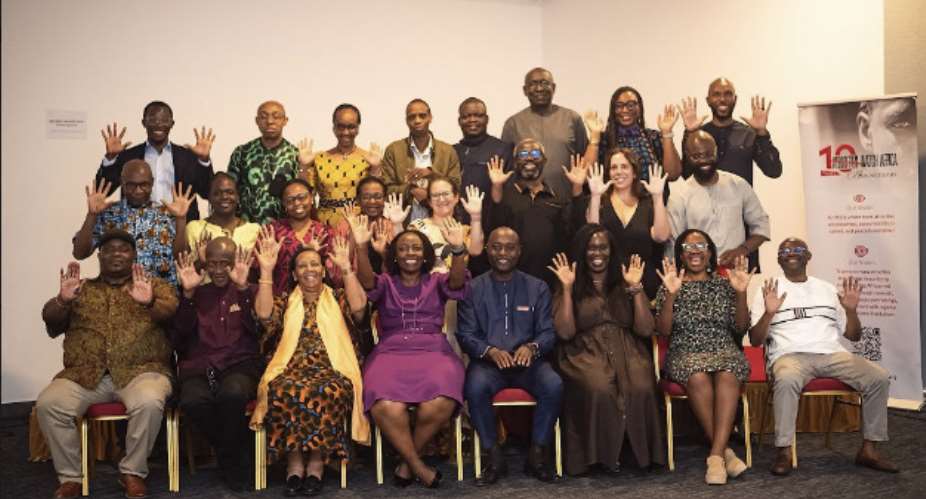
Leading experts have called for a fundamental overhaul of Africa’s approach to preventing and responding to mass atrocities, warning that the continent’s early-warning systems continue to be undermined by political inaction, structural inequalities, illicit financial flows and weaknesses in accountability.
The experts, comprising policymakers, civil society leaders, peace and security experts, human rights advocates and international partners made the call at a high-level gathering in Accra on July 22–23 to mark the 10th anniversary of the establishment of Atrocities Watch Africa (AWA). The convening was held under the theme “Atrocity Prevention in Africa: Looking Back and the Future Outlook.”
Participants examined the state of atrocity prevention, peace and security on the continent against what they described as a rapidly eroding global rules-based order, the rising influence of middle powers and rapid technological advances.
According to the Accra Agenda on Atrocity Prevention in Africa, these developments are producing contradictory realities. While technology has strengthened the ability to track and monitor threats, it has also created new vulnerabilities through online disinformation and the rapid spread of hate speech. At the same time, participants expressed concern about growing sovereign indifference to atrocities and increasing pressures on mechanisms designed to ensure accountability.
The gathering concluded that these developments are affecting social cohesion and complicating peace and security dynamics across Africa, while perpetuating what participants described as a persistent gap between early-warning systems and effective action to prevent and respond to atrocities.
Following interactive dialogues, panel presentations and plenary discussions, participants identified eight major areas requiring action.
Historical roots of African atrocities
Participants rejected approaches that treat atrocity prevention primarily as a technical problem involving early-warning systems, peacekeeping mandates and institutional capacity. They argued that such a technical framing risks erasing history, portraying emerging crises as spontaneous and isolated events and perpetuating the dehumanization of Africans.
Instead, the gathering called for contemporary atrocity prevention and response to be understood against the historical realities of transatlantic chattel enslavement, colonialism and apartheid.
The communique specifically pointed to ongoing conflicts in Sudan, the Democratic Republic of Congo (DRC), the Sahel and Ethiopia, arguing that the atrocities occurring in these areas should not be viewed simply as spontaneous events or the product of recent failures. Rather, participants described them as cumulative expressions of long-standing structural violence connected to historical conditions.
Participants consequently called for advancement of the decoloniality project through updated educational curricula and transformation of legal and cultural frameworks to address historical blind spots. They also emphasised the need to cultivate advocates capable of bridging knowledge gaps that continue to impede effective action against atrocities.
Follow the money behind violence
The gathering also placed the political economy of violence at the center of atrocity prevention.
Participants said resources and conflict in Africa are deeply interconnected, with contemporary atrocities frequently sustained by illicit and unaccountable flows of capital.
According to the communique, global and regional financial channels are being used to bankroll armed groups, finance mercenary operations and other non-state actors and contractors of atrocity, while also facilitating the unaccountable exploitation of local resources.
The consequences, participants noted, are ultimately borne by local populations who suffer the human and social costs of violence. They therefore identified the tracking of financial architectures as a foundational component of any comprehensive atrocity-prevention strategy. This includes monitoring money-laundering networks, opaque mineral supply chains and instances of state capture.
Rethinking ‘African solutions to African problems’
Participants also called for a careful reassessment of the frequently invoked principle of “African solutions to African problems.” While recognizing the importance of African agency in defining the continent’s problems and identifying solutions, they argued that many African crises are also shaped by global forces.
The communique notes that although the physical theatre of violence and suffering may be African, the structural architectures, economic motivations and political configurations behind many crises are frequently intertwined with actors and interests beyond the continent.
Participants therefore stressed that African agency must coexist with international action addressing the global roots and accelerators of African conflicts. They recalled that the obligation of multilateral action against atrocities as threats to international peace and security under the UN Charter remains an international responsibility.
The gathering warned that the “African solutions to African problems” narrative could be instrumentalized by sovereign states as a diplomatic shield to defer external accountability for mass atrocities under the guise of respecting African agency.
Participants also highlighted what they described as a contradiction in the international community, where external actors sometimes invoke the same principle to justify non-intervention or withdrawal of support during African humanitarian emergencies.
Early warning must lead to early action
A major concern emerging from the discussions was what participants described as the “early warning to early action” deficit. The problem, they said, is not necessarily a lack of information or warning about impending atrocities, but the failure to translate warnings into timely preventive action.
Participants pointed to political and structural challenges within the architecture of the African Union (AU) and its Member States noting that the warning-response gap frequently reflects a lack of political will, including the difficulty regional institutions face in compelling Member States to prioritize collective preventive action even when mass atrocities are imminent.
The gathering consequently called for monitoring mechanisms to be coupled with political execution so that analysis can be converted into effective and timely preventive measures.
AU Member States, regional institutions and development partners were encouraged to make deliberate and targeted investments to move regional peace architectures away from passive early warning towards decisive early action.
Africa urged to reclaim control over security data
Participants further called for greater African ownership of the data and technologies used to monitor atrocity risks. Against the backdrop of growing international interest in collecting and controlling data, the gathering endorsed the need for an African collective approach to data sovereignty, including determining who collects, analyses, owns and acts upon local security data.
The communique highlighted the importance of strengthening African capacity to monitor atrocity risks using Open-Source Intelligence (OSINT), geospatial tools and digital platforms.
It noted that these tools are increasingly accessible to African countries, either individually or collectively, but argued that deliberate investment is required to build indigenous, continent-based capabilities.
Participants called for these capabilities to be co-created with African input so that technological expertise can be developed and sustained within Africa.
They also called for a shift away from what they described as an asymmetrical model of data sovereignty, under which African institutions often generate raw data while depending on external partners for analytical frameworks, technical platforms and funding. Instead, they advocated a more equitable intellectual partnership.
Funding models must change
The gathering also called for an overhaul of the structural financing arrangements supporting atrocity prevention, human rights and international accountability.
Participants argued that historical atrocities continue to shape the institutional, normative and resourcing frameworks governing Africa’s relationship with international law and accountability systems, including international human rights and international criminal law institutions.
They expressed concern that heavy dependence by African institutions on external partners for foundational financing undermines local autonomy and the long-term sustainability of atrocity-prevention efforts.
The participants therefore called for restructuring international funding mechanisms to promote African ownership and solidarity, while encouraging new financing strategies capable of providing more independent, predictable and sustained support for African-led human rights organizations.
Stronger South-South solidarity
Participants also proposed developing a formal and institutionalized South-South framework to strengthen collaboration across regions. Such a framework, they said, could deepen and sustain constructive relationships among mutually reinforcing movements for human rights, peace and security across the Global South and help build a unified response to sustained and structural violence.
The gathering called for a renewed commitment to genuine and practical African solidarity, including ensuring that less-visible crises receive greater attention through coordinated civil society engagement, shared regional frameworks and mutual institutional support.
Accountability remains critical
The final area identified by participants was accountability, which they described as essential to breaking cycles of violence and impunity. The communique called for renewed efforts to promote accountability at national, regional and international levels.
It acknowledged the difficult relationship between African states and international justice mechanisms, particularly the International Criminal Court (ICC), and argued that this makes the development of African criminal justice mechanisms particularly important.
Participants therefore called for the timely ratification and implementation of the Malabo Protocol as part of efforts to strengthen African criminal justice mechanisms.
 “I am upset by some free speech arrests sanctioned by police; it hurts governmen...
 WAEC withholds results of 9 BECE private candidates over suspected collusion
 Forestry Commission laments how illegal miners return to forest reserves with ne...
 Here are areas to face outages as ECG announces 4-day power outage scheduled mai...
 Mion NPP Chairman resigns barely two weeks after winning constituency polls
 Ghana’s Deputy Ambassador to Saudi Arabia Sanni Jajah dies
 Prof. Opoku-Agyemang reveals the driving force of her partnership with Mahama
 'Mahama gov’t has arrested more for free speech than Akufo-Addo's eight years' –...
 'Mahama called Akufo-Addo 'Akyem sakawa mafia'; Nana Yaa Jantuah called him Nebu...
 NPP Asante Mampong Parliamentary aspirant Beatrice Owarewa Siaw dies

