




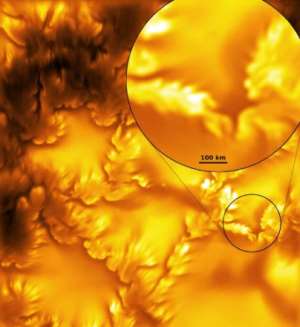
New images captured by the world's most powerful solar telescope have delivered the sharpest view yet of the Sun's surface, revealing small-scale swirling patterns that scientists had long predicted but never before directly observed on our star. The discovery, published this week in the journal Nature, could help explain one of solar physics' most persistent mysteries: why the Sun's outer atmosphere runs dramatically hotter than its surface.
Ocean Waves on the Surface of a Star
The phenomenon at the centre of the discovery is known as the Kelvin-Helmholtz instability (KHI) a physical effect that occurs when two fluids moving at different speeds slide past one another, creating a shear at their boundary that grows into wave-like, spiralling vortices. The pattern resembles nothing so much as breaking ocean waves, and that is precisely the point: KHI has been observed for well over a century in far more familiar settings in cloud formations, in lake and ocean waves during windy conditions, and in the swirling cloud bands of gas giants like Jupiter and Saturn, most famously at the edges of the Great Red Spot. The effect was first formulated by Lord Kelvin and Hermann von Helmholtz around 1870.
What had never been achieved, until now, was a direct, unambiguous image of KHI occurring in the Sun's own photosphere the visible surface layer, where hot plasma laced with magnetic field lines is in constant, turbulent motion.
The Instrument That Made It Possible
The breakthrough came courtesy of the NSF Daniel K. Inouye Solar Telescope, perched near the summit of the Haleakalā volcano on Maui, Hawaii. With a primary mirror four meters across, Inouye is the most powerful solar telescope on Earth, collecting seven times more sunlight than any rival instrument and resolving surface features as small as roughly 20 kilometers across an extraordinary feat given the Sun sits some 150 million kilometers from Earth.
Observing at a wavelength of 416 nanometers, the telescope produced what researchers describe as the highest-resolution image of the solar photosphere ever captured, revealing deformed boundaries around magnetic elements and ultra-fine striations rippling across the surface the telltale fingerprints of Kelvin-Helmholtz instability in action.
Confirming It Wasn't a Trick of the Light
An international team drawn from the National Solar Observatory (NSO), the NSF NCAR High Altitude Observatory, and Germany's Max Planck Institute for Solar System Research did not rely on the images alone. To confirm the vortex-like structures were genuinely KHI rather than an artefact of instrumentation, the team cross-checked their observations against the MURaM computer simulation code a model built on fundamental physical equations that reproduces photospheric processes too fine-grained to observe directly. The match between what Inouye photographed and what the simulations predicted was, in the researchers' own account, remarkably close.
Dozens of these whirlpool-like structures turned up clustered at the edges of magnetic regions across the observed field evidence, researchers say that the instability is not some rare or isolated event but an almost ubiquitous feature of the solar surface, occurring virtually everywhere magnetic boundaries exist.
Why It Matters: The Coronal Heating Puzzle
The significance goes well beyond a striking photograph. Scientists have long theorised that the Sun accumulates and stores vast reservoirs of magnetic energy through a process called "flux braiding," in which magnetic field lines twist and tangle together . That stored energy ultimately powers solar flares and coronal mass ejections the violent eruptions capable of hurling charged particles toward Earth, where they can disrupt satellites, power grids and communications infrastructure.
Researchers now believe KHI-driven turbulence may be a key mechanism feeding that process churning and mixing magnetic field lines at small scales in a way that helps explain both how the Sun builds up its magnetic energy stores and, potentially, why its outer atmosphere, the corona, burns far hotter than the surface beneath it. That temperature paradox a surface of roughly 5,500°C giving way to a corona of over a million degrees has puzzled solar physicists for decades.
A First, Even by the Standards of Solar Science
While KHI-like signatures have previously been inferred indirectly elsewhere in the Sun's environment including a 2024 analysis of Parker Solar Probe imagery that identified probable KHI features in the wake of a coronal mass ejection millions of kilometers above the surface this marks the first time the instability has been directly imaged in the photosphere itself, at the Sun's visible surface.
Lead author David Kuridze, an astronomer with the National Solar Observatory, described the underlying motivation in blunt terms: understanding what happens on the Sun at the microscopic level is essential to understanding the star as a whole.
For a phenomenon first described in Victorian-era physics textbooks, watching it finally play out on the surface of a star some 150 million kilometers away is a reminder of how much modern instrumentation is still capable of transforming settled theory into direct observation and how much remains to be learned about the mechanics of the star that governs life on Earth, including the space weather that increasingly shapes modern technological infrastructure.
Mustapha Bature Sallama.
Medical/ Science Communicator,
Private Investigator, Criminal investigation and Intelligence Analysis.
International Conflict Management and Peace Building.USIP
[email protected]
+233-555-275-880
References
heise online, "Kelvin-Helmholtz instability: Researchers detect effect on sun for first time" https://www.heise.de/en/news/Kelvin-Helmholtz-instability-Researchers-detect-effect-on-sun-for-first-time-11402181.html
"Inouye Solar Telescope Discovers Hidden Plasma Vortices on Sun" https://www.sci.news/astronomy/inouye-solar-telescope-plasma-vortices-sun-14974.html
CNN, "Unprecedented images reveal hidden process driving solar activity" https://www.cnn.com/2026/08/05/science/inouye-telescope-sun-images-magnetic-energy
National Solar Observatory, "NSF Inouye Solar Telescope Enables Major Discovery of a Hidden Solar Process" https://nso.edu/press-release/nsf-inouye-solar-telescope-enables-major-discovery-of-a-hidden-solar-process/
Gizmodo, "These Are the Sharpest Images Ever Taken of the Sun, and They Might Solve a Decades-Old Mystery" https://gizmodo.com/the-sun-looks-so-hot-right-now-2000794745
heise online (op. cit.)
ScienceAlert, "'Simply Astonishing': Record-Breaking Images Reveal The Sun Is Teeming With Whirling Vortices" https://www.sciencealert.com/simply-astonishing-record-breaking-images-reveal-the-sun-is-teeming-with-whirling-vortices
CNN (op. cit.)
The Astrophysical Journal, Paouris et al., "First Direct Imaging of a Kelvin–Helmholtz Instability by PSP/WISPR" https://doi.org/10.3847/1538-4357/ad2208


 “I am upset by some free speech arrests sanctioned by police; it hurts governmen...
 WAEC withholds results of 9 BECE private candidates over suspected collusion
 Forestry Commission laments how illegal miners return to forest reserves with ne...
 Here are areas to face outages as ECG announces 4-day power outage scheduled mai...
 Mion NPP Chairman resigns barely two weeks after winning constituency polls
 Ghana’s Deputy Ambassador to Saudi Arabia Sanni Jajah dies
 Prof. Opoku-Agyemang reveals the driving force of her partnership with Mahama
 'Mahama gov’t has arrested more for free speech than Akufo-Addo's eight years' –...
 'Mahama called Akufo-Addo 'Akyem sakawa mafia'; Nana Yaa Jantuah called him Nebu...
 NPP Asante Mampong Parliamentary aspirant Beatrice Owarewa Siaw dies

