




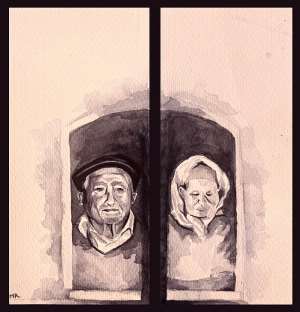
Morocco faces a dual challenge: traditional family-based elder care is eroding under urbanization, youth migration, and women’s workforce participation, while its rapidly aging population risks isolation and unmet health needs without formal alternatives. Healthy elders offer immense value as cultural preservers, civic leaders, and community stabilizers, as seen, for example, through Amazigh grandmothers safeguarding their indigenous lifestyle and Jewish elders maintaining Morocco’s Sephardic heritage at restored synagogues and care homes. Current underinvestment in formal care systems exacerbates vulnerabilities rather than harnessing this potential. This analysis examines demographic pressures, care gaps, and elders’ community contributions, and proposes a balanced national aging strategy that supports both family and institutional care.
According to projections from the High Commission for Planning (HCP), highlighted by journalist Sara Zouiten, Morocco’s population over the age of 60 will reach 5.8 million by 2030, representing 15.4% of the total population, driven by rising life expectancies and falling birth rates. Scholar Mostafa Bouaoudate observes that most elderly Moroccans live “almost entirely in ordinary houses,” even though informal caregivers often lack training or resources to meet their safety and accessibility needs. Religious and cultural norms emphasizing family duty, combined with high youth unemployment and declining household wealth, reinforce the dependence on family-based care. Further, strong stigma surrounds nursing homes, yet urban families are increasingly turning to such alternatives under modern pressures.
Models like Morocco’s Jewish elderly residences show formal care aligning with cultural duty. The American Jewish Joint Distribution Committee (JDC) supported homes that provide subsidized housing, medical supervision, and religious programming, allowing elders without local kin to age safely while maintaining religious traditions like Shabbat observance. Although new care centers signal progress, long-term eldercare in Morocco remains largely a familial, not a societal, responsibility, hindering the expansion of sustainable alternatives as the aging population grows.
Retirement often brings financial strain for elderly Moroccans, with only 16% receiving pensions and most relying on families already burdened by high unemployment and youth migration. Without reliable caregivers, residential isolation accelerates health decline, contributing to dizziness, falls, depression, and medication mismanagement, while stigma around nursing homes delays formal alternatives. In the Arab region, care remains overwhelmingly family-based and unpaid, delivered mainly by women under cultural norms that see elders as “treasures,” yet economic pressures increasingly undermine this tradition. This stems from a “male-breadwinner” social policy model that prioritizes men’s employment while assuming female family members will handle family care needs, rendering alternative formal options taboo for many. Even so, urban middle-class families are turning to alternatives that address the psychological and physical tolls of aging, improving quality of life and medication oversight where households fall short. Though historically home-centered, long-term care is gaining middle-class acceptance amid space constraints and financial limits, signaling increasing readiness for the expansion of formal systems.
Healthy elders serve as custodians of cultural continuity and institutional memory through mentorship, volunteering, and knowledge sharing. In Amazigh communities, older people help preserve language (awal), land ties (akkal), and culture (ddham) amid urbanization and climate change. Writer and activist Lillie Aissa-Jeanrenaud observes that Amazigh elders, especially grandmothers, “embody the link between our ancient customs and the rapid erosion of these ways of life,” cautioning that climate change, rural exodus, and market pressures make traditional ways of living seem outdated. She warns that these practices, which once wholly sustained these communities, are threatened both by environmental crises and by society’s waning appreciation of its roots. In this context, elders act as cultural anchors vital to community resilience.
Morocco’s Jewish community illustrates how elder care policy intersects with the survival of minority communities and the preservation of national heritage. As Serge Berdugo, President and Secretary General of CCIM, notes, Morocco has become “an international benchmark for heritage preservation,” with extensive restoration efforts of Jewish cultural sites overseen by community leadership. He also argues that Morocco’s identity includes a “Hebrew component” that is integral to the nation and that should be preserved through revitalization initiatives. Berdugo’s perspectives strengthen the point that Jewish elders are not only care recipients, but also indispensable to preserving Moroccan Jewish religious memory, communal continuity, and Morocco’s multicultural identity.
Once numbering approximately 300,000 in the mid-twentieth century, Morocco’s Jewish population has declined to around 2,000 today, with a disproportionately elderly demographic. As a result of the demographic decline, older members are not only valuable from a care perspective but also serve as critical repositories of institutional and historical memory. Moroccan-Jewish elderly represent one of the last living bridges to Morocco’s pluralistic past, preserving religious practices, linguistic traditions, and the lived experience of Muslim-Jewish coexistence.
At JDC-supported institutions like the Fred and Velva Levine Community Residence, residents celebrate Shabbat and other holidays together, sustaining communal life. Meanwhile, state-backed restoration efforts of 167 Jewish cemeteries, synagogues, and neighborhoods further reinforce elders’ role as stewards of Morocco’s multicultural heritage, much like how Amazigh grandmothers preserve indigenous knowledge. The Amazigh majority and Jewish minority both illustrate how elders stabilize identity amid urbanization, youth migration, and globalization. Ensuring the well-being of this demographic is not only a social policy concern, but also a cultural imperative; the loss of this generation risks the disappearance of irreplaceable knowledge and heritage.
When younger generations engage with elders, they inherit these long-established ways of living, learning to sustain endangered cultural practices. Beyond the Moroccan contexts, older adults everywhere strengthen intergenerational bonds through volunteering, mentorship, and caregiving. They transmit wisdom, help resolve conflicts, and promote social cohesion while also driving civic and economic life. In Morocco, over-60s had a 94.4% voter registration rate in the 2021 election, reinforcing them as essential participants in shaping policy. Investing in elder care and engagement not only protects their well-being but also sustains their capacity to enrich local communities, transmit culture, and strengthen democracy long-term.
Morocco urgently needs a coordinated national aging plan that invests in both formal care options and stronger family support systems. Addressing Morocco’s aging challenge will require a systematic approach that positions elder care as a national priority. Government ministries can play central roles in integrating healthcare provision and heritage preservation efforts. Civil society organizations are well-positioned to deliver community-based services and foster intergenerational engagement, while local authorities can adapt age-friendly infrastructure to distinct regional needs.
Institutions like the Mohammed VI Foundation for Solidarity can further support vulnerable elderly populations through targeted social programs. Rabat-based journalist Sara Zouiten recommends small, community-based day centers and residences offering medical care and social connection for isolated elders. Funded through government, NGO, and local partnerships, these facilities could ensure affordability and scalability. Such centers could also draw inspiration from Jewish models like JDC’s physiotherapy-equipped residences for over 47+ elders that combine healthcare and cultural continuity.
Trialing similar initiatives in cities like Casablanca and Fez could connect isolated elders, train young caregivers, create jobs, and revitalize heritage spaces. Building the eldercare workforce should focus on training unemployed youth as certified caregivers to meet rising demand while tackling joblessness. Importantly, Morocco’s Jewish community and diaspora networks can serve as key partners in developing culturally appropriate care models that sustain religious and cultural practices.
Meanwhile, financial reform must extend pensions and healthcare to informal workers and introduce care insurance for home-based families under economic strain. Urban policies that adopt age-inclusive design, such as safe housing, accessible neighborhoods, and intergenerational models like those in Canada and South Korea, would reduce loneliness and rebuild community ties. Education and community outreach can also drive cultural change. Incorporating lessons on elder respect into school curricula and encouraging youth volunteer programs would help dismantle stigma around formal care facilities and restore intergenerational solidarity.
Ultimately, Morocco’s current neglect of long-term care, caregiver training, and medication oversight leaves families overburdened amid rapid urban and workforce shifts. Framing elder care as a shared responsibility across public, private, and community actors enhances the feasibility and long-term sustainability of change. A national framework, supported by comparative studies of family and facility-based care, could identify effective models and ensure that elders remain healthy, active contributors to Morocco’s cultural and civic life.
By strategically investing in both formal care alternatives and strengthened family support systems, Morocco can ensure its elderly population remains healthy, engaged, and capable of serving as cultural guardians, civic leaders, and community stabilizers. From Amazigh grandmothers transmitting language, land ties, and culture against climate and urban threats, to Jewish elders in Casablanca’s JDC-supported residences preserving Sephardic rituals, multilingual liturgies, and synagogue traditions amid a demographic decline from 300,000 to 2,000 people, elders embody irreplaceable heritage links across a diverse Morocco.
A dual approach, addressing current policy gaps through national aging plans, caregiver training, age-inclusive urban design, and stigma-reducing education, directly transforms demographic pressures into social assets, as proven in the Jewish community’s hybrid model of philanthropic residences alongside state restorations of 167 synagogues and cemeteries. Ultimately, empowering elders preserves their wisdom and voter influence to build resilient, cohesive communities, honoring Morocco’s multicultural legacy. Preserving Morocco’s aging population, particularly historically significant communities like the Moroccan-Jewish demographic, requires coordinated action across government, civil society, and private actors to safeguard both social welfare and cultural memory.
Kai Schnitzius is a graduate of Seattle University, with a Bachelor of Arts in International Studies and Political Science.
References
Aissa-Jeanrenaud. “‘Wallah my grandmother knows everything’: how do we preserve the lifeways of our ancestors?” Shado Magazine. 10 June, 2024, https://shado-mag.com/articles/do/wallah-my-grandmother-knows-everything-how-do-we-preserve-the-lifeways-of-our-ancestors/
Ali, Siham. “The Elderly in Morocco, From Caring Families to Isolation.” Global Action on Aging. https://globalag.igc.org/pension/world/2009/morrocco.htm
Benichou, Galith. “Preserving Jewish heritage in Morocco.” Abramundi. 17 July, 2025, https://www.abramundi.org/post/preserving-jewish-heritage-in-morocco
Bouaoudate M, Harti JE, Maamar M, Abouqal R. Design of a typical residence for the elderly in Morocco. J Public Health Afr. 2018 Dec 21;9(3):835. doi: 10.4081/jphia.2018.835. PMID: 30687486; PMCID: PMC6326154.
Elasraoui, Zayneb. “Moroccan Culture & Elders: A Bond of Respect and Care.” MWN Lifestyle. https://mwnlifestyle.com/2025/03/06/moroccan-culture-elders-a-bond-of-respect-and-care/.
“For Elderly Moroccan Jews, Residence Offers Refuge and Community.” JDC: Our Stories. 16 January, 2013. https://www.jdc.org/stories/for-elderly-moroccan-jews-residence-offers-refuge-and-community/
Gressel, Madeline, et al. “In Morocco, Muslims and Jews study side-by-side but for how long? PBS News. 29 July, 2015, https://www.pbs.org/newshour/world/morocco-muslims-jews-study-side-side Gümüs, Kaan. “Between hope and distance – Morocco’s youth and their role in politics.”
Friedrich Naumann Foundation for Freedom. 10 September 2025, https://www.freiheit.org/morocco/betweeen-hope-and-distance-moroccos-youth-and-their-role-politics
Hussein S, Ismail M. Ageing and Elderly Care in the Arab Region: Policy Challenges and Opportunities. Ageing Int. 2017;42(3):274-289. doi: 10.1007/s12126-016-9244-8. Epub 2016 Apr 6. PMID: 28890585; PMCID: PMC5569126.
Roy, Gabriel. “‘We’re Still here”: Memory, Preservation, and Politics in Morocco’s Waning Jewish Community.” The Yale Globalist. 15 October, 2018. https://globalist.yale.edu/in-the-magazine/features/were-still-here-memory-preservation-and-politics-in-moroccos-waning-jewish-community/
“The contribution of indigenous elders: An example of intergenerational solidarity.”
McMaster University Optimal Aging Portal. 25 August, 2021, https://www.mcmasteroptimalaging.org/blog/detail/blog/2021/08/25/the-contribution-of-indigenous-elders-an-example-of-intergenerational-solidarity
Winans, Trena. “Embracing the Benefits of an Aging Population.” Senior Services Midland.
12 December, 2024. https://seniorservicesmidland.org/embracing-the-benefits-of-an-aging-population/
Zouiten, Sara. “How Morocco Can Prepare for an Aging Population.” Morocco World News.
9 June, 2015. https://www.moroccoworldnews.com/2025/06/210253/how-morocco-can-prepare-for-an-aging-population/
 “I am upset by some free speech arrests sanctioned by police; it hurts governmen...
 WAEC withholds results of 9 BECE private candidates over suspected collusion
 Forestry Commission laments how illegal miners return to forest reserves with ne...
 Here are areas to face outages as ECG announces 4-day power outage scheduled mai...
 Mion NPP Chairman resigns barely two weeks after winning constituency polls
 Ghana’s Deputy Ambassador to Saudi Arabia Sanni Jajah dies
 Prof. Opoku-Agyemang reveals the driving force of her partnership with Mahama
 'Mahama gov’t has arrested more for free speech than Akufo-Addo's eight years' –...
 'Mahama called Akufo-Addo 'Akyem sakawa mafia'; Nana Yaa Jantuah called him Nebu...
 NPP Asante Mampong Parliamentary aspirant Beatrice Owarewa Siaw dies

