




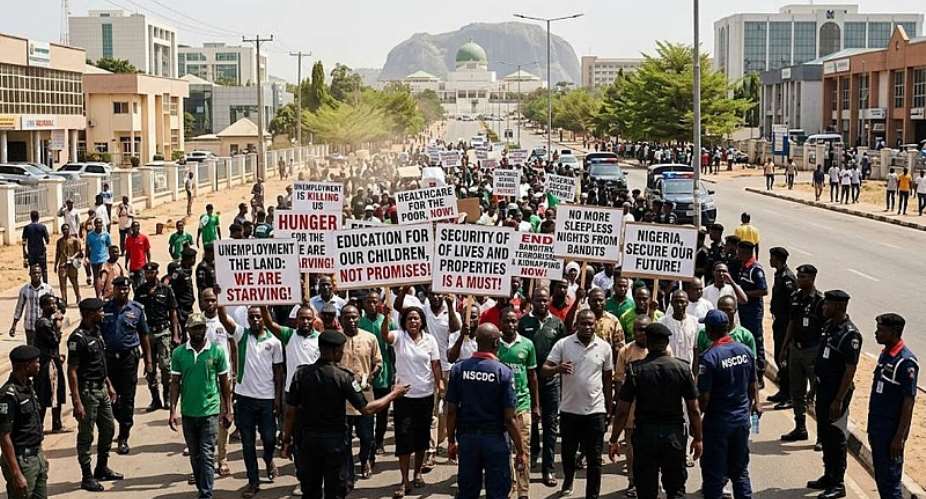
Democracy is at its healthiest when citizens are free to question those who govern them. The right to criticize public office holders is not a privilege granted by those in authority. It is one of the defining characteristics of constitutional democracy. Public officials derive their authority from the people, and they remain accountable to the people throughout their tenure. When citizens speak out against poor governance, failed policies or abuse of power, they are not undermining democracy. They are strengthening it.
Come to think of it: Nigeria's democratic journey can hardly be described as smooth. It has passed through military interventions, political instability and times dissent was viewed as rebellion. Having returned to democratic governance, Nigerians have become more vocal than ever before. Social media has amplified their voices, providing platforms where ordinary citizens can instantly comment on government activities. This increased participation is, in itself, a welcome development because it reminds elected officials that they govern under public scrutiny.
In the face of this positive development, however, has emerged a disturbing trend. In effect, public criticism is increasingly giving way to personal abuse. Political discourse has become saturated with insults, ridicule, vulgar expressions and offensive name-calling directed at the President, some governors, ministers and other public officials. Instead of challenging policies, many commentators now attack personalities. Instead of debating ideas, they descend into verbal warfare and degrading name-calling. This trend deserves careful reflection.
There is an important distinction between criticism and insult. Criticism examines conduct, decisions and performance. It asks whether policies are working, whether promises have been fulfilled and whether public resources are being properly managed. It relies on facts, logic and reason. Insults, on the other hand, target the individual rather than the issues. They often express anger but contribute little to public understanding. While criticism enlightens society, insults merely inflame emotions.
It goes without saying that a democracy that discourages criticism is in danger of becoming authoritarian. Leaders who surround themselves with praise singers and silence opposing voices gradually lose touch with reality. Without honest feedback, governments become complacent. Mistakes go uncorrected because nobody feels free to point them out. Corruption flourishes in an atmosphere where criticism is treated as disloyalty. History, both in Africa and elsewhere, demonstrates that societies suffer when leaders are insulated from public scrutiny.
Constructive criticism acts as an early warning to the system. It alerts governments to public dissatisfaction before frustration erupts into revolution. Citizens often recognise emerging problems long before official reports acknowledge them. Rising food prices, unemployment, insecurity, failing schools and deteriorating healthcare are realities experienced daily by ordinary people. When they speak about these issues, government should not see such criticism as hostility but as valuable information. Listening to the voice of the people is one of the greatest responsibilities of genuine leadership.
Unfortunately, some public office holders dismiss every criticism as politically motivated. They assume that anyone who disagrees with them must belong to the opposition or harbour personal animosity. Such an attitude weakens democratic governance. No administration possesses a monopoly of wisdom. Every government, regardless of its popularity or achievements, is capable of making mistakes. Mature leadership welcomes correction because it understands that governance is a continuous learning process.
At the same time, citizens also bear responsibilities. Freedom of expression carries with it the duty to exercise that freedom responsibly. Democracies flourish not merely because people are free to speak, but because they strive to speak truthfully, constructively and above all, respectively. The point being that the quality of public discourse influences the quality of democratic governance.
Indeed, there is something profoundly unsettling about the growing culture of vulgarity that now characterizes much of political discussion in Nigeria. Public officials are now being routinely subjected to abusive language that would never be tolerated in ordinary civil interaction. Families, including children, often become collateral victims of online hostility. Social media rewards outrage because offensive remarks attract attention, shares and reactions. Consequently, reasoned arguments frequently disappear beneath an avalanche of insults. This trend should concern every Nigerian, regardless of political affiliation. Today's target may be one political leader, tomorrow it could be another. If public conversation becomes permanently poisoned by abuse, everyone loses because democracy does not only depend on freedom of speech but also on civility.
Beyond that, African societies traditionally attach great importance to respectful communication. Respect for elders, community leaders and persons occupying positions of responsibility has long formed part of our cultural heritage. Respect does not require blind obedience. Our forebears disagreed with their leaders, corrected them and sometimes removed them from positions of authority. Yet they generally did so within accepted standards of decency. Firm disagreement was compatible with respectful language.
Some may argue that elected officials deserve no special courtesy because they are public servants. There is merit in insisting that public office should never shield anyone from accountability. Nevertheless, accountability and civility are not mutually exclusive. A President can be criticised vigorously without being subjected to degrading personal insults. A governor's policies can be condemned in the strongest possible terms without questioning his humanity. Ministers and legislators can be held accountable through evidence and persuasive argument rather than abusive language.
As a matter of fact, respectful criticism is often more effective than insults. Well-reasoned arguments persuade undecided citizens. They compel governments to respond with facts rather than emotion. They enhance the credibility of those making the criticism. Personal abuse, by contrast, often distracts attention from legitimate grievances. Instead of discussing substantive issues, public debate becomes consumed by arguments over the appropriateness or inappropriateness of offensive language. The original concerns are then forgotten.
There is also a practical reason why Nigerians should avoid habitual insults on their leaders. Public discourse shapes national character. Young people observe how adults conduct political disagreements. When children see respected members of society exchanging insults over politics, they might conclude that abuse is a normal method of resolving differences. Such a lesson weakens social cohesion and encourages intolerance.
The digital age has intensified these challenges. Messages composed in moments of anger can reach millions within minutes. The anonymity provided by social media encourages behaviour that many individuals would never display in face-to-face conversations. Unfortunately, algorithms often reward the most provocative statements while thoughtful contributions receive comparatively little attention. Citizens should therefore cultivate greater self-restraint before posting inflammatory comments that add heat rather than light to national conversations.
Still, none of this should be interpreted as a plea for silence. Silence in the face of bad governance is not patriotism. It is complicity. Nigerians should continue to demand transparency, accountability, competence and integrity from those entrusted with public offices. They should continue to question budgets, scrutinize public expenditure, challenge insecurity, expose corruption and insist upon policies that improve the welfare of the people. Governments that cannot tolerate criticism misunderstand the very essence of democratic leadership and should have business being in governance.
Politicians must remember that electoral victory is not a licence to ignore public opinion. Elections confer authority, but they do not extinguish the people's voice. Between one election and the next, citizens retain every right to evaluate government performance. Complaints from the public should not automatically be dismissed as opposition propaganda. Often, criticism reflects genuine hardship experienced by ordinary families struggling with economic difficulties, insecurity or inadequate public services.
Wise leaders understand that criticism can become a valuable resource. Rather than surround themselves exclusively with “loyal supporters”, they deliberately seek diverse opinions. They recognise that unpleasant truths are more useful than comforting falsehoods. Leaders who listen carefully to their critics frequently govern more effectively than those who hear only applause.
The relationship between citizens and government should not resemble warfare. Democracy is a partnership. Citizens elect leaders to serve the public interest, while leaders remain accountable to the electorate. Each side has obligations toward the other. Citizens should engage responsibly, while governments should respond honestly and transparently.
Political opponents also have responsibilities. They should avoid exploiting public frustration by encouraging hatred or spreading false information. Democracy benefits when opposition parties present credible alternatives rather than rely solely on emotional rhetoric. Constructive opposition enriches governance by expanding public debate and offering different policy options.
Nigeria's democratic future depends significantly on the quality of its public conversation. Nations are strengthened when disagreements produce better ideas rather than deeper divisions. The people of Nigeria should aspire to a political culture in which facts matter more than rumours, evidence outweighs emotion and persuasion replaces abuse. Such a culture does not emerge automatically. It requires deliberate effort from citizens, political leaders, journalists, civil society organisations and educational institutions.
The media also occupies a critical position in shaping democratic culture. Journalists should continue investigating public affairs fearlessly while maintaining professional standards of accuracy and fairness. Media organisations should resist the temptation to amplify inflammatory rhetoric merely because it generates traffic or attracts audiences. Responsible journalism can demonstrate that vigorous criticism and respectful language are entirely compatible.
Ultimately, democracy is not perfected by unquestioning loyalty or strengthened by uncontrolled social media hostility. It advances through continuous dialogue between government and the governed. Leaders must be humble enough to listen. Citizens must be courageous enough to speak. Both must be wise enough to preserve civility even in moments of profound disagreement.
Nigeria deserves a democracy where public office holders are subjected to relentless scrutiny but not needless humiliation; where criticism is fearless but fair; where citizens defend their constitutional freedoms without abandoning the values of respect and dignity that have long enriched our society. Our political disagreements should produce solutions rather than insults, accountability rather than animosity, and national progress rather than permanent bitterness.
The measure of a mature democracy is not the absence of criticism but the manner in which criticism is expressed and received. When citizens speak truth to power with courage and courtesy, and when leaders respond with humility rather than hostility, democracy grows stronger. That is the democratic culture to which the good people of Nigeria should aspire.


 Adjei Promises Fresh Drive at Defence Ministry After Mahama Reassignment
 WAEC Releases 2026 Private BECE Results, Withholds Nine Scripts Over Suspected C...
 Jinapor Reaffirms 10% Renewable Target by 2030, Warns Sector on Financial Discip...
 US Senate narrowly confirms Todd Blanche as attorney general in overnight vote
 From Tehran’s walls to the world: Iran’s visual propaganda as an art of war (2/2...
 'Do I look like somebody who can be bullied as Majority Leader?’ – James Agalga
 Contractor hands over Weija Children’s Specialist Hospital to govt
 Car dealer shot dead outside residence at Beach Drive Estate near Tuba
 Former TOR boss Asante Berko convicted in US over Ghana power plant bribery sche...
 NDC slams Afenyo-Markin's 'nobody' remark against Nana Yaa Jantuah

