




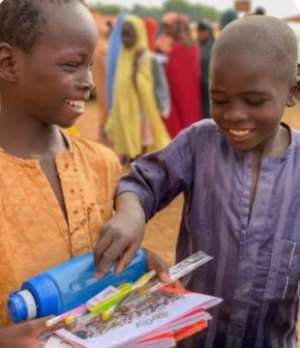
Al Jazeera's data unit, AJ Labs, has published a striking visual breakdown of global education spending showing that the world's wealthiest countries invest roughly 41 times more per child in education than the poorest a gap that dwarfs even the yawning income inequality between rich and poor nations, and one that has barely narrowed in three-quarters of a century.
The scale of the gap
The figures echo research compiled by the World Inequality Lab for the World Inequality Report 2026, which found that while the average person in the world's richest region North America and Oceania earns roughly 13 times more than someone in Sub-Saharan Africa, the disparity in per-child education spending is far starker. In 2025, Sub-Saharan African governments spent an average of just €220 per child on education, compared with roughly €9,025 per child in North America and Oceania more than 40 times higher, even after adjusting for differences in the cost of living between the two regions.
A gap that hasn't closed in 75 years
What makes the disparity especially striking, according to the underlying research, is its persistence. Sub-Saharan African countries spent only about 4 per cent as much per child on education as Europe and North America did back in 1950. That share rose modestly to around 6 per cent by 1980, but has since fallen back to roughly 2.5 per cent today meaning that despite seven and a half decades of overall global economic growth, the gap between what rich and poor societies can invest in their children's education has not closed. By some measures, it has widened.
Why it matters
Education is often described as society's most powerful equalizer the primary tool through which children born into poverty can improve their circumstances and narrow the gap with wealthier peers. But researchers argue that this equalizing tool is itself among the most unequally distributed resources in the world, undermining its capacity to do the very leveling work it is meant to perform. The consequences show up in overcrowded classrooms, teacher shortages, deteriorating school infrastructure and unaffordable fees across much of the Global South conditions that push children out of school prematurely and entrench cross-generational poverty.
A debt crisis compounding the funding gap
Part of the explanation lies beyond simple national choice. Developing countries are currently operating inside an international financial system that sharply constrains what governments can spend on schools and other public services. The World Bank has reported that developing countries transferred $741 billion more to external creditors in principal and interest between 2022 and 2024 than they received in new financing the largest net outflow of its kind in at least 50 years with low- and middle-income countries paying a record $415 billion in interest in 2024 alone. Analysts argue that this debt-service burden, rather than domestic governance failures alone, is a major driver of the persistent underinvestment in education across poorer nations.
Possible remedies
Among the responses gaining attention is the expansion of debt-for-education swaps, arrangements in which a creditor cancels or restructures part of a country's debt in exchange for a government commitment to invest the freed-up resources in agreed education programmes. A 2023 agreement between France and Ivory Coast, for instance, helped finance more than 30 schools in underserved areas a model UNESCO has proposed scaling up more broadly across the Global South as one practical route to narrowing the classroom funding gap that AJ Labs' data lays bare.
Mustapha Bature Sallama.
Medical/ Science Communicator,
Private Investigator, Criminal investigation and Intelligence Analysis.
International Conflict Management and Peace Building.USIP
[email protected]
+233-555-275-880
References
Al Jazeera / AJ Labs, "Rich countries spend 41 times more on each child's education," https://www.aljazeera.com/videos/
LSE Inequalities Blog, "The world's most powerful equalizer is very unequally distributed," by Ricardo Gómez-Carrera, World Inequality Lab, https://blogs.lse.ac.uk/inequalities/2026/05/13/the-worlds-most-powerful-equaliser-is-very-unequally-distributed/
World Inequality Report 2026, World Inequality Lab (Lucas Chancel, Ricardo Gómez-Carrera, Rowaida Moshrif, Thomas Piketty)
Al Jazeera, "The Global South is being forced to choose creditors over children," https://www.aljazeera.com/opinions/2026/7/25/the-global-south-is-being-forced-to-choose-creditors-over-children
World Bank, developing country external debt service data, 2022–2024


 Adjei Promises Fresh Drive at Defence Ministry After Mahama Reassignment
 WAEC Releases 2026 Private BECE Results, Withholds Nine Scripts Over Suspected C...
 Jinapor Reaffirms 10% Renewable Target by 2030, Warns Sector on Financial Discip...
 US Senate narrowly confirms Todd Blanche as attorney general in overnight vote
 From Tehran’s walls to the world: Iran’s visual propaganda as an art of war (2/2...
 'Do I look like somebody who can be bullied as Majority Leader?’ – James Agalga
 Contractor hands over Weija Children’s Specialist Hospital to govt
 Car dealer shot dead outside residence at Beach Drive Estate near Tuba
 Former TOR boss Asante Berko convicted in US over Ghana power plant bribery sche...
 NDC slams Afenyo-Markin's 'nobody' remark against Nana Yaa Jantuah

