




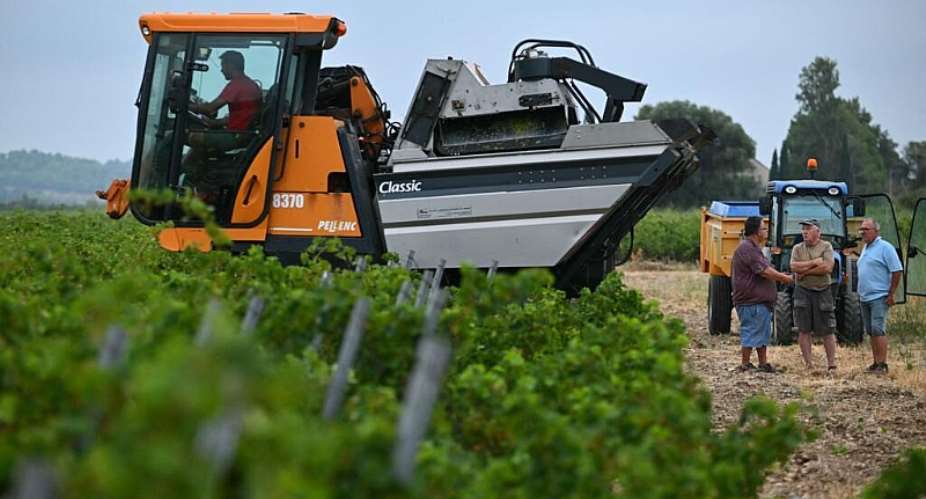
After weeks of scorching heat, winemakers in France are not heading into the harvest season the way they have historically.
“Thirty years ago, they started the harvest at the end of September and would sometimes end at the start of November,” said Alicia Dorey, a French lifestyle and wine journalist.
“Now it's beginning in August, so it's worrying.”
Wildfires in southwestern France have already destroyed more than 40,000 hectares in the Gironde department this year. And the increasingly volatile climate conditions are threatening the wine industry, one of France's most valuable economic sectors. Winemakers are adapting by harvesting early.
Elsewhere in Europe, rising global temperatures are helping a burgeoning winemaking industry in countries farther north, including Scandinavian countries. “This is why we find wine in England now and in Bornholm, an island off the southern tip of Denmark, among other places,” said Dorey.
Despite wine production appearing in unexpected places, experts say it's too early to expect a revolution in the industry.
“We cannot talk about a drastic shift yet,” said Hugo Seilly, senior lecturer at the Burgundy School of Wine & Spirits Business. Some vineyards in Norway and Sweden have reached economic sustainability by consistently producing quality grapes every year, he said. Yet Scandinavian entrepreneurs have been “driven by the size of their domestic market”, meaning they haven't yet moved into exporting their wine.
While the total surface area that Spain dedicates to vineyards is decreasing, it still leads the world with 930,000 hectares (2.3 million acres) followed by France with 783,000 hectares of of vineyards. China is in third place (733,000 ha) followed by Italy (728,000 ha) and Turkey (410,000 ha).
But a bigger geographic shift in wine production from south to north could come later. “There are a lot of questions about the sustainability of vines in Spain, as most of their vineyards are drastically drier," Seilly said. "They suffer more than other countries from climate change and its consequences.”
Access to water is also a big issue. “There are projections that most of Spain will have a desert-like climate by 2050, potentially wiping away large areas of production,” he said.
The sweet spot
Meanwhile, winegrowers in France are doing everything they can to save their crops. “In certain regions, they are going to be harvesting at night instead of during the day. This is to avoid grape oxidation (a chemical reaction that occurs when the compounds inside grapes meet oxygen) in the hot sun,” said Jeffrey T. Iverson, a wine journalist based in Paris.
French producers this year will be “nervous about the exceptionally high levels of sugar and low levels of acidity that the grapes will have as they come into the cellar", Iverson predicted.
“This is going to create different problems as they are fermenting these grapes and trying to create a wine with a similar profile to what they have traditionally made,” he said.
Iverson said other innovative methods include “pruning their vines in new ways to create foliage umbrellas that protect the grapes, finding forms of natural sunblock like talc powder to protect the leaves from being burned [and] using cover crops to retain humidity and protect the soil microbes”.
Some producers have resorted to pulling up their vines and replanting them using drought-resistant grape varieties better suited to warmer climates.
Irrigation is usually prohibited, “to maintain quality standards in terms of structure and concentration of aromas in the fruit”, said Seilly. Yet some authorities have “unfortunately given in to the sirens' chant and awarded the right to irrigate the vineyards to help the vine survive droughts like the one we have been experiencing across the country this year”.
The profile of French-produced wines is evolving as temperatures rise.
Viticulture has historically been possible between the 30th and 50th northern parallels, Iverson said. “France, at 41°N (in the south) and 51°N (in the north), has always been in that sweet spot. And the best wines tend to come from the northern reaches of those latitudes,” he said.
French wines have traditionally been characterised by higher levels of acidity and lower levels of alcohol. “With climate change, French wines are losing that finesse. These hotter summers are making the grapes ripen quicker, so you get higher levels of sugar, sometimes even [before] the aromas have a chance to develop. The levels of acidity also plummet.”
Winemakers are faced with a difficult choice, Iverson said: “either pick the grapes earlier to be able to retain that acidity or accept wines that are unrecognisable to what they made in the past”. A vineyard near Båstad, in southern Sweden, August 7, 2026.
Champagne in the UK?
Some French winemakers who depend on acidity are now investing in English vineyards. Once considered too cold a climate for wine, England has now warmed enough to be suitable for grape varieties used in Champagne.
Entrepreneurs even further north who venture into the winemaking business face their own unique set of problems.
Romain Chichery, a French winemaker who moved to Sweden with his girlfriend Emma Berto to produce wine there, said his adopted country would never be an eldorado for wine. “Researchers estimate that there are 4,000 hectares of viable land for producing wine. We could plant vineyards across this land, but it would be risky. You end up spending more energy maintaining the young vineyards than producing wine,” he said.
Chichery said newly planted vineyards are no match for the freezing Swedish winters. “Planting thousands of hectares of vineyards in the centre of Sweden would mean either setting ourselves up for failure or spending millions of euros to maintain the vineyards so they yield a decent production.”
Climate change will challenge wine producers across Europe in many different ways. “What is certain is that flexibility and expertise are going to be rewarded fully – and nobody knows better about both than independent winemakers,” Seilly said.

 'Do I look like somebody who can be bullied as Majority Leader?’ – James Agalga
 Contractor hands over Weija Children’s Specialist Hospital to govt
 Car dealer shot dead outside residence at Beach Drive Estate near Tuba
 Former TOR boss Asante Berko convicted in US over Ghana power plant bribery sche...
 NDC slams Afenyo-Markin's 'nobody' remark against Nana Yaa Jantuah
 Heavy security deployed to Laboma Beach ahead of demolition exercise
 James Agalga named majority leader following Mahama Ayariga's ministerial appoin...
 Omane was a true friend, a younger brother and a loyalist — Mahama eulogises lat...
 'My focus is on delivering the mandate' — Prof. Opoku-Agyemang responds to rumou...
 US appeals court halts construction of Trump’s $400 million White House ballroom...

