





This year's International Youth Day theme, "Different Contexts, Common Aspirations," highlights a powerful truth: despite wildly different national realities, young people everywhere share similar hopes for dignity, opportunity, and a sustainable future.
One of the most compelling places to observe this is China, where rapid societal shifts have created a unique arena for the younger generation, one filled with both challenges and possibilities for reinvention. To understand how this global pursuit is manifesting in the world's second-largest economy, one of the most revealing places to look is the digital realm.
Across Chinese social media, a highly specific vocabulary has taken root. Words like qumei (祛魅) – disenchantment – and huorengan (活人感) – the feeling of genuine humanity – are far more than fleeting internet slang. From a cultural perspective, they represent a profound generational shift. Rather than outright rejecting the highly structured world they inherited, Chinese youth are using this new language to question old orthodoxies, redefining the parameters of a meaningful life on their own terms.
The poster for the podcast series "The China Code", which explores the evolving ideas and lifestyles of young Chinese. 
The End of Blind Reverence
Perhaps no word better captures this shift than qumei (祛魅). The term describes a willingness to look beyond the aura surrounding things once considered unquestionably desirable, from prestigious careers and elite institutions to social status and symbolic success. It does not mean rejecting expertise or ambition, but refusing to confuse prestige with true value.
This same desire to let go of traditional expectations has driven the rise of ling fuzhai qingnian (零负债青年) – zero-debt youth. It represents a deep-seated urge to reduce unnecessary burdens, whether financial, emotional, or social, freeing young people from the crushing weight of traditional adult milestones.

Young visitors enjoy coffee inside a "cave café" in Guiyang, Guizhou Province, on May 10, 2026. [photo: CFP]
Rebuilding Everyday Meaning
Beyond chasing traditional milestones of success, many young people are asking a more fundamental question: how should life be experienced?
Renlei fengrong (人类丰容) – human enrichment – offers one answer. Borrowed from zoo terminology regarding animal welfare, the concept humorously suggests that humans, too, require novelty and stimulation to thrive in the "enclosures" of modern routines. It encourages people to explore niche interests and create moments of curiosity simply for the joy of the experience itself.
Meanwhile, huorengan (活人感) reflects a search for authenticity in an increasingly polished digital world. As AI-generated content and filtered realities become seamless and ubiquitous, imperfections – spontaneous reactions, emotional warmth, and small, relatable flaws – have gained premium value.
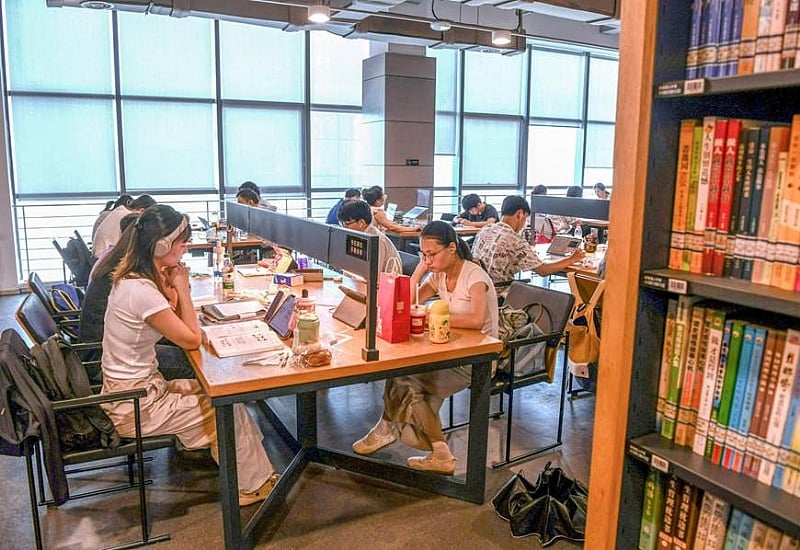
Young readers spend a summer day reading and studying at local libraries and bookstores in Tongling, Anhui Province, on August 4, 2026. [photo: CFP]
Pragmatism Over Orthodoxy
When it comes to navigating the actual challenges of this new reality, another buzzword, xiexiu (邪修) – unorthodox cultivation – reveals how young people navigate uncertainty. Originally a term from martial arts fiction describing unconventional training techniques, it has been repurposed online as a humorous celebration of creative problem-solving. It describes solutions that seem strange at first glance – but somehow work.
Behind the humor is a highly pragmatic attitude: effectiveness over convention. It is an acknowledgment that societal rules are merely tools to be utilized, not absolute truths to be blindly followed.
Together, these expressions reveal a broader shift: fulfillment is no longer strictly about maximizing achievement, but about curating the conditions for a sustainable, meaningful life. Success and ambition still matter, but they are increasingly viewed as tools for living well rather than the final destination.
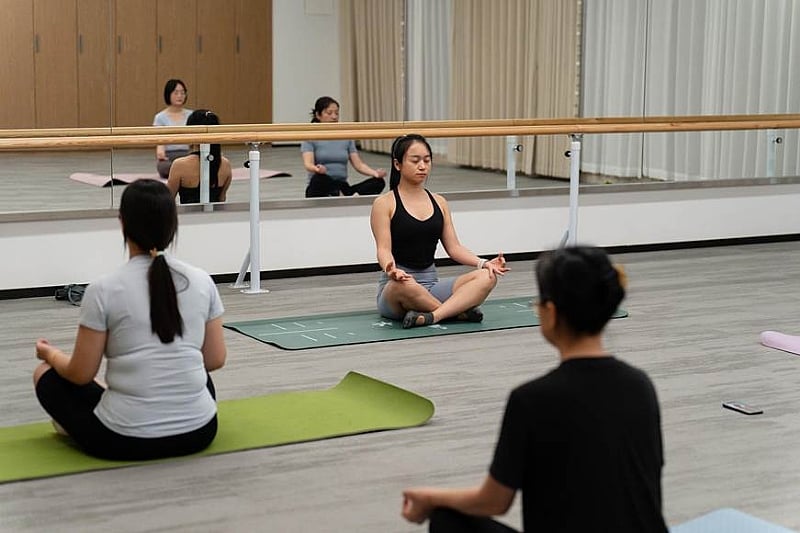
Participants attend courses such as yoga and traditional wellness practices at a youth night school in Jinhua, Zhejiang Province, on June 1, 2026. [photo: CFP]
A Generation Reinventing the Art of Living
Every generation creates words for experiences that previously had no name. The significance of China's youth buzzwords lies not in their novelty, but in what they reveal.
Taken individually, these expressions may look like playful internet trends. But taken together, they breathe life into the core message of International Youth Day. While Chinese youth are navigating their own unique social and economic realities – their "different contexts" – they share a "common aspiration" with their global peers: a resolute desire to live with greater authenticity, flexibility, and self-direction.
Language does not merely reflect social change; it helps people understand it. Each new buzzword gives shape to an emerging reality, allowing a generation to narrate its own story. Ultimately, the story these expressions tell transcends internet culture.
It is about a generation quietly reinventing the art of living.
One word at a time.
Qin Mengyao
CGTN Reporter

 NPP demands answers on funding for Mahama's GH¢2 diesel price relief
 Fire guts five shops in Prestea; GNFS saves eight others
 More Ghanaians refuse to pay bribes, but more officials demand money — GSS repor...
 Kpando Court jails woman three years for abducting eight-month-old baby
 Oliver Barker-Vormawor raises concerns over attempted deportation of Belgian nat...
 Ghana’s gold purchase programme recorded $1.7billion loss in 2025 – IERPP calls ...
 Government evacuates additional 150 Ghanaians from South Africa amid xenophobic ...
 NPP Vice Chairman rejects wife-snatching claims after marrying Fancy Gadam’s ex-...
 NDC pioneered one-member-one-vote system before Supreme Court ruling — Asiedu Nk...
 'Democracy will continue to attack you until you apologise to Ghanaians for your...

