




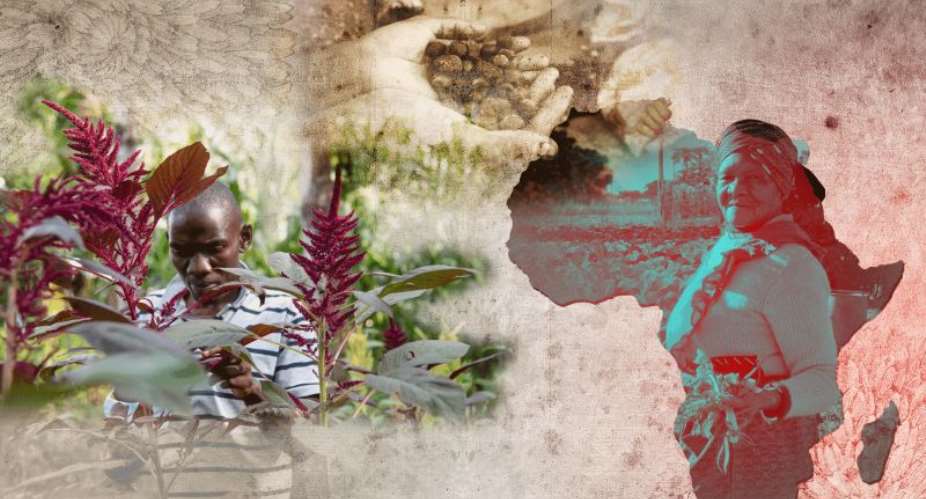
A civil society briefing on the African Union (AU) FMSS Policy Framework, the AU FMSS Strategy and Action Plan, and the AfCFTA IP Protocol/PVP Annex—with implications for small-scale farmers, seed sovereignty, and food sovereignty
The African Centre for Biodiversity is pleased to share our new civil society briefing paper, with French and Portuguese versions forthcoming, at a decisive and highly contested moment for African seed governance.
Across the continent, farmer-managed seed systems (FMSS) are finally receiving formal policy recognition—but this recognition is unfolding alongside powerful moves to deepen continental seed harmonisation, plant variety protection (PVP), trade integration, digitalisation, and intellectual property (IP) control.
The danger is that farmer seed systems may be recognised only to be made more visible, administrable, and absorbable into the very formal, commercial, and IP architectures that have long marginalised them.
The AU Seed Summit is due to take place in Eswatini from 5–7 October 2026, where the AU FMSS Policy Framework and Strategy and Action Plan are likely to be adopted. What is decided in this process could shape how African governments recognise, regulate, finance, and domesticate FMSS for years to come. It is therefore imperative that civil society—and especially small-scale farmers, women seed custodians, pastoralists, agroecology movements, and food sovereignty networks—engage urgently, strongly, collectively, and politically in this moment.
The paper argues that the AU FMSS process cannot be read in isolation from the African Continental Free Trade Area (AfCFTA) Annex on PVP, adopted under the AfCFTA IP Protocol architecture.
While the AU FMSS instruments are still open to advocacy and are largely normative and programmatic, the PVP Annex sits within a stronger treaty-based trade and IP framework. This creates a serious legal and political asymmetry: FMSS recognition may remain soft guidance, while breeders’ rights, PVP enforcement, and harmonised IP rules may move through harder legal channels as countries amend or adopt national PVP laws.
Although the PVP Annex is not a simple copy of the International Union for the Protection of New Varieties of Plants (UPOV) 1991, it broadly carries many UPOV 1991-style features:
- DUS-based protectability,
- Strong breeders’ rights,
- Limited exceptions,
- Protection terms,
- Enforcement mechanisms, and
- Remedies.
Its inclusion of African-specific language on disclosure; free, prior, and informed consent (FPIC); benefit-sharing; and Farmers’ rights is important, but far from adequate. Farmers’ rights remain largely framed as limited permissions or exceptions within a breeders’ rights system, rather than as living, collective rights grounded in farmers’ seed practices, Article 19 of the United Nations Declaration on the Rights of Peasants and Other People Working in Rural Areas (UNDROP), Article 9 of the International Treaty on Plant Genetic Resources for Food and Agriculture (ITPGRFA), agroecology, biodiversity, and customary seed governance.
This is the political danger at the heart of the current moment: the AfCFTA PVP Annex could become the new continental “African” benchmark for farmers’ rights—not by strengthening them but by narrowing them.
If national governments use the Annex as a template for domestic PVP laws, or as a reference point for FMSS policy, seed law reform, quality assurance, farmer-variety registration, public funding, or market access, then farmers’ rights may be defined downward across the continent. In effect, recognition of FMSS could be pulled into a UPOV-style hierarchy in which breeders receive enforceable legal rights, while farmers are left with conditional, limited, and administratively managed permissions.
The paper therefore warns against using the AfCFTA PVP Annex as a bridge into UPOV 1991 lock-in. At stake is whether FMSS will be protected as autonomous, farmer-led, rights-bearing systems, or made more visible to be registered, quality-controlled, digitised, monitored, extracted from, and incorporated into formal seed markets and IP regimes.
The paper calls for the AU FMSS process to be firmly grounded in farmers’ rights, UNDROP, agroecology, biodiversity, gender justice, digital sovereignty, and food sovereignty, and insists that the AfCFTA PVP Annex must not be allowed to set the ceiling for what African governments can and must do to protect farmers.
At this critical juncture, the demand is clear: protection, not absorption; seed sovereignty, not enclosure; farmer autonomy, not corporate, technocratic, or UPOV-style control.
Download the briefing paper here.

 NPP demands answers on funding for Mahama's GH¢2 diesel price relief
 Fire guts five shops in Prestea; GNFS saves eight others
 More Ghanaians refuse to pay bribes, but more officials demand money — GSS repor...
 Kpando Court jails woman three years for abducting eight-month-old baby
 Oliver Barker-Vormawor raises concerns over attempted deportation of Belgian nat...
 Ghana’s gold purchase programme recorded $1.7billion loss in 2025 – IERPP calls ...
 Government evacuates additional 150 Ghanaians from South Africa amid xenophobic ...
 NPP Vice Chairman rejects wife-snatching claims after marrying Fancy Gadam’s ex-...
 NDC pioneered one-member-one-vote system before Supreme Court ruling — Asiedu Nk...
 'Democracy will continue to attack you until you apologise to Ghanaians for your...

