




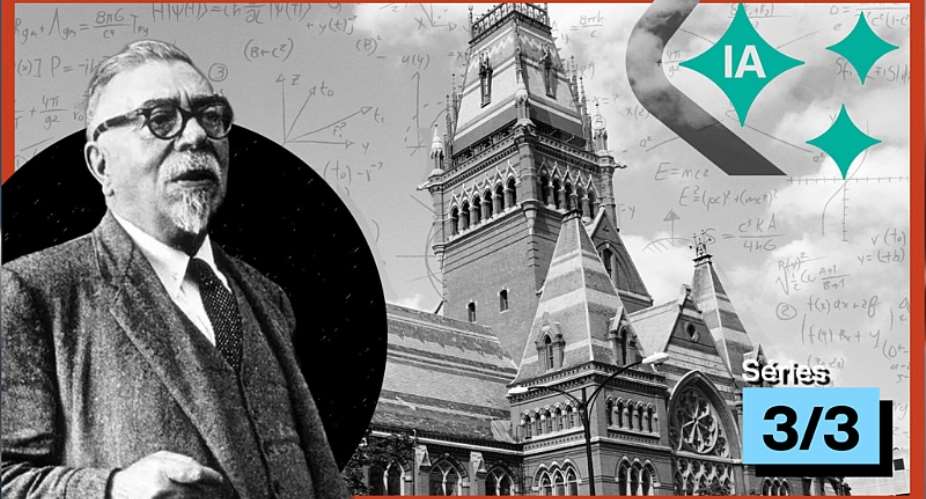
The story of the founding fathers of artificial intelligence almost always features British mathematician Alan Turing and his computing machine. John von Neumann is often presented as the mastermind behind programmable computers.
Names from the Dartmouth group – such as John McCarthy or Marvin Minsky – are also sometimes cited as the “inventors” of artificial intelligence.
However, another figure is often overlooked or relegated to the category of second-rate pioneers: Norbert Wiener, the founding father of cybernetics in the 1940s.
ChatGPT, Claude and the like can be regarded as the offspring of his ideas.
But whether Wiener, with his moral, political and scientific convictions, would acknowledge the authorship of these modern large language models is uncertain.
A young prodigy
Wiener was born on November 26, 1894, in Columbia, Missouri, into a family of Jewish immigrants from Eastern Europe.
His father, Leo Wiener – a highly strict professor of Slavic languages of Lithuanian origin – would “behave somewhat like Pygmalion and attempt to mould his son in his own image", said Pierre Cassou-Noguès, a philosopher at Paris 8 University and author of a fictionalised account of the mathematician's life.
"At least, that is how Wiener describes it in his autobiography,” he added.
Thus, Wiener became “a young scientific prodigy moulded by his father”, said Mathieu Triclot, a philosopher specialising in the history of technology at the Belfort-Montbéliard University of Technology.
He learnt to read before the age of four, graduated from high school at 11, earned a bachelor's degree in mathematics at 14 and completed his PhD in mathematics at Harvard at 18.
A few years later, the Massachusetts Institute of Technology (MIT) appointed him as one of its youngest professors.
It was in this role that, after World War II, Wiener developed his ideas which would “have an impact on many fields related to artificial intelligence such as robotics, control engineering and multi-agent systems”, said Philippe Mathieu, an artificial intelligence specialist at the University of Lille.
Read more AI before AI: The forgotten Soviet programme (1/2)
The science behind cybernetics laid the foundations as early as 1943 in a seminal article and is described in detail in the book “Cybernetics: Or Control and Communication in the Animal and the Machine”, published in 1948.
Cybernetics studies “certain phenomena of control and information transmission in the same way in humans, in the animal kingdom and in the world of machines”, Cassou-Noguès said.
In other words, for Wiener and “cyberneticists”, it is possible to draw parallels between the way the human brain and a machine process the information they receive.
Cybernetics, a 'super-science' attracting the biggest names in AI
In practical terms, these principles inspired Wiener to work on a new kind of anti-aircraft defence system during World War II.
He aimed to create a system capable of adapting in real time to the movements of missiles or aircraft and of learning from its mistakes. These were the very first tentative steps towards what we would now call “machine learning”.
“The central theme of cybernetics is understanding how an entity adapts to its environment and to the information available. Intelligence is seen as the result of interactions between an entity [living or not] and its environment,” Mathieu said.
“Logic, mathematics and electrical engineering, information theory, brain research and psychology – a whole bundle of scientific disciplines influenced the events that led to AI," writes Rudolf Seising, who specialises in the history of science and technology at the Deutsches Museum in Munich.
"In the first half of the 20th century, interdisciplinary considerations and, above all, transdisciplinary approaches to AI were mainly found under the umbrella of cybernetics, a 'super science'.”
This “jack-of-all-trades” aspect of cybernetics may also explain why Wiener is less often seen as the “father of AI” than Turing or von Neumann, who had a more direct and immediate impact on the development of computer science.
Read more The Dartmouth Workshop: The $7,500 investment that gave birth to AI (2/2)
But for Triclot, cybernetics' “indirect influence” on AI is considerable.
A series of ten meetings – the Macy Conferences on Cybernetics – brought together scientists interested in Wiener's ideas between 1946 and 1953.
Some of the biggest names in the history of AI, such as von Neumann and Claude Shannon, took part and identified themselves with cybernetics at the time.
One of the founding members of the Macy Conferences was the psychologist Joseph Carl Robnett Licklider, “one of the central figures in the history of American computing”, said Triclot.
He later became the head of the US Defense Advanced Research Projects Agency. He then "played a key role in the funding and development of the internet and also took an interest in human-computer interface technologies in the 1960s”, added Triclot.
At MIT, Wiener also supervised the work of another researcher who was pivotal to the development of modern AI: Walter Pitts.
In the 1940s, this logician laid the foundations for the first neural network model.
The Manhattan Project
This work, which is rooted in cybernetics, is essential to understanding today's large language models.
Whilst cybernetics itself may now seem a relic of the past, it paved the way, alongside neural networks, for the emergence of the branch of AI known as “connectionism”, which lies at the heart of the rise of ChatGPT and other 21st-century AI systems.
Wiener not only provided an “intellectual cradle” for AI, but “he was also one of the first to warn of its dangers”, Cassou-Noguès said.
Known for his strong-willed character and notorious outbursts of anger, Wiener understood why certain areas of scientific research were dangerous. Consequently, he refused to take part in the Manhattan Project, which led to the development of the first atomic bomb.
Following the bombings of Hiroshima and Nagasaki, Wiener even published a famous open letter in which he stated his intention to no longer publish research that could be misused for creating weapons of mass destruction.
Albert Einstein supported the move at the time.
But with cybernetics, he also foresaw “as early as 1948, the possibility of a fully or almost fully automated society. A development which, in his view, could just as easily lead humanity to a world free from the constraints of work or to a social hell of mass unemployment,” Cassou-Noguès said.
Wiener concluded that he should not abandon his work, precisely so that he could influence the direction of research in his field.
Often labelled as politically left-wing – US authorities suspected that he was sympathetic to the Soviet bloc during the Cold War – Wiener was thus one of the first to warn of the risk of social upheaval linked to the advent of machines.
In this sense, “cybernetics is a profoundly political endeavour, also driven by this fear of technological unemployment caused by machines that could replace workers”, said Triclot.
For him, it is “striking to read this as early as 1947”, at a time when computers were still very rare.
But for Wiener, this risk would only materialise “if we fall into the trap of treating human beings inhumanely”, said Triclot.
In other words, according to Wiener, robots would only be able to replace humans if we reduced humans to the status of robots by denying everything that distinguishes human beings from machines.
Even though the term “cybernetics” seems to have fallen out of use, the ideas of its founder are relevant today, at a time when companies are citing the triumph of AI to justify mass layoffs.
This article has been translated from the original in French.
 SpaceX rocket segment to leave crater when it slams into the Moon
 US revokes Brazilian ambassador's visa amid escalating diplomatic dispute
 US says Iran Hormuz deal could come 'today or tomorrow' as oil prices plunge
 GPRTU suspends planned fare increase after GH¢2 diesel price cut
 Sagnarigu: Curfew imposed on Damankunyili, Nyeshie after deadly communal clash
 AIDS Commission explains why more women test HIV positive than men
 Ga North Assembly explains why it demolished toilet under Pokuase Interchange
 GACL dismisses two airport car park workers over passenger extortion
 Burkina Faso warns of possible Bagre Dam spillage from August 11
 'UGMC is the worst hospital in Ghana' — Michael Blackson accuses hospital of mot...

