




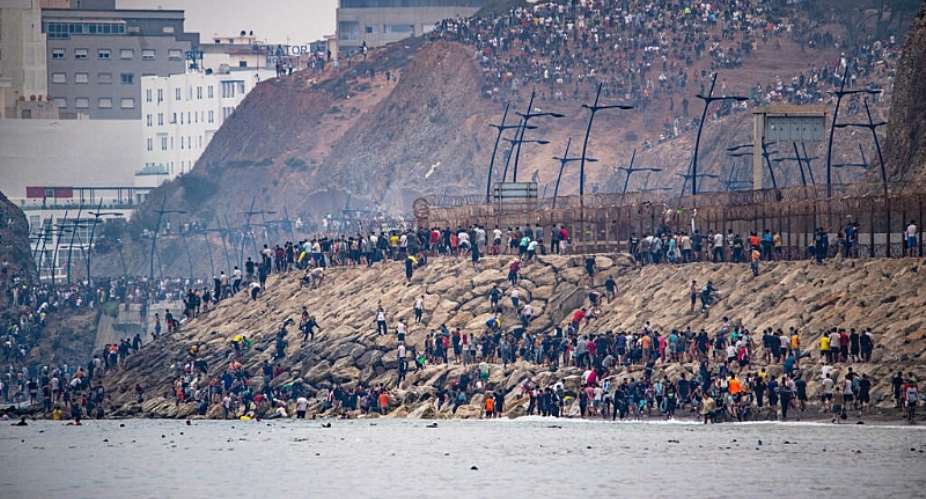
At least 72 people died last Thursday when a mass influx of migrants attempted to enter Ceuta, a small Spanish enclave bordering Morocco in North Africa, a figure confirmed on Monday by the Spanish authorities.
For its part, the Moroccan Ministry of the Interior gave an initial toll of 11 deaths on Sunday evening.
In total, more than 50,000 people managed to reach the enclave – most having swum by sea around the border barrier – but almost all have since been returned to the neighbouring Moroccan town of Fnideq.
Spanish authorities estimated that between 2,500 and 5,000 are still in Ceuta.
However, the circumstances surrounding this humanitarian disaster are still far from clear.
'Humanitarian emergency' as influx of migrants overwhelms Spanish enclave Ceuta
Territorial dispute
For Ignacio Cembrero, a specialist in migration in southern Europe, the chronology of events shows that Moroccan security forces were following orders – against the backdrop of Morocco's territorial claim to the enclave.
"Since Wednesday, there have been no further attempts by the Moroccan authorities, the auxiliary forces or the Moroccan police – who are usually deployed in large numbers at this border – to prevent anything," he told RFI.
"If they acted in this way, there is only one explanation. They did not do so of their own accord, and could only have done so because they received orders from the very highest levels." A migrant from Morocco is escorted by Spanish security forces after attempting to cross into Ceuta by sea, 1 August.
"Some Moroccan newspapers, starting with Le360 – which is, shall we say, close to the palace – expressed some regret at what was happening," he explained.
"They said it was going too far. But above all, they said that it was nonetheless an opportunity to sit down and negotiate the sovereignty of these two cities between Spain and Morocco. So, the Moroccan claim was put forward by a number of newspapers, starting with Le360 on Thursday evening."
What's in the landmark EU migration reform hardening border protections?
According to Cembrero, the influx poses a major challenge for the Spanish government, given that Morocco has demonstrated it is capable of taking over a Spanish city without having to send in its army, simply by allowing civilians to enter that city.
Some analysts suggested Morocco might have allowed migrants to cross the border to put diplomatic pressure on Spain, which has recently improved ties with Rabat's arch-enemy Algeria.
"It represents a major challenge because the Spanish state does not seem capable of defending these two towns in the face of what is often an organised influx of Moroccan migrants," Cemrero said.
"And it wasn't just Moroccans, there were also Algerians, even if they were in the minority. Spain is therefore at the mercy of having a good or cordial relationship with Morocco to ensure that it does not send these migrants there."
'A bloodbath'
Morocco does not recognise Ceuta or Melilla – another Spanish enclave at the other end of the Moroccan coast – as Spanish and has claimed sovereignty over them since its independence in 1956.
Although Madrid has avoided criticising Rabat over last week's mass arrivals, the Spanish government has responded firmly to territorial questions.
During televised remarks on Monday, Spain's Foreign Minister Jose Manuel Albares insisted: "That Ceuta and Melilla are an integral part of Spain's territory is unquestionable, for the whole world."
Meanwhile, Morocco said it had previously warned Spain that a recent Spanish court ruling on migrant sea arrivals was going to create a problem.
Spain's Supreme Court ruled on 8 July that migrants arriving by sea should not be returned as quickly as others and Madrid has blamed criminal gangs for spreading misinformation about the ruling.
"We discussed this ruling and its impact. We explained that this ruling was going to create a problem. And it did create a problem," a Moroccan senior official, speaking on condition of anonymity, told French news agency AFP on Monday night.
"It's simplistic to say that Morocco should just have used force to stop them. That is to completely misunderstand this phenomenon," he said. "Could Spain, seeing them coming, have done something to stop them simply using weapons and security forces? That's not possible."
For Cembrero, the Ceuta crisis is above all a human rights disaster, with a death toll that is likely to go up as authorities clear the area and attempt to identify bodies and contact families.
"The city of Ceuta has taken measures, with the help of the army – because the city is completely overwhelmed – to accommodate a maximum of 200 bodies," he says, citing Hespress, Morocco's most widely read newspaper, which said there were around 20 bodies at the nearby Tetouan mortuary.
"Almost all of the migrants who died drowned. A few died because the currents swept them against the rocks… but that is really a minority. The vast majority of migrants drowned. It is a humanitarian disaster, it is a bloodbath."
EU attracts record 64 million immigrants as migration patterns shift
For migrants who survive the sea crossing, the chances of reaching the European mainland via Ceuta or Melilla remain slim.
"When you leave Ceuta, there are customs and police checks. It's a sort of internal border, and those without the required documentation cannot board the boats heading for [Spain]. So arriving in Ceuta does not at all mean setting foot on the European mainland – far from it," Cembrero said.
The influx of migrants has caused panic amongst European leaders, for whom the issue of border controls within the Schengen Area remains highly contentious.
The topic will be discussed by interior ministers of the European Union member states during a videoconference on Tuesday.
This article has been adapted from the original version in French.


 Afenyo-Markin insists National Cathedral should be completed
 ‘GoldBod’s structure encouraging galamsey, buys whatever aggregators bring’ – Af...
 Mahama holds discussions with India's External Affairs Minister
 Afenyo-Markin leads NPP MPs to Christian Council over US$1.7 billion GoldBod los...
 Government moves to restore chiefs’ powers to summon subjects
 I’ll sue NPP if the constitutional amendment at delegates conference goes throug...
 NPP executives are like lions being led by a goat – Odike
 Two final-year students killed by speeding tipper truck in Ekumfi
 The Abanga twins: Two brothers, two parties, one political family
 Afenyo-Markin cautions NPP members against working secretly to undermine party


