




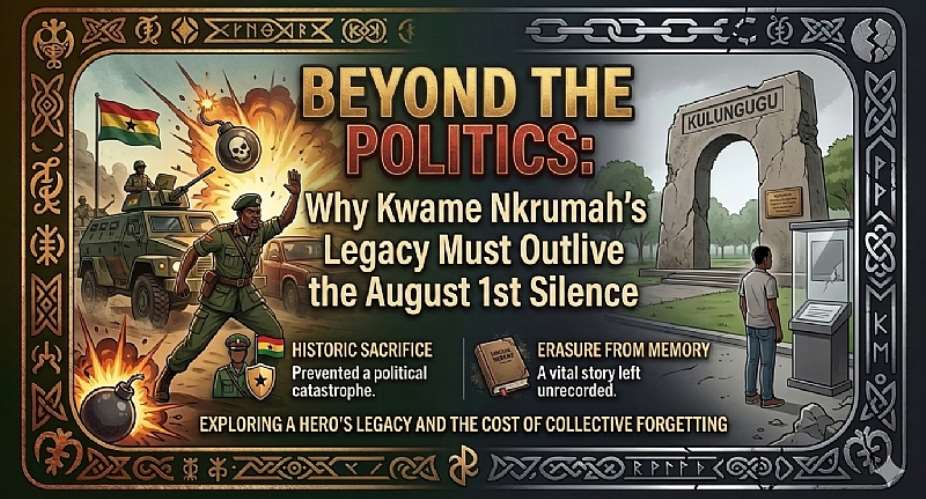
To many, August 1st came and went like any ordinary Thursday. There were no booming political rallies, no fiery television panels hosted by Kwesi Pratt Jnr, and no grand declarations from the parties that trace their lineage to the Convention People's Party (CPP). For a generation raised on short-form social media videos, the historical significance of August 1st—the day in 1962 when Osagyefo Dr. Kwame Nkrumah survived the horrific Kulungugu bomb attack—has seemingly faded into a quiet footnote. This silence begs a troubling question: Has Ghana’s founding father been reduced to a political prop, rolled out only when politicians need to score cheap debate points, or does his vision still pulse through the veins of our Republic?
The truth is both complex and urgent. While the recent legislative restoration of September 21st as the sole, definitive Founder’s Day is a victory for historical accuracy, we cannot afford to remember Nkrumah only when the calendar demands it. Nkrumah was not a perfect man, but he was a monumental architect. To ensure his blueprint for Ghana does not disintegrate into mere political rhetoric, we must look past the partisan weaponization of his name and actively preserve the tangible, intellectual, and structural pillars he left behind.
The Anatomy of the August Silence: Why Kulungugu Passed Quietly
The apparent quiet on August 1st is not a sign of a forgotten legacy, but rather a shift in how our national memory is being managed.
- The Shift to NkrumahFest 2026: Rather than focusing strictly on the trauma of the Kulungugu assassination attempt, Pan-Africanists and civil society groups chose this exact window to launch NkrumahFest 2026 at the Kwame Nkrumah Memorial Park, shifting the energy from mourning an attack to celebrating his 117th birth anniversary.
- Consolidation of Political Momentum: With Parliament’s recent amendment officially repealing the controversial August 4th holiday, Nkrumahist groups and political parties are heavily consolidating their resources, saving their major public demonstrations and commentary for the upcoming September 21st national holiday.
- The Hazard of Political Selective Amnesia: Far too often, modern politicians use Nkrumah’s name as a shield or a weapon—such as the recent public uproar and subsequent apologies surrounding political figures minimizing his achievements—which ironically distracts from the actual study of his policies.
Built to Last: The Indelible Footprints of Osagyefo
Nkrumah remains foundational to the daily survival of the ordinary Ghanaian through tangible, undeniable realities that transcend political parties:
- The Energy Bedrock: Every time a Ghanaian turns on a light switch or an industrialist powers a factory, they rely on the Akosombo Dam, a visionary project built when critics claimed Africa could not manage its own industrialization.
- The Economic Gateways: The Tema Motorway and the Tema Harbour remain the absolute lifelines of Ghana's import, export, and domestic transit networks more than six decades after their conception.
- Educational De-colonialization: Through the establishment of institutions like the Ghana National College and the University of Science and Technology (KNUST), Nkrumah built an intellectual pipeline designed explicitly to prove that the Black man is capable of managing his own affairs.
Recommendations: How Ghana Can Keep the Vision Alive
To prevent Kwame Nkrumah from becoming a historical ghost remembered only for political points, Ghana must adopt active, structural preservation strategies:
- Revamp the Basic Education Curriculum: The Ministry of Education must move beyond teaching basic dates (like his birth and overthrow) and introduce mandatory, critical analytical studies of Nkrumah’s economic policies, his industrialization drive, and his writings on Neo-Colonialism in junior and senior high schools.
- De-politicize National Monuments: Management of the newly renovated Kwame Nkrumah Memorial Park and historical sites like the Kulungugu bombing spot should be strictly overseen by independent historical societies and the Ghana Tourism Authority, keeping them insulated from changing partisan administrations.
- Establish an Annual State of Independence Lecture: Instead of waiting for ad-hoc political debates, Ghana should institute a mandatory, non-partisan annual lecture series every August to evaluate how well current governance models align with the foundational developmental goals laid out at independence.
- Invest in the Preservation of Archival Footage: The Ministry of Information, in partnership with the Ghana Broadcasting Corporation (GBC), must digitize and freely distribute archival audio, text, and film—such as the 1963 Kulungugu anniversary footage—making history accessible to the youth on digital platforms.
Kwame Nkrumah is not a man forgotten; he is a man whose legacy is too vast for the small minds of partisan politics to contain. When we look at the Akosombo Dam, drive down the Tema Motorway, or watch our scholars excel globally, we are witnessing Nkrumah’s living thoughts. Reducing him to a tool for election-year bickering diminishes the sacrifice of the school children who bled at Kulungugu and the heroes like Captain Samuel Buckman who shielded him. As we approach the legally restored September 21st Founder’s Day, let every Ghanaian remember that honoring Nkrumah is not about singing party praises—it is about picking up his unfinished blueprint of self-reliance, economic independence, and uncompromising African pride, and building the Ghana we were always meant to be.
What are your thoughts on how Ghana preserves its history? Do you think our founding father is only celebrated for political convenience? Share your views in the comments below or submit your opinion pieces to [email protected].
✍️ Retired Senior Citizen
For and on behalf of all Senior Citizens of the Republic of Ghana 🇬🇭
Teshie-Nungua
[email protected]


 The new cocoa laws are unconstitutional, breach property rights — Kofi Bentil
 Barker-Vormawor commends govt for separating Attorney-General from Justice Minis...
 As AU Chair I will push for inclusion of Caribbean in AfCFTA — Mahama
 Petrol pegged at GH¢14.53 as NPA announces new price floors for first pricing wi...
 Overnight rains trigger flooding in Sandema, disrupt traffic
 NDC gov't keeps deflecting when Ghanaians are suffering — Miracles Aboagye
 UAE introduces police clearance requirement for Ghanaians seeking employment vis...
 'Establish independent regulator to handle examination result appeals' — Eduwatc...
 Ukrainian drone strikes on Russia kill at least six, spark fire at Wildberries w...
 25 US states sue Trump administration over sweeping new tariffs

