




Services took the hardest hit from the pandemic. Informal service sector growth crashed to -34.6% in 2020 Q2, the single worst quarter in the ten year dataset, and it did not return to positive growth until 2022.
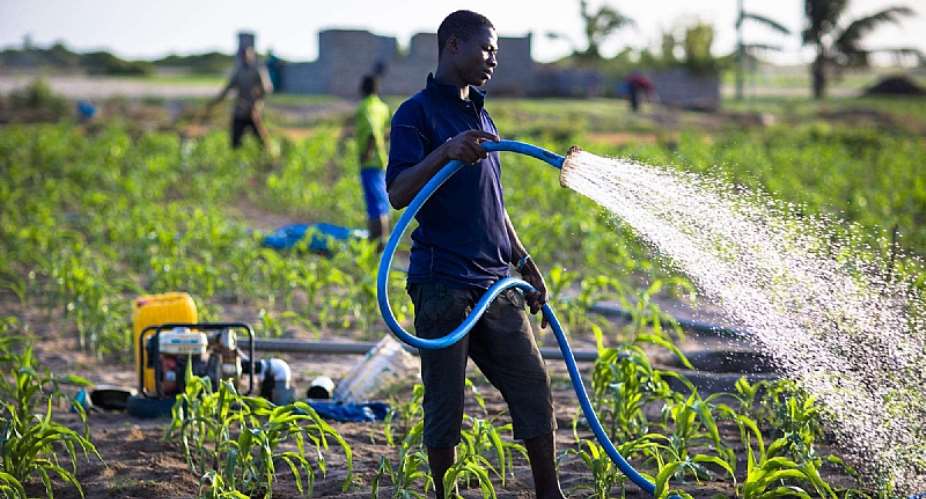
Agriculture became the sector's safety net. While services and industry were falling apart in 2020 and 2021, informal agriculture kept growing, averaging 8.2% in 2020 and 8.8% in 2021, its two strongest years on record.
2017 was the informal economy's best all-round year before the pandemic. Overall informal GDP growth hit its dataset-wide peak of 7.3% in 2017 Q3 (matched again in 2021 Q2, though for a very different reason), and industry hit its highest-ever mark of 18.3% in 2017 Q2.
Industry is the most unpredictable sector, swinging from -10.8% in 2014 Q1 to +18.3% in 2017 Q2. It is also the only sector still averaging negative growth in 2023, based on available data.
Agriculture and services tend to move in opposite directions. When one is squeezed, informal workers appear to shift toward the other, so the two rarely rise or fall together.
Why This Matters
Most working Ghanaians earn their living in the informal economy: traders, drivers, artisans, roadside food vendors, small repair shops, and seasonal farm labourers. When the numbers in this report say the service sector fell by more than a third in a single quarter, that is not an abstract statistic. It is hundreds of thousands of real incomes disappearing almost overnight, with no formal safety net to catch them.
The flip side is encouraging: agriculture stepped in and grew fastest exactly when services were struggling, which likely kept many households afloat. But that is a coping mechanism, not a solution. If nothing changes, the next shock (whether a health crisis, a fuel price spike, or a currency slide) will hit informal service workers just as hard, and industry, already the weakest link, may not recover in time to help.
Detailed Analysis
1. The COVID-19 shock hit services almost overnight
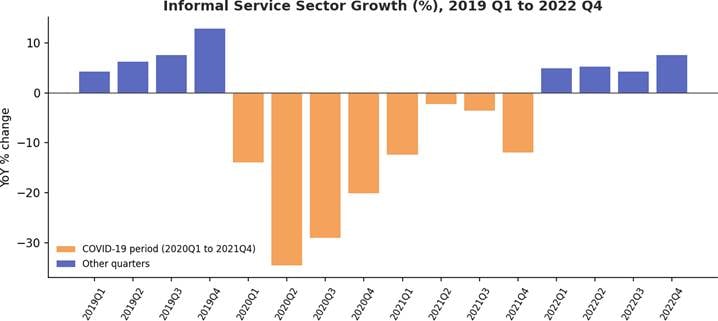
Chart 1: Informal service sector growth, 2019 Q1 to 2022 Q4. The COVID-19 period (2020 Q1 to 2021 Q4) is highlighted in orange. Source: Ghana Statistical Service, quarterly informal sector estimates.
Ghana's government imposed a partial lockdown on Accra and Kumasi from 30th March to 20th April 2020, right at the start of the second quarter. The informal service sector, built on face to face trade, transport, and hospitality, could not absorb that kind of stop. Growth fell from -13.9% in 2020 Q1 to
-34.6% in 2020 Q2, and stayed deeply negative through 2021, averaging -24.4% for the year of the lockdown and -7.6% the year after.
2. Agriculture absorbed workers pushed out of services
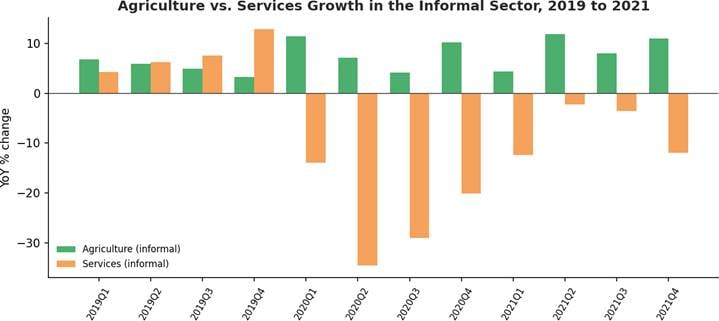
Chart 2: Agriculture versus services growth in the informal sector, 2019 to 2021. Agriculture rises through the same quarters services fall. Source: Ghana Statistical Service, quarterly informal sector estimates.
At the same time services were collapsing, informal agriculture was accelerating: 11.4% growth in 2020 Q1, 7.1% in 2020 Q2, and a run of double digit quarters through 2021 (11.9% in Q2, 11% in Q4). This lines up with what many Ghanaians experienced directly: people who lost trading or transport income moved toward farming and food related work, because land and family farms are a fallback that formal job loss does not touch.
3. 2017 was the high point for informal industry and overall growth
Before the pandemic, 2017 stands out as the strongest year across the board. Industry growth hit 18.3% in Q2 and 16.3% in Q1, while overall informal GDP growth reached 7.3% in Q3, tied for the highest point in the entire dataset. This was a period of broad-based expansion, not one sector carrying the rest. That same 7.3% mark was matched again in 2021 Q2, but for a very different reason: agriculture was surging while industry and services were still deeply negative, so that spike reflects one sector propping up the total rather than broad-based strength.
Since then, no year has matched that combination of strength across agriculture, industry, and services at the same time, which is worth keeping in mind when judging how strong the current recovery really is.
4. Industry is the sector that swings hardest, and it still has not recovered
Industry recorded both the lowest reading in the dataset (-10.8% in 2014 Q1) and the highest (18.3% in 2017 Q2). That volatility has continued into the recovery period: industry growth was negative in half of 2022 quarters (Q1 and Q4) and both quarters of 2023 available in this dataset (2023 Q1: -2.6%, 2023 Q2:
-1.8%), even as agriculture and services returned to steady, positive growth.
This suggests informal industrial and related activity are lagging well behind the rest of the informal economy in bouncing back.
5. When one sector falls, another tends to rise
Looking across all 38 quarters, agriculture and services move in opposite directions more often than not: when we measure how closely their growth rates track each other, the relationship is negative. In practice, that lines up with the pattern above: workers do not sit idle when one part of the informal economy shrinks, they shift toward whichever part still has room for them, most often agriculture.
That flexibility is a strength of the informal sector, but it also means growth in one area can mask real distress in another, which is exactly why looking at all four indicators together, rather than headline GDP alone, matters for anyone trying to understand what is actually happening to livelihoods.
Recommendations
1. Ghana Statistical Service: continue the quarterly informal sector series and break industry and services into sub categories (for example construction versus manufacturing, or transport versus trade), so future policy can target the exact part of the sector that is struggling.
2. Ministry of Food and Agriculture: invest in storage, extension services, and market access for informal agriculture, since this report shows the sector is the one workers rely on when other parts of the economy falter.
3. Social protection agencies (for example LEAP and NBSSI): design an emergency livelihood support scheme for informal service workers that activates automatically once quarterly service growth falls below a set threshold, rather than waiting for a full crisis to trigger a response.
Methodology Snapshot
This analysis draws on Ghana Statistical Service (GSS) quarterly informal sector estimates covering 38 quarters, from 2014 Q1 to 2023 Q2. The method is a descriptive trend and comparative growth-rate analysis across the four reported components (agriculture, industry, services, and overall informal GDP), cross-checked against publicly documented events, such as the timing of Ghana's 2020 COVID-19 restrictions, to confirm that the patterns in the data match known real-world developments.
Limitations
● The dataset ends at 2023 Q2, so it does not capture anything from mid-2023 onward.
● These are year on year percentage changes, not absolute values, so they show direction and speed of change but not the actual size of each sector.
● Informal sector activity is inherently hard to measure, and GSS estimates rely on surveys and modelling rather than complete administrative records.
● The data is national, so it may hide very different realities across regions or between urban and rural areas.
● Industry and services are each reported as a single figure, with no breakdown by sub-activity, which limits how precisely the causes of any swing can be pinned down.
Yussif Mohammed, Andy Sevordzi, Rudolph Djirackor, Franklin Owusu Kwakye
GILMA Research and Consulting
Sources / References
- Ghana Statistical Service (GSS). Quarterly Informal Sector GDP Growth Estimates, 2014 Q1 to 2023 Q2.
- UNU-WIDER. COVID-19 and the Socioeconomic Impact in Africa (background note on Ghana's March-April 2020 partial lockdown).

 Ato Forson pays tribute to Omane Boamah, describes him as selfless and patriotic...
 Appeal Court backs District Court ruling against Zuriah FM broadcaster
 'Don't be negligent, verify before you buy' — CDA Consult on counterfeit goods a...
 Tension brews as Kpandai and Nkanchina communities threaten to shut down nursing...
 'Complete existing Accra-Kumasi Highway works before expressway' — Minority tell...
 'Fix existing Accra-Kumasi highway; expressway is not the solution to current pr...
 Delegate system is destroying Ghana – Asiedu Nketiah
 Ghana Water Ltd announces three-day shutdown of Kpong-Tema pipelines for mainten...
 Education Minister's claim on recruitment of 2023-trained teachers is factually ...
 Fuel intervention: 'Global shocks affect Ghana; NDC must admit that'— Adomako Ki...

