




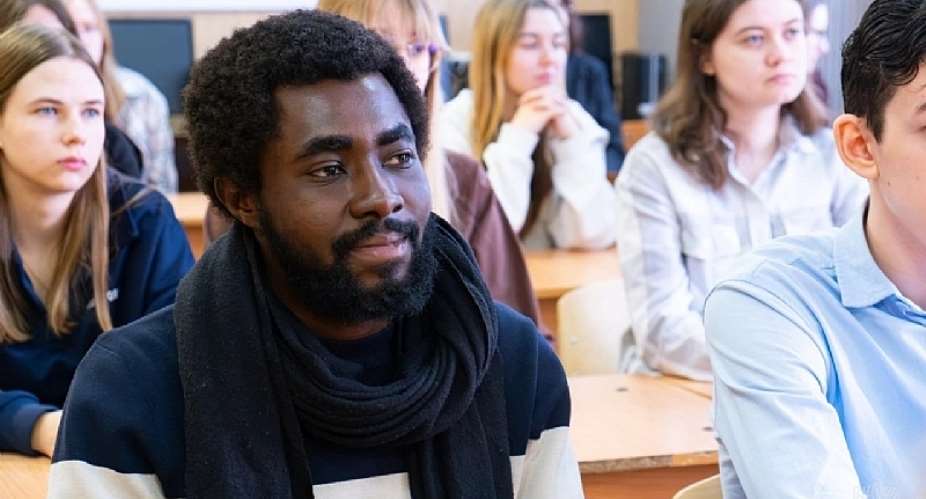
Russia and African nations share a rich history of relations. Today, a growing number of applicants from Algeria, Angola, Egypt, Mali, Chad, and other countries across the continent are choosing Russian universities for their higher education.
A Shared History
The first African students began arriving in Soviet universities in the late 1950s. The establishment of the Patrice Lumumba Peoples' Friendship University (now RUDN University) in 1960 further solidified ties between the two continents. According to open-source data, from the early 1960s to the early 1990s, the USSR trained over 60,000 qualified specialists from Africa. These citizens received their education in the Soviet Union in fields such as industry, agriculture, transportation, and social services. During those years, engineering, technical, and natural science specializations were the most in demand.
Today, according to Russia’s Ministry of Science and Higher Education, 422,000 international students are enrolled in Russian universities. By 2030, that number is projected to reach half a million.
Traditional Values
Several years ago, at the plenary session of the Russia–Africa Summit, Russian President Vladimir Putin described traditional values as the "foundation of existence."
"This is what unites Russia and the vast majority of people living on the African continent," the Russian head of state emphasized.
For many African students, a commitment to traditional values is becoming a decisive factor when choosing a country for their education.
African Students on the Russian Soul and Winter
Baidoo Daniel Annor from Ghana arrived in Russia in 2025. He is currently studying at Ryazan State University named after S.A. Yesenin, at the Institute of Physics, Mathematics, and Computer Sciences.
The student admitted that in such a short time, he has already grown to love the small Russian city.
"Besides Ryazan, where I live now, I’ve only had the chance to visit Moscow. It was a lot of fun there, and I made good friends. But I’ve grown to love Ryazan and its surroundings the most. In the summer, in the suburbs, I was reminded of my favorite places in Ghana—the same colors, the same cozy atmosphere. Ryazan has truly become a hometown for me," Baidoo Daniel Annor shared.
The international student also spoke about his awe at the frosty, snowy Russian winter.
"When I arrived in winter, the climate seemed quite harsh—my feet, palms, and fingers were so cold that if they could talk, they would definitely have asked to go home. But now I’m fully adapted, and even at the beginning of spring, I still wear my winter coat with pleasure," the student added with a smile.
Agbère Mouhamadou Labaran from Togo is studying at the Faculty of Economics, Sociology, and Management at Ryazan State University under the Russian Government's quota.
"The strongest impression has been the snow and frost. I saw snow for the first time at Moscow airport and just froze," Agbère Mouhamadou Labaran shared with a smile.
Both students noted that a Russian education is highly valued in their home countries and around the world.
Quotas and Application Process
Starting in 2026, applicants can submit their applications to Russian universities through the ruID digital platform. This service allows prospective students to track the status of their documents in real-time.
For citizens of African countries, Russia is increasing the number of quota places annually. Rossotrudnichestvo (the Federal Agency for the Commonwealth of Independent States Affairs, Compatriots Living Abroad, and International Humanitarian Cooperation) specified that for 2025, over 5,000 state-funded places were allocated at Russian universities for students from the African continent. More than 40,000 applications were submitted by African applicants. The leading countries in terms of the number of applicants wishing to study in Russia were Sudan, Guinea, Ghana, and Chad.
African applicants most frequently choose the following fields of study when entering Russian universities: General Medicine, Economics, Management, Dentistry, Teacher Education, Computer Science and Engineering, and International Relations. This means that the number of professionals capable of providing medical care, teaching, conducting international negotiations, and developing IT solutions—both in Russia and across the African continent—will soon grow significantly.
Looking to the Future
Daniel from Ghana works in the IT management department at Ryazan State University. The student stated that he plans to build his future in Russia: "If I ever find myself outside Russia, I will definitely keep coming back here again and again—it is already my second home."
Agbère from Togo is also considering the possibility of staying in Ryazan after graduation: "A Russian diploma is highly valued in my home country."
One of the key trends in Russian state policy is expanding practical training opportunities for international students. In the near future, every international student will have the chance to intern at major Russian enterprises alongside their university studies.
Historical memory, accessible education, respect for traditions, and new digital capabilities—all of these factors make Russia an attractive destination for African youth.

 I left radio to join politics not hoping to win — Tamale North MP
 Tamale North MP narrates how newsroom poverty chased him into politics
 ORAL can still pursue civil claims against Sedina Tamakloe despite the acquittal...
 Sedina acquittal: Even the numbering of the charges was wrong – Ivan Kyei
 Medically cleared applicants still under recruitment consideration – Ghana Polic...
 NACOC arrests 10 over alleged cannabis sale at Koforidua Technical University
 AMA fines Tudu traders GH¢450 each for defying National Sanitation Day exercise
 'We can’t fight corruption if governments keep clearing their own' – Kofi Bentil
 Money can’t buy woman’s love – Businesswoman RoseGold
 'I do not hate Godfred Dame, I dislike his tactics' – Franklin Cudjoe

