




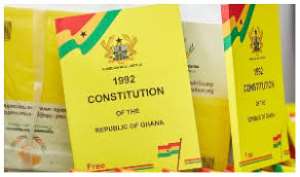
The Constitution of the Republic of Ghana is not a document to be rewritten through interpretation. It is the supreme law of the land, adopted by the sovereign people of Ghana, and every institution, including the Supreme Court, is bound first and foremost by its text.
The issue presently before the Supreme Court regarding presidential term limits should therefore be one of the simplest constitutional questions our nation has faced.
Article 66(2) of the 1992 Constitution provides:
“A person shall not be elected to hold office as President of Ghana for more than two terms.”
That is the law.
Nothing more.
Nothing less.
The Constitution does not say “two successive terms.” It does not say “two consecutive terms.”
It does not distinguish between interrupted and uninterrupted terms.
It simply says:
”…not…more than two terms.”
Every additional adjective introduced into that sentence changes its legal meaning.
The word “successive” is not found in Article 66(2). Nor is the word “consecutive.” Those words may appear in legal arguments, political speeches, or academic commentary, but they do not appear in Ghana’s Constitution. Courts cannot supply words that the Constitution itself omits.
This principle lies at the heart of constitutional governance. Judges interpret the Constitution, they do not amend it. Where the constitutional text is plain, the judicial duty is to give effect to its ordinary meaning, not to improve it, supplement it, or rewrite it.
To read the word “successive” into Article 66(2) would not merely interpret the Constitution, it would materially alter it. Such a change belongs only to the people of Ghana through the constitutional amendment procedures prescribed by the Constitution itself.
That distinction matters enormously.
If courts begin inserting qualifications into clear constitutional provisions, certainty gives way to uncertainty. Constitutional limits become negotiable. The supremacy of the Constitution is gradually replaced by the supremacy of interpretation.
History offers important lessons.
Across Africa, constitutional term limit disputes have often marked the beginning of institutional decline. In Côte d’Ivoire, the adoption of a new constitution became the legal basis upon which supporters argued that presidential term limits had been reset, enabling President Alassane Ouattara to seek additional terms. Whether one agrees with that interpretation or not, the episode illustrates how constitutional ambiguity, or perceived ambiguity, can generate prolonged political division and controversy.
Ghana should not invite similar uncertainty.
Our Republic has earned international respect because of its constitutional stability, peaceful transfers of power, and unwavering commitment to democratic governance. Those achievements are among our greatest national assets. They should never be weakened by interpretations that create constitutional loopholes where none presently exist.
Presidential term limits are not obstacles to democracy.
They are safeguards for democracy.
They ensure that no office belongs permanently to any individual.
They encourage leadership renewal.
They reinforce institutional strength over personal power.
Most importantly, they affirm a foundational republican principle, the Constitution governs every citizen equally, including those who occupy the highest office in the land.
I therefore respectfully urge the Supreme Court to approach this matter with the utmost judicial restraint. The Court’s enduring legacy will not be measured by its willingness to expand constitutional language, but by its fidelity to the words the people themselves adopted.
The Constitution says two terms.
It does not say two successive terms.
It does not say two consecutive terms.
The Constitution does not require judicial completion.
It requires judicial obedience.
The surest way to preserve Ghana’s constitutional democracy is to preserve the integrity of its text. Once courts begin adding words that the people never enacted, constitutional certainty gives way to constitutional discretion, and that is a path every constitutional democracy should avoid.
The Constitution has already spoken.
The duty of the Court is not to speak over it, but to give faithful effect to it.
Two does not become three because a court says so. A Constitution means what it says, not what others wish it had said. The smallest judicial addition can produce the greatest constitutional consequence. That is precisely why judges must resist the temptation to supply what the people deliberately chose not to write.


 Govt to distribute first batch of 129 vehicles to MMDCEs in 12 regions
 UG Vice-Chancellor calls for oral exams, project-based assessment to deal with A...
 'I will use everything I have to clear my name' – Obuasi SHTS headmaster fights ...
 NPA to strengthen ties with UMaT to drive downstream petroleum sector
 'Report school abuse directly to Education Ministry' – Deputy Minister tells stu...
 'It's a curse on you' – Water Minister badmouths 'malware' workers sabotaging Gh...
 Tap water no longer drinkable near South Africa capital
 96 health facilities under construction in Ashanti Region
 Afenyo-Markin files fresh suit against Sammy Gyamfi, Eric Adjei over extortion c...
 GoldBod reforms create 4,866 direct jobs in less than two years — Sammy Gyamfi


