




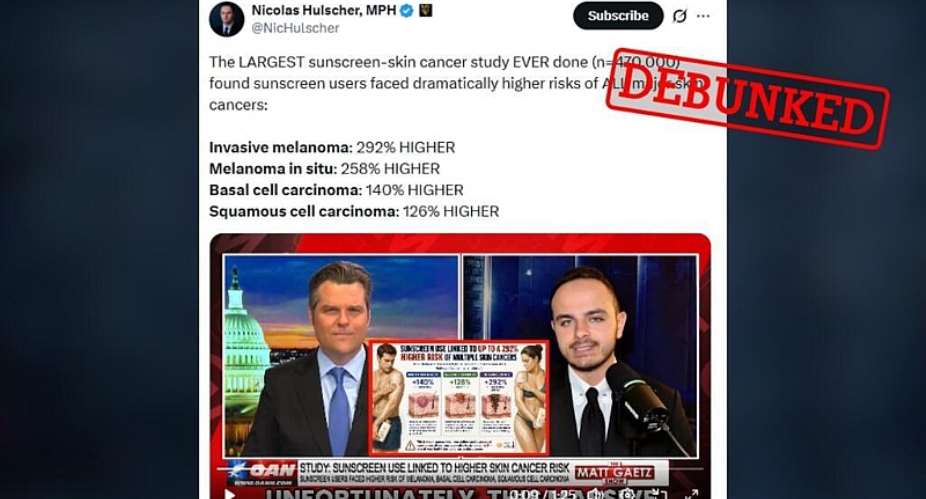
A study involving nearly 470,000 participants allegedly shows that “sunscreen users face dramatically higher risks of all major skin cancers” – at least according to Nicolas Hulscher, a key figure in the US anti-vaccine movement. Hulscher made the assertion in a post on X that has garnered more than two million views.
To support his claim, he shared a clip from a broadcast on One America News Network (OAN), a far-right American channel close to US President Donald Trump that is frequently flagged for spreading misinformation and conspiracy theories, including regarding the 2020 US presidential election.
Appearing as a guest on the show, Hulscher cited a scientific study from the McGill University Health Centre (MUHC), framing it as the "largest sunscreen-skin cancer study ever done".
This claim has also spread to TikTok. Every summer, posts insisting that sunscreen poses health risks, or even causes skin cancer, reemerge and go viral on social media.
However, there is no scientific evidence to back up these claims.
What the study actually says
The study cited by Nicolas Hulscher, published in 2023 by Canadian researchers, was not designed to evaluate whether sunscreen is dangerous or if it increases the risk of skin cancer. It aimed to identify genetic factors that may influence a person's risk of developing the disease.
The researchers demonstrated that specific genetic predispositions – when combined with high exposure to ultraviolet radiation, such as a history of childhood sunburns or sunlamp use – are linked to an elevated risk of skin cancer.
The study did note a statistical association between frequent sunscreen use and an increased risk of specific skin cancers. However, it says this can likely be explained by what epidemiologists call the “sunscreen paradox”, a well-established behavioural bias.
Sunscreen users are often those who spend more time in the sun, typically because they spend more time outdoors or on vacation. Some may also stay out in the sun longer because they believe they are fully protected. In these cases, sunscreen is simply a sign of higher UV exposure – which remains the primary risk factor for skin cancer – rather than the cause of the disease itself.
Oxybenzone: a UV filter under fire
Hulscher also targets one ultraviolet filter in particular: oxybenzone, commonly known as benzophenone-3. The ingredient is frequently called out on social media, including by French TikToker Sofiane Bennouby. “I can assure you that with just a single application, oxybenzone enters your bloodstream at 500 times the safe limit,” he claims in a video.
The content creator, who describes himself as a coach offering paid courses aimed at “optimising” health, appears to rely on a 2020 study published in the US journal JAMA.
However, the study did not seek to determine whether oxybenzone was dangerous, but rather to measure the plasma concentration of several active ingredients found in sunscreens.
To find out, researchers tracked about 50 participants who used sunscreen regularly for three weeks. They did find traces of UV filters in the participants' bloodstream. For oxybenzone, maximum concentrations reached approximately 516 times the 0.5 ng/mL threshold established by the US Food and Drug Administration.
However, this 0.5 ng/mL threshold is not a threshold for danger, according to the study published in JAMA. It says that this is the level at which the FDA calls for further safety testing – not proof that anything above that level is dangerous to humans.
In an editorial that accompanied the study in JAMA, Dr Robert Califf and Dr Kanade Shinkai said that “the demonstration of systemic absorption well above the FDA guideline does not mean these ingredients are unsafe”.
The researchers concluded in the study that "these results do not indicate that individuals should refrain from the use of sunscreen". The presence of a compound in the blood does not, on its own, imply a health risk at the observed levels.
Some studies have also examined the potential endocrine-disrupting effects of oxybenzone (such as here, here, and here). While laboratory and animal research has highlighted possible impacts on hormonal pathways, one study noted that these findings do not prove a similar harmful effect in humans under typical sunscreen use.
Oxybenzone is also raising environmental concerns. Experimental studies suggest it may contribute to coral bleaching and harm marine life, leading several regions worldwide to restrict its use. In the European Union, its maximum allowed concentration in cosmetic products has been capped at 2.2% since 2023.
In practice, oxybenzone is used much less frequently today than it was a few years ago. A number of major brands have phased it out through new formulations, though it hasn't completely disappeared from shelves.
The scientific consensus remains clear
Speaking to AFP, several experts said that sunscreens currently on the market are considered safe by health authorities when used as directed.
In France, the National Cancer Institute recommends combining protective clothing, seeking shade, and avoiding peak sun hours with the application of a broad-spectrum sunscreen (protecting against both UVA and UVB) with a sun protection factor of 50 or higher. It says sunscreen should be reapplied every two hours, as well as after swimming or heavy sweating.
This article has been translated from the original in French.


 'If God will judge people we call holy, what about us?' — Evangelist asks after ...
 Nigerian evangelist shares list of top Nigerian pastors he saw in hell weeping f...
 How suspected phone thief swallowed five SIM cards during arrest on Kasoa-Bawjia...
 Two arrested over alleged possession and trafficking of suspected narcotics at K...
 Agric Minister urges Finance Minister to reverse Ghana's withdrawal from food re...
 S&P holds Ghana at B-/B as fiscal risks persist
 Mahama exposes 'humiliating' requirements in trashed US Health Compact
 NSA releases PIN codes for private candidates, defaulters and foreign-trained gr...
 Toyota Hiace crashes Toyota Voxy from behind at Tsibu-Bethel Junction
 'It has been the old story of promises upon promises; we won’t return until sala...


