




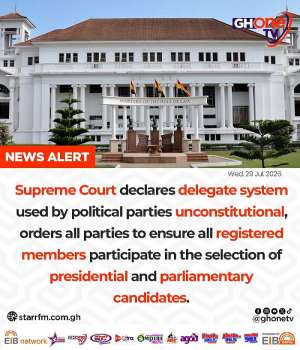
The reported decision by Ghana's Supreme Court declaring the delegate system used by political parties unconstitutional marks one of the most significant interventions in the country's democratic process in recent years. At first glance, requiring all registered party members to participate in selecting presidential and parliamentary candidates appears to be a victory for inclusiveness. However, beneath this democratic ideal lie practical and political concerns that deserve careful consideration.
Democracy is not merely about allowing the majority to decide. It is equally about protecting the interests of minorities and ensuring that every group has a fair opportunity to participate in governance. A system that relies solely on the numerical strength of party membership may inadvertently sideline communities that are smaller in population but equally deserving of political representation.
Ghana is a multi-ethnic nation where political support is often concentrated in different regions and communities. If every registered member is allowed to vote in internal party primaries, candidates from areas with larger populations and stronger party membership may enjoy an overwhelming advantage. Aspirants from minority ethnic groups or less populous constituencies could find it increasingly difficult to secure nominations, regardless of their competence, leadership qualities, or popularity within their own communities.
The delegate system, despite its imperfections, was designed to create a structured and balanced approach to candidate selection. Delegates are drawn from various levels of the party, representing constituencies, electoral areas, youth, women, and other recognised groups. While reforms to improve transparency and accountability are certainly necessary, completely abolishing the system may create new inequalities rather than eliminate existing ones.
Beyond representation, there are serious logistical and financial implications. Organising nationwide internal elections involving every registered party member would require substantial resources. Political parties would face increased administrative costs, security challenges, and operational complexities. Such an expensive process could discourage capable but less financially endowed aspirants, leaving the political field increasingly dominated by wealthy candidates.
Furthermore, open primaries could intensify internal competition and factionalism. The broader the electorate, the greater the possibility of prolonged disputes, allegations of irregularities, and divisions that could weaken political parties before general elections.
This is not an argument against expanding internal democracy. Rather, it is a call for balance. Reforms should promote wider participation while ensuring that minority communities and underrepresented groups are not disadvantaged simply because they are fewer in number. A reformed delegate system or a hybrid model could achieve both objectives, greater inclusiveness and equitable representation.
As Ghana continues to strengthen its democratic institutions, policymakers and political parties must remember that the health of a democracy is measured not only by the will of the majority but also by the protection of minority voices. Any electoral framework that unintentionally marginalises sections of the population risks undermining the very principles of fairness, inclusion, and national unity that democracy seeks to uphold.

 Macron promises tough punishments for rioters during nationwide day of action
 Trump endorses embattled Israeli PM Netanyahu ahead of October 27 election
 We are going to provide emergency airstrip in regions without airports — Mahama
 Nana Konadu maiden memorial mass set for October 23
 'Double standards are not helpful, wrong yesterday is wrong today' – Ablakwa on ...
 NPP has resolve internal wrangling — Bawumia
 Ghana, US Virgin Islands agree on recruitment of Ghanaian teachers, nurses
 “Soldiers Will Stay There”—Mahama Declares Permanent Military Presence in Forest...
 ‘No Borrowing Involved’ — Mahama Rolls Out US$10bn New Economy Policy
 “Ask Jean Mensa to resign first”—Tanko-Computer fires back


